












In today’s scenarios such as data scraping, automation workflows, and multi-account management, proxies have become essential infrastructure. Among them, HTTP proxies and SOCKS5 proxies are the two most common types. However, many users are still unclear about their differences and how to choose the right option.
This guide explains the differences between HTTP and SOCKS5 proxies from multiple perspectives, including principles, features, and performance, helping you quickly determine which solution fits your needs.
I. What Are HTTP Proxies and SOCKS5 Proxies?
Before comparing them, it’s important to understand how proxies work. A proxy acts as an intermediary between the client and the target server. It sends requests on behalf of the user, receives responses, and hides the real IP while optimizing traffic and control.
1. What is an HTTP proxy?
An HTTP proxy is based on the HTTP protocol and is mainly used for web requests. The request flow is: user → HTTP proxy → target website → response.
Its core characteristic is that it only supports HTTP/HTTPS traffic, making it suitable for browser access and basic scraping.
Key features:
● works on HTTP/HTTPS protocols
● simple setup and easy to use
● short-lived connections (request-based)
● can interpret and modify data
However, HTTP proxies have limitations in anonymity and protocol support, especially for complex network tasks.
2. What is a SOCKS5 proxy?
A SOCKS5 proxy is a lower-level protocol with stronger flexibility and compatibility. The request flow is: user → SOCKS5 proxy → target server.
Unlike HTTP proxies, SOCKS5 does not parse data but directly forwards packets, supporting multiple protocols including TCP and UDP.
Key features:
● supports TCP and UDP
● no application restrictions
● supports authentication (higher anonymity)
● strong compatibility for complex environments
SOCKS5 acts more like a universal network relay, capable of handling almost all types of traffic.
II. Core Differences Between HTTP and SOCKS5 Proxies
1. HTTP Proxy vs SOCKS5 Proxy Comparison Table
| Comparison Item | HTTP Proxy | SOCKS5 Proxy |
| Protocol Type | HTTP (application layer) | SOCKS (transport-level relay) |
| Data Handling | Parses and understands requests | Forwards data without parsing |
| Supported Protocols | HTTP/HTTPS only | Supports TCP, UDP, and more |
| Connection Type | Request-response (short-lived) | Persistent connection (flexible) |
| Security Capability | Can filter and inspect data | No data processing (more hidden) |
| Use Cases | Web browsing, basic scraping | Multi-protocol apps, complex networks |
| Performance | Can cache and optimize requests | Better for high-volume data transfer |
2. Key Differences Explained
2.1 Protocol mechanism
HTTP proxies rely on the HTTP protocol and follow a client-server model, making them ideal for web interactions.
SOCKS5 proxies operate at the transport level, forwarding packets directly without caring about content, supporting any protocol or port.
2.2 Data handling
HTTP proxies can analyze and modify data:
● filter unnecessary content
● cache web pages
● modify headers for scraping
SOCKS5 proxies:
● do not parse data
● do not interfere with requests
● only forward traffic
2.3 Functionality and compatibility
HTTP proxies:
● handle HTTP/HTTPS traffic
● mainly for browsers and web requests
SOCKS5 proxies:
● support all protocols
● suitable for streaming, gaming, P2P, and APIs
2.4 Security and privacy
HTTP proxies focus on control:
● detect malicious traffic
● enable filtering and protection
SOCKS5 proxies focus on anonymity:
● no data inspection
● harder to track
2.5 Performance and speed
HTTP proxies are suitable for high-frequency requests:
● caching reduces repeated requests
● optimized for scraping
SOCKS5 proxies are better for:
● large data transfers
● real-time communication
● long connections with lower latency
3 Which proxy should you choose?
There is no universally better option—it depends on your use case.
● HTTP proxy: best for efficient web browsing, scraping, and automation
● SOCKS5 proxy: ideal for advanced applications and complex environments
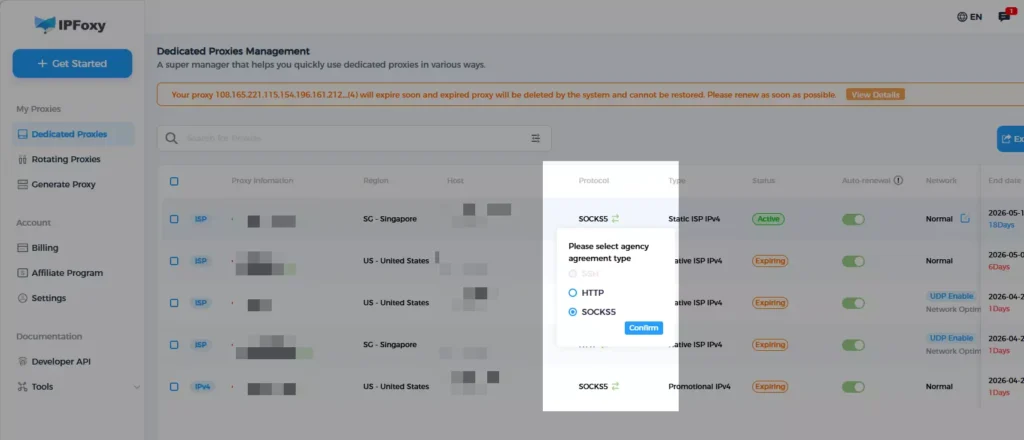
As tasks become more complex, many users prefer flexible proxy solutions that support switching between HTTP and SOCKS5.
For example, IPFoxy provides global proxy services supporting both HTTP and SOCKS5 protocols. Users can switch based on different needs, whether for web scraping, automation, or complex network tasks.
III. FAQ
Generally, SOCKS5 proxies are faster and more stable because they do not process data, reducing latency. HTTP proxies may introduce overhead due to parsing.
SOCKS5 is an upgraded version of SOCKS4. It supports both TCP and UDP, includes authentication, and offers better compatibility.
SOCKS proxies themselves do not provide encryption. Security depends on usage. When combined with HTTPS, they can protect data transmission. Choosing a reliable provider is also critical
IV. Summary
HTTP and SOCKS5 proxies each have their strengths. HTTP proxies are better for simple and efficient web requests, while SOCKS5 proxies excel in flexibility and complex environments.
For most users, the practical approach is to choose a proxy solution that supports multiple protocols and switch based on task requirements. This ensures a better balance between efficiency, stability, and privacy.