











When performing web scraping or automated data collection, choosing the right proxy type often determines whether your project runs smoothly. Different proxies vary significantly in speed, anonymity, and stability, making them suitable for different scraping scenarios.
This article compares residential proxies, datacenter proxies, and ISP proxies from a practical perspective, helping you quickly determine which proxy is best for your specific use case.
I. The Role of Proxies in Web Scraping
Web scraping proxies are essential tools that act as intermediaries. Normally, when you send requests to a website, your real IP address is exposed. With a proxy, the target site only sees the proxy IP.
During scraping, websites often block crawlers through:
● Geographic restrictions
● Rate limiting, CAPTCHAs, and bans
Proxies solve this in two key ways:
● Anonymous access: Requests are routed through a proxy, hiding your real IP
● Request distribution: Traffic is spread across multiple IPs, simulating real users and reducing detection risk
II. How to Choose the Best Proxy Type for Web Scraping? Residential vs Datacenter vs ISP Proxies
Common proxy types used in web scraping include residential proxies, datacenter proxies, and ISP proxies.
1、Datacenter Proxies
Datacenter proxies are IPs generated by cloud servers or data centers. They do not belong to real residential or mobile networks.
- Advantages: fast speed, low latency, low cost, stable performance, easy to manage
- Disadvantages: higher detection and blocking rates, shared subnets may lead to group bans, less effective on high-security platforms
Use cases:
● Low-protection or open websites
● Large-scale public data collection
● Tasks prioritizing speed over stealth
2、Residential Proxies
Residential proxies are IPs assigned by real ISPs to household users. They originate from real devices and home networks, making them appear as normal users.
- Advantages: high anonymity, high success rate, able to bypass advanced anti-bot systems, suitable for high-security platforms
- Disadvantages: higher cost, variable speed and stability, requires larger IP pools for scale
Use cases:
● High-security platforms such as social platforms and search engines
● Scraping data behind login
● Long-term monitoring tasks such as e-commerce data tracking
3、ISP Proxies
ISP proxies (residential proxy) are hybrid proxies. The IP is assigned by a real ISP but hosted in a data center, combining trust with performance.
- Advantages: balance between speed and anonymity, more stable than residential proxies, lower cost than pure residential
- Disadvantages: smaller IP pool, more expensive than datacenter proxies, may still be detected on high-security platforms
Use cases:
● Medium-scale scraping projects
● Tasks requiring stable performance without high residential costs
4、Quick Comparison Table
| Feature | Datacenter Proxies | Residential Proxies | ISP Proxies |
|---|---|---|---|
| IP Source | Cloud servers / data centers | Home Wi-Fi / mobile networks | Data center + ISP |
| Detectability / Anonymity | Easy to detect / low anonymity | Very hard to detect / high anonymity | Moderate detection / medium anonymity |
| Speed | Fastest | Moderate | Fast |
| Stability | High | Medium | High |
| Price | Low | High | Medium |
| Core Advantage | Speed and low cost | High anonymity and anti-detection | Balanced performance |
| Best Use Cases | Bulk scraping, low-security sites | High-security scraping | Account management, medium-scale tasks |
III. How to Choose the Right Proxy for Your Scraping Task
The best proxy depends on your scraping goals and the target site’s security level, along with factors like IP pool size, rotation strategy, success rate, and performance.
For high-security websites, residential proxies are recommended due to their authenticity and higher success rates. With large IP pools and flexible rotation, they effectively reduce bans.
For public data or low-security sites, datacenter proxies are more suitable thanks to their speed, low cost, and high concurrency, though some blocking is expected.
For tasks involving login sessions or long-term operations such as account management, ISP proxies are ideal. Their static IP (sticky session) ensures stability while maintaining reasonable anonymity.
IV. 4 Key Criteria for Choosing a High-Quality Scraping Proxy Provider
Not all proxy providers offer equal quality. It is best to test before committing, focusing on the following:
1、IP Pool Size and Quality
Larger IP pools are better, ideally at the million level for large-scale scraping. More IPs mean better rotation and lower detection risk.
2、Rotation and Session Control
Support for request-based rotation, sticky sessions, and timed rotation is essential to match different scraping scenarios.
3、Success Rate and Stability
A success rate above 95% is recommended. Lower rates increase retries and reduce efficiency.
4、Performance
Fast response time and high concurrency support are critical to avoid bottlenecks in large-scale scraping.
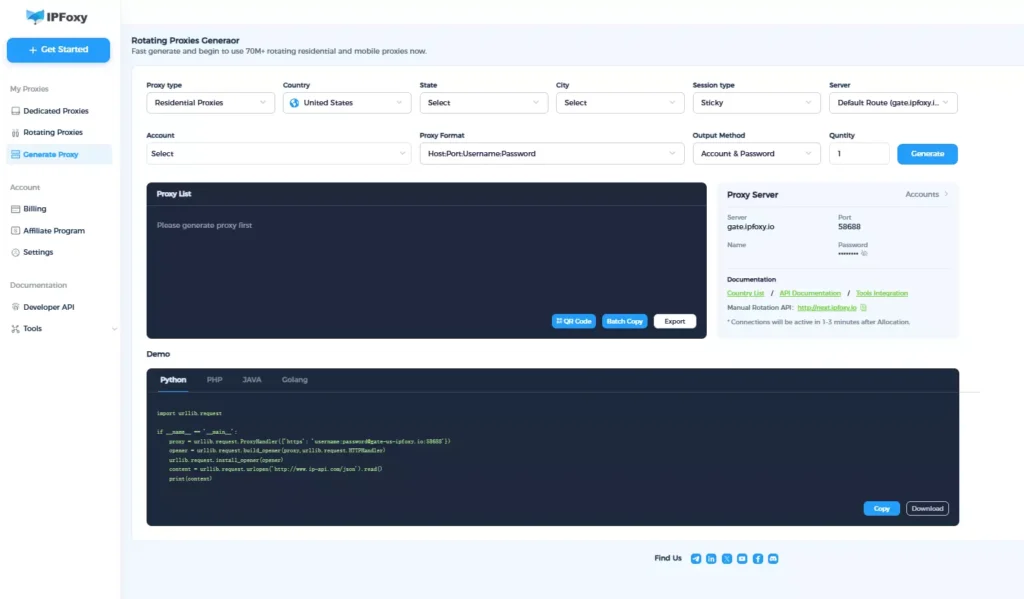
Using IPFoxy as an example, its rotating residential proxy network includes over 90 million real IPs across 200+ regions. It supports both request-based rotation and sticky sessions, offers low repetition rates, and uses real ISP-sourced IPs, making it suitable for high-security websites and frequent IP rotation scenarios.
V. FAQ
Residential proxies use real residential IPs, making them more effective at bypassing anti-bot systems, but they are slower and more expensive. Datacenter proxies are faster and cheaper but easier to detect.
Free proxies are usually unreliable, slow, and insecure. Paid proxies like IPFoxy provide better reliability, speed, and security.
Consider your target website, data volume, budget, and required features. IPFoxy offers flexible options for different scraping needs.
Conclusion
The core of web scraping lies in stability and efficiency, and proxies are the key factor behind both. Whether prioritizing speed with datacenter proxies, anonymity with residential proxies, or balance with ISP proxies, the right choice depends on your specific use case. At the same time, provider quality—especially IP pool size, success rate, and performance—plays a critical role. Choosing the right proxy solution ensures safe, stable, and efficient long-term data collection