












In today’s rapidly evolving global internet and digital marketing environment, an IP address is no longer just an “online location.” For high-risk or privacy-sensitive scenarios such as e-commerce operations, digital marketing, social media management, and data collection, residential proxy IPs have become an essential infrastructure tool.
This article provides a complete overview of residential proxy IPs, covering how they work and how to choose the right service. It aims to help you improve account security, maintain stable advertising performance, and achieve efficient data collection through the correct use of residential proxy services, ultimately reducing operational risk and friction.
I. What Is a Residential Proxy and How Does It Work?
1. How residential proxies work
If an IP address is compared to a home address, then browsing the web or sending requests is like going out and handling tasks using that address. Platforms can identify your network location based on it. A proxy works like a “stand-in”: you send your request to the proxy, which then communicates with the platform on your behalf. What the platform sees is the proxy’s IP address, not your real one.
The key difference with residential proxy IPs is that they originate from real household networks, such as standard home broadband or fiber connections. These IPs are assigned by legitimate internet service providers and are identical in nature to those used by everyday users. As a result, most platforms cannot distinguish them as proxies and simply treat the traffic as normal user activity.
Compared with ordinary proxies, which are easier for platforms to identify and are typically used for low-cost or speed-focused scenarios, residential proxies offer higher authenticity and are far less likely to be restricted. They are better suited for use cases that require strong anonymity and long-term stability.
The main advantage of residential proxies lies in their use of residential IP addresses. ISPs assign these IPs to household users and provide either dynamic or static IPs for each connection.
2. Why choose residential proxy IPs
Ordinary proxy IPs, such as data center IPs, are often easy for platforms to detect. Once a platform recognizes that an IP originates from a data center, it is frequently associated with automated behavior or scraping activity. Residential proxy IPs, on the other hand, fully simulate real user network behavior.
Their strengths include appearing identical to real household users in terms of origin and network attributes, making them difficult for platforms to identify. Many residential proxies also support dynamic switching mechanisms, allowing IPs to change periodically while still remaining real residential addresses. In addition, reputable residential proxy services do not leak your real IP address or behavioral traces, further reducing exposure risk.
3. Types of residential proxy IPs
Residential proxy IPs can generally be divided into two types: static residential proxies and rotating residential proxies.
Static residential proxies, also known as sticky IPs, allow users to access the internet through a fixed residential IP address over a long period of time. In practice, these IPs match real household broadband connections in terms of ISP attribution and network characteristics, and they remain stable for extended durations. This makes them particularly suitable for scenarios that require consistent login environments, such as e-commerce store management, social media account maintenance, and advertising account operations. From a platform’s perspective, this continuous and natural access pattern closely resembles real user behavior and helps reduce the likelihood of triggering risk controls or account restrictions.
Rotating residential proxies, by contrast, do not rely on a single IP address. Instead, they automatically switch between IPs from a large pool of real residential addresses, either per request or at set time intervals. Because the IP constantly changes, rotating residential proxies provide stronger anonymity and security. They are especially effective for high-frequency operations, data collection, anti-scraping environments, and multi-account testing. When combined with an anti-detect browser, rotating residential proxies can help distinguish login locations and environments across multiple social media or e-commerce accounts, reducing the risk of accounts being flagged as linked and improving overall account stability.
II. How to Choose a Residential Proxy Provide
1. Six key factors to evaluate proxy providers
When selecting a residential proxy service, several critical aspects must be carefully evaluated. The size of the IP pool is essential, as a larger pool reduces IP reuse and lowers the risk of bans. Location coverage is equally important, ensuring the provider offers IPs in the countries or cities required for localized operations. Speed and stability can vary significantly between providers, so it is recommended to test performance during trial periods. Pricing should be reasonable and aligned with features, as extremely cheap services often indicate unreliable quality. Customer support should be responsive and capable of resolving setup and usage issues efficiently. Finally, the usability of the management interface directly affects operational efficiency, as overly complex tools can slow down workflows.
Poor performance in any of these areas can negatively impact both the proxy experience and account security.
2. Common pitfalls and misconceptions
In many cases, what is marketed as a “residential IP” is not truly residential at all. A large number of so-called residential proxies on the market are actually disguised alternatives. Some data center IPs are modified at the ISP level to appear residential, but their traffic patterns quickly expose them. Others rely on broadcast IPs that are heavily reused by multiple users, resulting in highly overlapping behavior that platforms can easily flag. There are also services that claim to offer exclusive IPs while actually sharing exit nodes among many users, meaning one violation can affect everyone on the same network.
Such fake residential IPs are highly transparent to platforms like TikTok, Facebook, and Google Ads. Using them often leads to failed account setup, rejected ads, and delayed account trust building, ultimately wasting both money and time.
3. How to determine whether an IP is residential
A commonly used detection site is ipinfo.io.
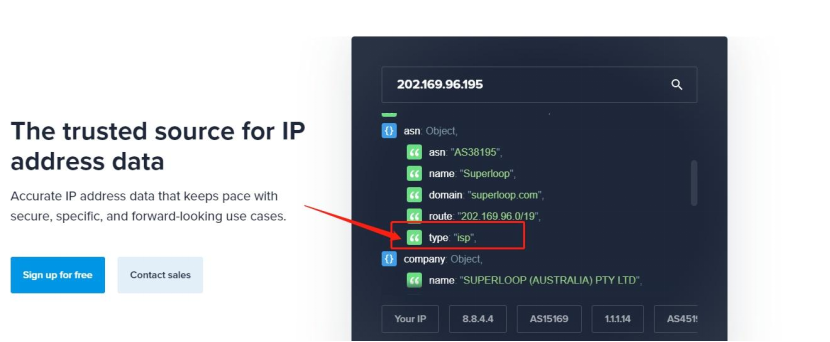
After opening the site, the current IP address and related information such as country, city, and service provider are displayed. Scrolling down reveals the IP type. If the type is listed as “ISP,” it generally indicates a residential IP. If it is listed as “hosting,” it typically means the IP is from a server or data center.
Another commonly used site follows a similar process. After entering the IP, you can locate the IP type field. If it shows a metropolitan or access network, it is usually residential, whereas a data center label suggests a server-based IP.
4. How to check IP cleanliness
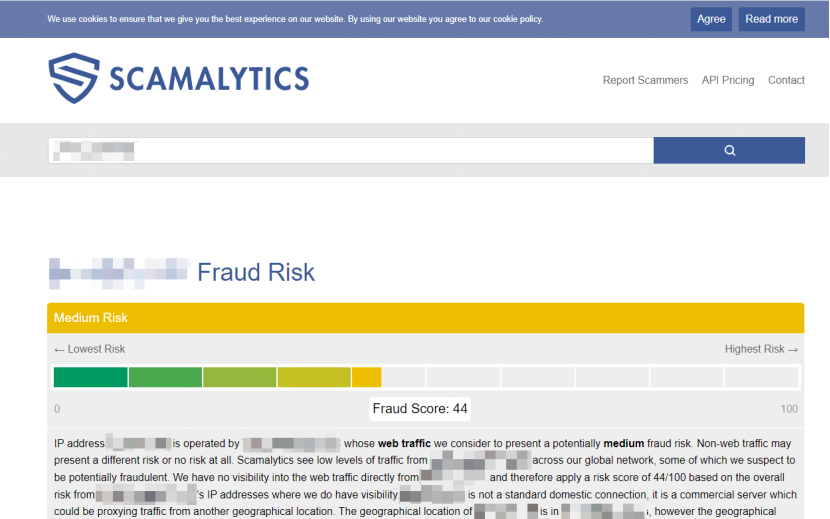
Scamalytics is a security-focused IP analysis tool designed to identify potentially malicious or abused IP addresses. It helps determine whether an IP has participated in activities such as spam distribution or network attacks and shows blacklist status, ASN information, and risk scores.
Whoer.net is a comprehensive IP detection platform that provides geographic data, proxy detection, DNS details, and anonymity scoring. It can also reveal information about browsers, operating systems, and whether a proxy is being used.
A truly usable residential IP must meet three core criteria: it must be original and authentic, it must be static and exclusive, and it must operate within a controllable behavioral environment.
This is why, in real-world projects, providers like IPFoxy are often recommended.
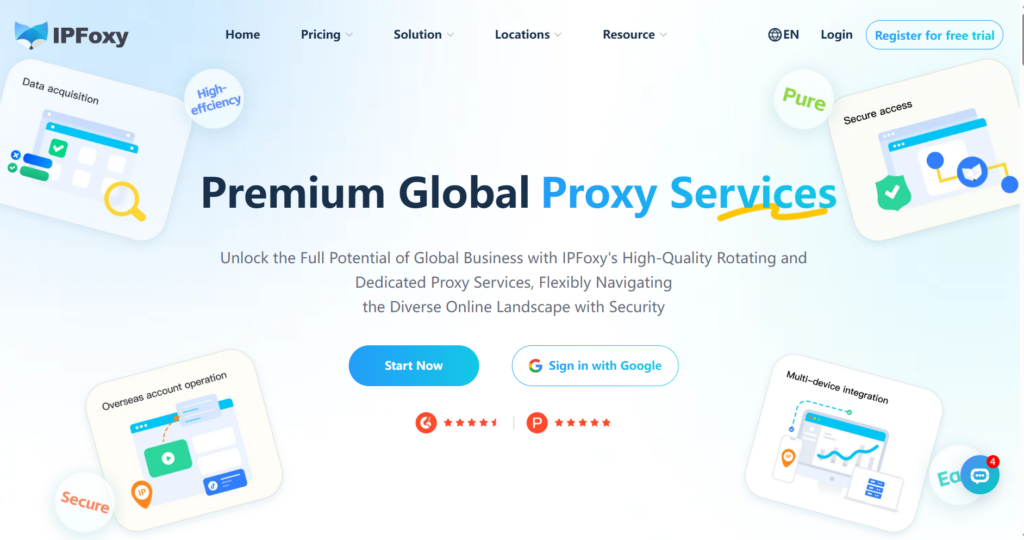
They offer real residential IPs sourced from household networks, support both static and rotating residential proxies, provide coverage across more than 200 countries and cities, and include management tools that integrate smoothly with anti-detect browsers and account environments.
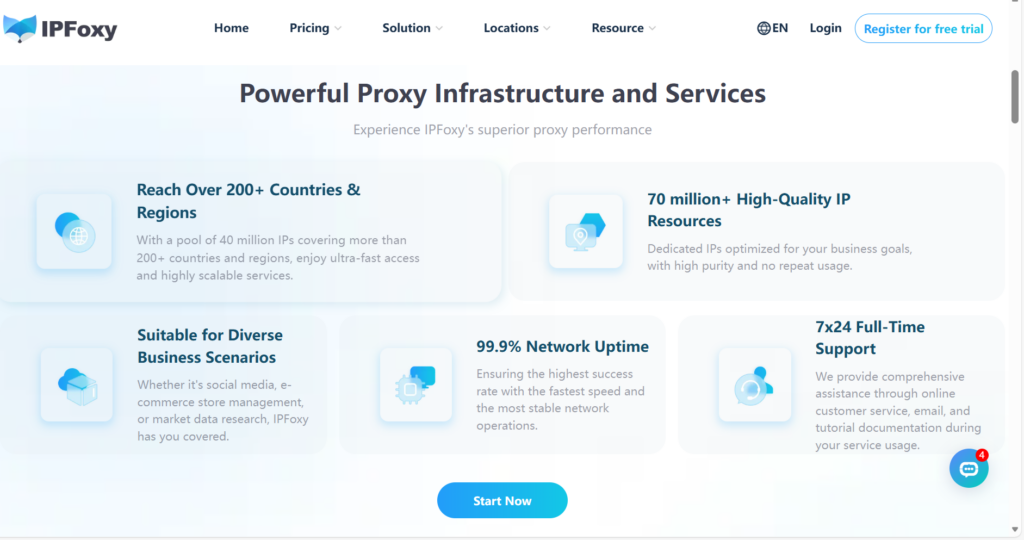
In high-risk scenarios such as account setup, advertising campaigns, e-commerce operations, and TikTok management, choosing the right residential proxy IP can significantly reduce unnecessary obstacles.
Conclusion
Overall, residential proxy IPs are not a universal solution, but choosing the right one can save substantial time and cost in high-risk environments such as marketing, e-commerce operations, and social media management.
In practice, reliable residential proxy providers like IPFoxy offer authentic household IPs, broad global coverage, flexible switching between static and rotating residential proxies, and comprehensive management tools. These capabilities help maintain account security, ensure stable advertising performance, and enable efficient data collection even in complex operational scenarios.