











In e-commerce operations, ad account management, social media account scaling, and data collection, choosing the right proxy architecture is essentially about building long-term network trust for accounts and businesses.
When selecting proxies, many users encounter terms such as “Native ISP,” “Dual ISP,” and “Single ISP.” However, these concepts are often defined inconsistently across providers and are sometimes misleading.
This article explains the three main proxy architectures from the perspectives of network structure, registration and deployment, and platform risk control logic, and provides practical evaluation methods and selection guidance.
I. Proxy Basics: Why Platforms Care About ISP Information
A proxy acts as an intermediary between your device and the internet, hiding your real address. However, not all proxies are the same. The underlying network architecture directly affects speed, stability, and trust level.
The ISP (Internet Service Provider) plays a critical role in proxy architecture, determining origin and routing paths. Simply put, an ISP is the telecom operator that provides internet access.
Examples include AT&T, Verizon, Comcast, BT, Orange, and Telefónica.
For major platforms such as Meta, Google, TikTok, and Amazon, an address is not evaluated as a single value. Instead, risk control systems analyze multiple dimensions, including:
ASN (Autonomous System Number)
ISP name
Proxy type (residential, data center, hybrid)
Network routing path
Historical behavior profile
II. Native ISP: A Network Structure That Truly Resembles Real Users
- Definition of Native ISP
Strictly speaking, a Native ISP proxy must meet all of the following conditions:
The ASN belongs to a local telecom operator
The registration entity (Company) is the same operator
The network route does not pass through third-party relay networks
In other words, both the deployment network and the registration ownership come from the same local ISP.
- Why Native ISP Proxies Are More Trusted
The advantage does not come from the “native” label itself, but from these network characteristics:
Clear network origin with no intermediate forwarding
Highly similar to home broadband and real office networks
Lower probability of large-scale abuse
Cleaner historical risk records
During account registration, warm-up, and ad account cold start stages, Native ISP proxies usually receive higher initial trust scores.
III. Dual ISP: A High-Trust Proxy Architecture
- How Dual ISP Is Defined
In the proxy industry, Dual ISP usually means:
- ASN Type = ISP
- Company Type = ISP
This does not indicate two different ISPs. Instead, it means that both key identification dimensions are recognized as ISP-level networks.
- How to Verify Dual ISP in Practice
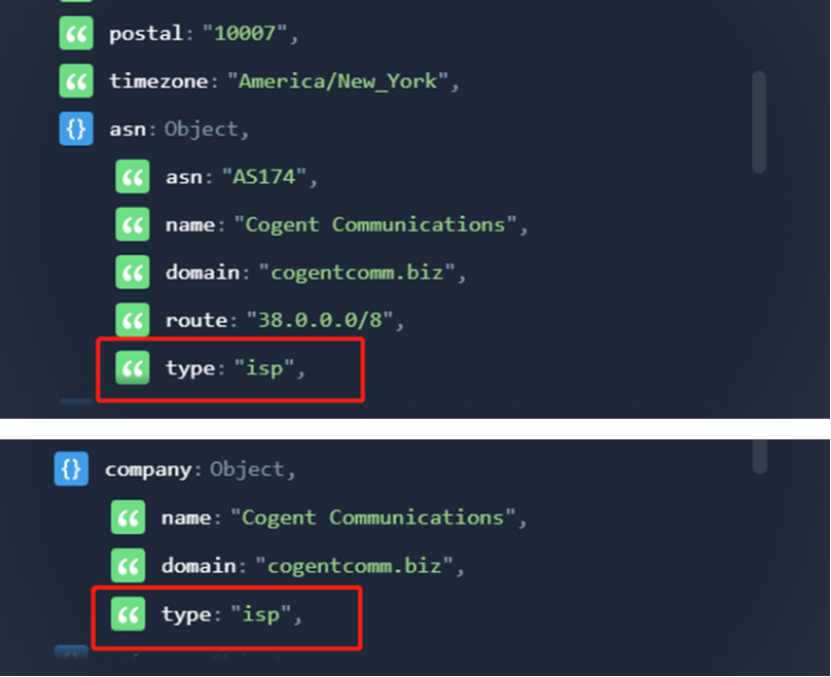
You can use third-party tools such as ipinfo.io or ip2location and focus on:
ASN: the actual operating network
Company: the registered and managing entity
If both fields show the type as ISP, the proxy is generally considered a Dual ISP architecture.
- Business Value of Dual ISP
Dual ISP proxies perform especially well in the following scenarios:
- Social media account registration and long-term operation
- Ad account delivery and multi-account management
- E-commerce store environment setup
- Sensitive actions on high-risk-control platforms
From a platform perspective, this structure closely matches real household network behavior.
IV. Single ISP: ASN Is ISP, but Company Is Not
- Structural Characteristics of Single ISP
A Single ISP proxy typically shows:
- ASN belongs to an ISP
- Company is listed as a business or third-party entity
This means:
- The underlying resources originate from a telecom operator
- They are not directly assigned to end users by the operator
- A third-party company purchases them in bulk and redistributes them
- Why Many “Residential Proxies” Are Single ISP
This model is common in the proxy market because:
- Direct ISP-issued resources are costly and highly restricted
- Third-party aggregation improves scalability
- The ASN retains ISP attribution, while registration ownership changes
Single ISP does not mean low quality; it reflects a different ownership layer.
- Practical Use Boundaries of Single ISP
High-quality Single ISP proxies still perform well in many scenarios:
- Data collection and automation tasks
- Stable account operations
- Ad accounts already in steady delivery
However, for new accounts, cold starts, and high-risk operations, trust levels are usually slightly lower than Dual ISP or Native ISP.
V. Hosting Proxies: Why They Are More Likely to Be Restricted
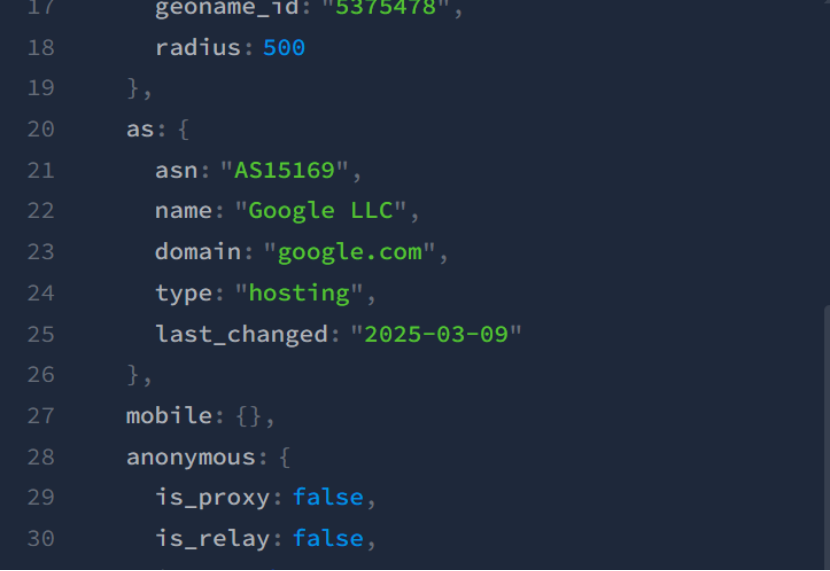
In detection results, ASN or Company fields are often labeled with network types such as:
ISP: home or local access networks, closest to real user environments
Business: commercial or enterprise networks
Education: academic or research networks
Hosting: data center or cloud provider networks
Hosting proxies typically show:
ASN or Company linked to cloud providers or data centers
Network type marked as Hosting
These proxies differ significantly from real user networks, have higher usage concentration, and a higher history of abuse. As a result, they are more likely to be restricted or deprioritized by platform risk control systems.
Hosting proxies are therefore unsuitable for account registration, ad delivery, and other sensitive activities.
VI. How to Choose Proxy Architecture for Different Scenarios
| usiness Scenario | Recommended IP Architecture |
|---|---|
| New Account Registration / Account Maintenance | Native ISP / Dual ISP |
| Advertising / Multiple Accounts | Dual ISP / High-quality Single ISP |
| Cross-border E-commerce Stores | Dual ISP |
| Data Collection / Automation | Single ISP |
| High-risk Control Platforms | Avoid Hosting, prioritize Dual ISP |
VII. IPFoxy’s Approach to ISP Architecture
IPFoxy focuses on whether proxies match platform expectations of real user network behavior, rather than relying on marketing labels.
Our architecture design emphasizes:
- Coverage of real Native ISP networks across multiple regions
- Support for ISP-level filtering and proxy segmentation
- Strict control over abnormal routing and Hosting mixing
- Better suitability for account operations, advertising, and long-term business use
Summary
- Native ISP: network ownership and operation are unified, offering the highest trust
- Dual ISP: both ASN and Company are ISP, closely resembling real home networks
- Single ISP: ASN is ISP, Company is third-party, still practical for many use cases
Choosing a proxy is not just about connectivity.
It is about building a stable, long-term network foundation for your accounts, advertising, and business operations.