












Shopee is one of the largest and fastest-growing eCommerce platforms in Southeast Asia, holding approximately 47% market share and serving millions of users in Malaysia, Singapore, Thailand, Taiwan, Indonesia, Vietnam, and the Philippines.
For companies looking to expand in Southeast Asia, Shopee data is highly valuable.
By analyzing Shopee data, sellers can identify which products perform well in the Southeast Asian market, understand regional price differences, and track changes in customer demand to gain a competitive advantage. This article will introduce the core challenges of Shopee data scraping, practical solutions, and proven implementation methods to help you build a stable and sustainable data extraction strategy.
I. Why Scrape Shopee Data?
For eCommerce sellers, product data on Shopee is not just “reference information,” but a core variable that determines profit structure and capital security. Scraping Shopee data can help sellers:
1. Product structure analysis
Shopee product data essentially supports three core decisions: whether pricing is reasonable, whether the conversion logic matches the local market, and whether inventory turnover is safe.
By continuously collecting data on prices, promotion cycles, and discount structures, sellers can identify the real transaction price range and determine whether short-term price cuts are used during major promotions. This helps uncover what local consumers truly value and reduces the risk of inventory backlog.
2. Market structure insights
By tracking bestseller rankings, search keyword trends, and category performance, sellers can identify which products have sustained demand and which are driven by short-term marketing. They can also determine which markets are suitable for high-ticket products and which favor cost-effective positioning, whether local warehousing is necessary, and whether localized product adjustments are worthwhile. This reduces trial-and-error costs caused by blind product expansion.
3. Competitive landscape monitoring
Shopee competition is highly intense, especially in popular categories where pricing and traffic competition is constant.
By continuously monitoring competitors’ pricing changes, product structure adjustments, and user review feedback, sellers can identify competitors’ strategic focus. Observing specification updates and strengthened selling points can also help predict market trend shifts and uncover recurring customer concerns and potential selling points hidden in reviews.

II. Why Is My Shopee Scraping Task Frequently Blocked?
Shopee uses a multi-layered anti-automation system that tightly integrates front-end architecture with risk control mechanisms, making traditional scraping methods almost ineffective.
1. JavaScript dynamic rendering
Shopee product data is not directly embedded in raw HTML. Instead, it is dynamically loaded via JavaScript in the browser environment. Sending basic HTTP requests alone will return incomplete data.
Core information such as price, inventory, reviews, and specifications only appears after JavaScript execution. This means:
- Traditional static crawlers cannot retrieve core data
- Headless browsers supporting JS rendering (such as Playwright or Puppeteer) are required
2. Mandatory login wall
Unlike Amazon or eBay, Shopee sets login barriers for most key data. Anonymous access often triggers redirect loops or forced login pages, increasing scraping difficulty.
This means scraping Shopee requires more than simply visiting pages. It also requires session management, cookie maintenance, and login state persistence.
3. Strict detection system
Shopee’s anti-scraping mechanisms continue to evolve, mainly reflected in:
- CAPTCHA verification triggered by abnormal behavior
- IP tracking and rate limiting, where high-frequency requests quickly lead to bans
As a result, the technical challenge shifts from “whether it can be scraped” to “how to avoid looking like a bot.”
Rotating proxy solutions are widely recognized as an effective approach. By continuously changing exit IP addresses, requests are distributed across different geographic locations to simulate real user behavior.
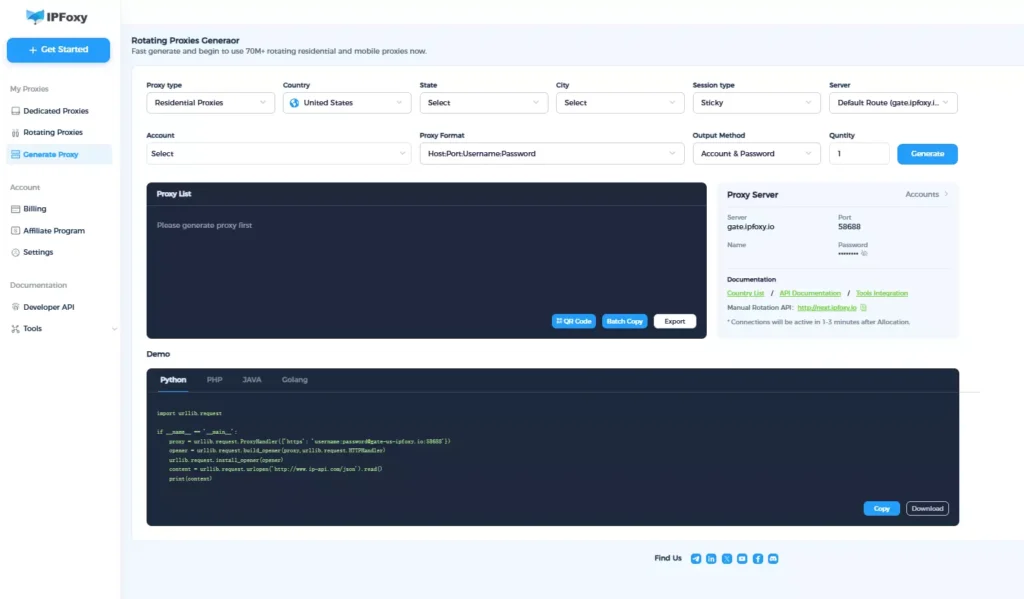
For example, IPFoxy’s rotating residential proxy offers a pool of 90+ million real-user IPs, supports automatic rotation under high concurrency, and maintains stable connections compatible with JavaScript rendering scenarios, making it suitable for dynamic content scraping.
III. Shopee Scraping Tutorial (Using Playwright as an Example)
There are many ways to scrape Shopee. This article uses Playwright as an example.
Step 1: Build a Stealth Playwright environment
Shopee detects automation browser features such as navigator.webdriver = true. Standard Playwright is easily identified, so a Stealth plugin is required.
First: Create a base project file
Create a new script file (e.g., shopee_scraper.py) for writing all scraping logic.
Second: Launch the browser with stealth configuration
Reduce detection risk by disabling automation indicators and sandbox detection. It is recommended to use non-headless mode initially so the browser window opens visibly, allowing you to monitor page loading, detect CAPTCHA prompts, and troubleshoot blocking issues. Set a reasonable window size to simulate normal user behavior. The core principle is to remove automation fingerprints as much as possible.
Third: Set realistic browser environment parameters
Configure a common user-agent string and match language and timezone settings with the target site. For example, when scraping the Singapore site, use an Asian timezone. If the proxy IP is located in Singapore but the browser timezone or language indicates Europe, this geographic mismatch increases detection risk.
Fourth: Apply Stealth patches
Use the Stealth plugin to modify or hide common automation fingerprints. The execution flow is:
- Create an independent browser context
- Open a new page
- Apply stealth processing to the page
- Visit Shopee
Important: Stealth must be applied before accessing the target site. Each new page requires stealth processing. Even when using persistent profiles, stealth must still be applied.
Step 2: Log in to Shopee and maintain session state
To obtain valid data, Shopee scraping requires maintaining login status. There are two main approaches:
Method A: Manual login
- Open the Shopee login page
- Log in manually in the browser
- Export cookies after successful login
- Save cookies locally
- Load cookies during subsequent sessions
Method B: Persistent browser profile
Save the full browser profile (including cookies and local cache).
- Specify a local user data directory
- Launch the browser in persistent mode
- Log in manually during the first run
- Subsequent runs automatically maintain login status
Step 3: Scraping Shopee product data
Scraping search result pages:
- Generate the Shopee search URL based on keywords, such as search?keyword=iphone
- Wait for page load, since Shopee dynamically renders product lists
- Continuously scroll to trigger lazy loading
- After confirming products are fully loaded, iterate through product card elements to extract product name, price, sales volume, and link
- After finishing one page, navigate to the next page and repeat the process until reaching the desired page count or data volume
Scraping product card data:
Each product card typically includes product name, current price, original price (if discounted), product link, sales volume, and rating.
Pay attention to data cleaning for price fields. Remove currency symbols, commas, and spaces to avoid formatting issues during analysis.
If only basic list data is needed, proceed to pagination. For more detailed information, visit individual product detail pages.
IV. Frequently Asked Questions (FAQ)
Shopee pages load data dynamically via JavaScript, making traditional crawlers like Scrapy insufficient. The solution is to use tools that support JavaScript rendering, such as Selenium or Scraper APIs, which simulate real browser behavior.
If only early pages are accessible, the anti-scraping mechanism may be triggered based on request frequency, IP address, or session behavior.Common solutions include lowering request frequency, using rotating proxy solutions, and simulating normal browsing behavior with scrolling and random delays.
Yes. Reviews are usually dynamically loaded and subject to stricter detection due to high traffic volume.
When scraping reviews, ensure login status, scroll multiple times, use stricter proxy strategies, and handle CAPTCHA challenges.
Conclusion
The difficulty of Shopee data scraping lies not in writing code, but in handling dynamic rendering, mandatory login requirements, and risk control systems.
From a business perspective, the core value of scraping Shopee data is to determine real price ranges, understand market trends, monitor competitor changes, and reduce inventory and pricing risks.
In short, technology solves “how to scrape,” while strategy determines “how long you can sustain scraping.” What truly matters is not scraping data once, but obtaining data in a long-term, stable, and sustainable manner.