












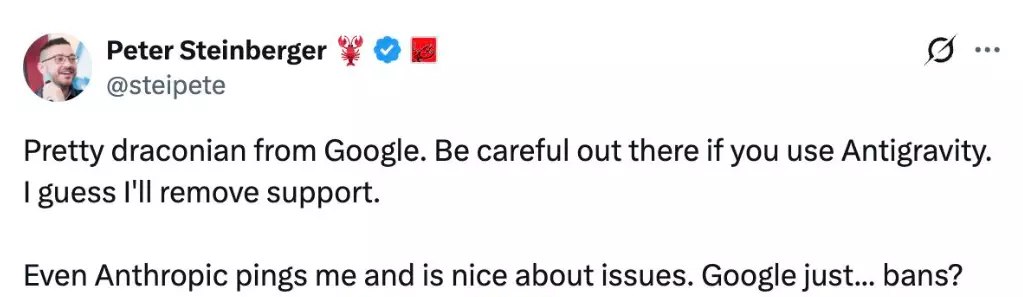
At the end of February 2026, users of the open-source AI agent OpenClaw, integrated with Google’s Antigravity/Gemini models, experienced widespread account bans. Not only were abusers banned, but even compliant API-paying users were affected, with many accounts being banned without warning and appeals going unanswered.
This sparked considerable controversy: Why were even “normal” users caught in the crossfire? How do AI platforms detect potential violations?
I. Overview of the Google OpenClaw Ban Incident
OpenClaw is an open-source AI agent that allows users to automate tasks by authorizing their Google accounts through OAuth. At the end of February 2026, users of OpenClaw, integrated with Google’s Antigravity/Gemini models, faced massive account bans.
- Core Issue: A mismatch between subscription costs and API usage. An Ultra user could generate token usage via OpenClaw that, when converted to API payment, could range from $1000 to $3600 per month, far exceeding the $20-$250 subscription fee, causing significant commercial losses for Google.
- Controversy: Not only were abusers banned, but many legitimate API users were also affected, with bans being issued without warning and no clear recourse for appeals.
This raised the question: Why were “normal users” also impacted? How did AI platforms identify them?
II. How Do AI Platforms Detect “Abnormal Accounts”?
AI platforms don’t just flag accounts based on specific software usage; they use a multidimensional monitoring model to detect abnormal accounts.
1、Unusual Request Features and Behavior Patterns
- Request Frequency Beyond Human Capability: OpenClaw’s “heartbeat mechanism” automatically wakes up every 30 minutes, while regular users cannot maintain such high-frequency operations.
- Lack of Human-Like Behavior: Human activity includes pauses, thinking, and random intervals, while bots operate with precision, regularity, and near-simultaneity.
- Unusual Token Consumption Curve: Token usage surges within a short period, far exceeding normal individual usage.
2、Network Fingerprints and IP-Geolocation Correlation
- Shared IPs or Associations: Using dirty IP pools, shared accounts, or proxies, where one account triggers risk control, others on the same IP can be affected.
- Low IP Purity: IPs from data centers or cloud providers are more easily detected as “machine environments” and flagged.
- Geolocation Jumping: A key requesting from multiple countries in a short time shows abnormal behavior.
- Device Fingerprint Abnormality: A single device fingerprint linked to multiple accounts or frequent switching of device fingerprints can lead to an abnormal score.
3、Insecure API Key Management
- Hardcoded API Key Risks: If API keys are embedded in code and uploaded to public repositories, once scraped by bots, the associated account will bear the consequences of abuse.
- Ignoring Error Codes in Requests: Making high-frequency requests with a single key despite receiving 429 errors (rate-limiting), overwhelming the server.
4、OAuth Misuse
- Scope Mismatch: Authorizing personal login rights to automated programs performing high-frequency tasks.
- Behavioral Shift: Accounts suddenly switching from “human mode” to “machine mode” might be flagged as “hacked.”
- Violating Terms of Service: Personal subscription accounts being used for commercial-level automation, which violates platform pricing expectations.
III. Best Practices for Using AI Models and Maintaining Account Stability
1、Simulate Human-Like Operations
- Rate Limiting: Add reasonable delays in scripts to avoid sudden bursts of requests.
- Implement Exponential Backoff: When encountering errors like 429, avoid retrying immediately and increase wait times progressively.
- Mimic Human Behavior: Avoid precise, regular calling patterns in non-essential scenarios and introduce random intervals.
2、Avoid High-Frequency Risk with Dynamic Proxies
- Choose High-Quality Proxy Providers: Data center IPs are often flagged as “machine environments,” so using clean residential proxies reduces the risk of bans due to IP sharing or data center features.
- Use Dynamic Proxies with Sticky/Rotating IPs: Decrease AI usage limits by changing IPs with each request or keeping them stable for a set time.
- Maintain Stable Geolocation: Prevent IP geolocation jumps within a short period to avoid detection.
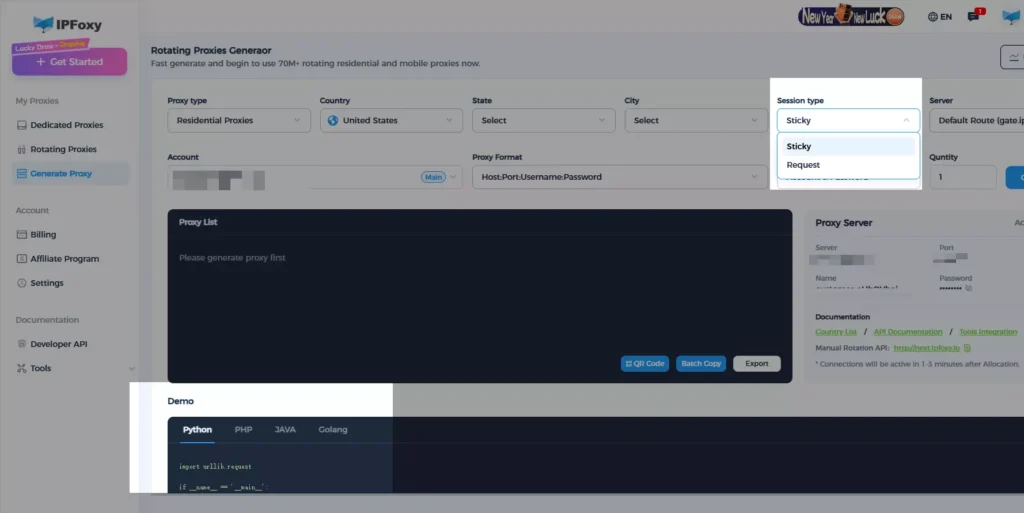
- We recommend using IPFoxy dynamic residential proxies and configuring them as per the tutorial:
1 Go to IPFoxy’s dynamic route extraction page.
2 Choose the country/state/city (200+ countries available).
3 Choose session requests:
● Sticky sessions: Rotate IPs every 30-60 minutes automatically.
● Per-request: Rotate IPs with each request.
4 Select the proxy export format to match your script or device configuration.
5 Get proxy credentials (username, password, port, etc.) and apply them to your AI calling script or device.
3、Secure Key Management
- Create Independent Keys for Different Applications: Avoid using one key across multiple projects to better isolate risks.
- Rotate Keys Regularly: Establish a system for periodic key updates to minimize damage in case of leaks.
4、Use Official Access Methods
- Use API Keys Instead of OAuth: For high-intensity AI applications, use dedicated API keys instead of authorizing personal accounts via OAuth.
- Comply with Terms of Service: Understand the platform’s policies on personal subscriptions and API usage to avoid boundary-crossing.
- Consider Multi-Model Architecture: Use model routing mechanisms to use low-cost models for simple requests and reserve high-performance models for complex inferences, balancing performance and cost.
IV. FAQ
A: The issue lies in the volume and frequency of requests. Your AI agent may have completed what would have been a month’s worth of manual tasks in a short time, triggering abnormal behavior flags.
A: High-quality proxies reduce the risk of IP-related flags, but they are not a “get-out-of-jail-free card.” They must be combined with compliant usage to fully mitigate risks.
A: You can try submitting an appeal. Visit the Google Cloud Console to check for warnings and then submit a request through the appeal page, explaining your usage scenario and promising to optimize your request frequency.
V. Conclusion
The Google OpenClaw ban incident highlights how AI platforms use multidimensional monitoring mechanisms to detect “abnormal accounts.” When an account’s behavior deviates from normal human usage, it may be flagged as abuse and banned. For legitimate users, simulating human behavior, using high-quality proxies, and managing API keys securely are key strategies to avoid being wrongly banned.