












In e-commerce and brand marketing, Instagram is no longer just a content platform, but an important “market signal source.” By analyzing competitor accounts’ content, engagement, and audience feedback, teams can quickly identify:
- What products are trending
- What types of content convert better
- Which accounts are worth cooperating with
- Which ad creative directions are reusable
As a result, more teams are trying to scrape competitor data from Instagram for product selection and ad analysis. However, in practice, many discover that although data is visible, it is difficult to collect it consistently.
- Common issues include:
- Requests being rate-limited
- Incomplete data returned
- 403 responses
- IP banned
- Account verification triggered
This is not because the data cannot be collected, but because Instagram strictly detects “abnormal access behavior.” Your access pattern does not look like that of a real user.
I. What Instagram Competitor Data Should Be Collected
From a business perspective, competitor data can be divided into four main categories:
- Content performance data (to identify trending content)
- Likes and comments
- Posting time
- Hashtags used
- Caption keywords
This data can be used to:
- Analyze which content structures perform best
- Determine product popularity cycles
- Extract reusable content templates
- Account-level data (to filter high-quality competitors)
- Follower count
- Account growth rate
- Posting frequency
- Account positioning
This data helps distinguish leading competitors from small accounts, assess market saturation, and find potential partners.
- Interaction and comment data (to identify real user needs)
- Comment content
- High-frequency keywords
- User questions
- Sentiment trends
This data can be used to identify user pain points, improve product descriptions, and design ad copy.
- Creative and advertising signals
- Video structure
- First-3-second hook
- Titles and CTAs
Whether the content appears to be advertising
This data supports creative imitation, ad testing, and campaign direction decisions.
II. Common Methods for Scraping Instagram Competitor Data
- Manual analysis
Manually browsing accounts, recording data, and comparing screenshots is safe and simple, but slow and not scalable, making it inefficient for business operations.
- Browser automation (Selenium / Playwright)
These scripts simulate real user behavior such as opening pages, scrolling, and loading comments.
Advantages: higher success rate and lower risk
Disadvantages: higher cost and lower efficiency
- Direct API scraping (Web API)
Analyzing request endpoints and directly obtaining JSON data.
Advantages: fast and suitable for batch collection
Disadvantages: strict risk control and high requirements for IP and behavior
III. Why Instagram Scraping Gets Blocked Easily
Instagram does not care about what you scrape, but how you scrape it. Common risk control triggers include:
- Abnormal IP behavior
Requests too frequent
Multiple accounts accessed from one IP
Country does not match the content being accessed
- Abnormal device fingerprints
User-Agent unchanged for long periods
Fixed cookies
Identical TLS fingerprints
- Abnormal behavior paths
Only requesting APIs
Not loading page resources
No pagination or navigation
From the system’s perspective, this looks more like a script than a real user.
IV. How to Make Instagram Data Collection Work
If your goal is to validate the workflow first, you can optimize in three areas:
- Reduce request frequency
Add random delays
Avoid concurrency
Simulate human browsing rhythm
- Mix request paths
Page requests plus data APIs
Occasional homepage visits
Load images and scripts
- Use high-anonymity proxy
Avoid data center IP
Use IPs that resemble real users
Control requests per IP
This approach works for testing and small-scale collection, but is not suitable for long-term stable operation.
V. How to Build a Stable Instagram Data Collection Architecture
A usable competitor analysis workflow typically looks like:
→ Competitor account list
→ Request scheduler
→ Proxy pool
→ Cookie / account pool
→ Instagram
→ Data cleaning
→ Database storage
→ Product selection / ad analysis
The key lies in proxy pool quality and request behavior control. When competitor data moves from testing to long-term monitoring, the real bottleneck is usually not the code, but:
- Whether the IP is real
- Whether the country matches
- Whether session persistence is supported
- Whether it can run stably over time
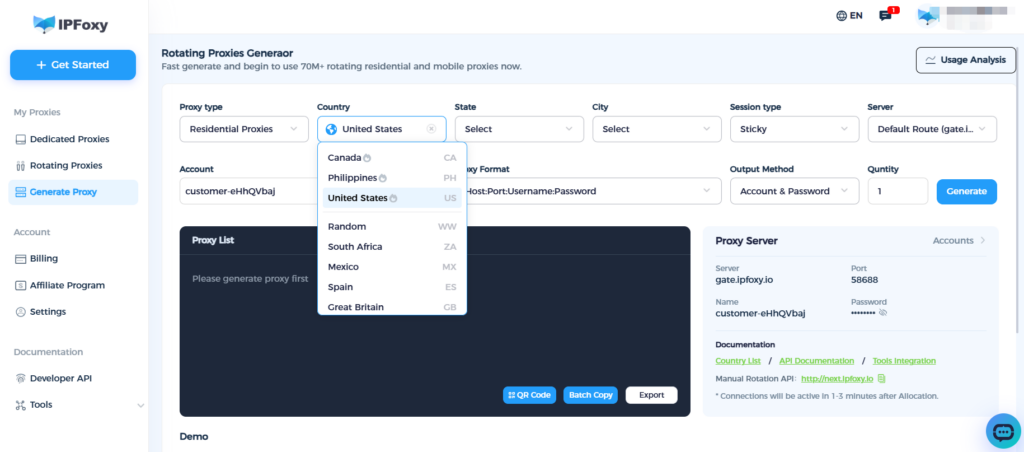
Stable Instagram data collection usually requires residential or mobile proxy support. These scenarios are better suited to proxy networks designed for data collection. For example, IPFoxy’s residential and mobile proxy resources are more suitable for Instagram competitor analysis in the following aspects:
- Multiple country locations to match target markets
- High anonymity to reduce ban risk
- Support for long-term operation and strategy control
- Better suited for large-scale competitor monitoring
Conclusion
Scraping competitor data from Instagram is not a technical problem, but a behavioral one: making your access look like a real user. By controlling request frequency, mixing access paths, and using proxy, you can make data collection workable. Only when the collection environment is stable can competitor data continuously generate business value.