











As TikTok becomes an important data source for product selection, advertising, and trend analysis, more teams are starting to scrape data from TikTok for purposes like popular video analysis, influencer screening, competitor monitoring, trend prediction, and user behavior research.
However, many people quickly encounter a common issue: the code works fine, but data is either missing or accounts are quickly banned. Frequent CAPTCHAs, empty data returns, 403/429 errors, and IP bans have almost become a standard in TikTok data scraping. This isn’t because TikTok restricts data access, but because TikTok is highly sensitive to “abnormal access behavior”—your scraping environment doesn’t look like a real user.
To collect TikTok data stably, the core isn’t “writing more complex scrapers,” but rather building a scraping environment that closely resembles a real user.
I. What Data Can You Scrape from TikTok?
From a business value perspective, the data that can be scraped from TikTok falls into three main categories:
1.Video Content Data
- Video ID
- View count, likes, comments, shares
- Hashtags, music, publishing time
- Video description and captions
This data is often used for viral video analysis, trending hashtag discovery, and content structure research.
2.Account and Influencer Data
- Followers, works count
- Account bio, location information
- Historical performance of posts
- Content update frequency
Primarily used for influencer screening, account growth analysis, and competitor account monitoring.
3.Comment and Interaction Data
- Comment content
- Commenting users
- Liking users (in some APIs)
Used for sentiment analysis, keyword extraction, and real demand insights.
Different data types have varying levels of risk control, with the highest risk levels typically found on search pages, comment pages, and user profiles.
II. 3 Common TikTok Data Scraping Methods
1.Official API
Pros:
- Legal and stable
- Lowest risk control
Cons:
- High application barriers
- Limited fields
Cannot meet product selection or competitor monitoring needs
Suitable for: Brands, advertisers, and legitimate analytical scenarios.
2.Browser Simulation Scraping (Playwright/Selenium)
Simulating real user actions through automated browsers:
Scrolling videos
Opening homepages
Loading comments
Pros:
- High success rate
- Relatively friendly risk control
Cons:
- High cost
- Slow speed
- Difficult to scale
Suitable for: Small-scale collection or verification phases.
3.Direct API Connection (Web/App API Scraping)
Directly obtaining data by analyzing TikTok request APIs.
Pros:
- High performance
- Scalable
Cons:
- Strictest risk control
- High requirements for IP, UA, and cookies
Suitable for: Long-term scraping and commercial analysis systems.
III. Why Does TikTok Data Scraping Fail Easily?
TikTok’s risk control logic isn’t about detecting whether you’re a scraper, but determining:
Are you behaving like a real user?
Common reasons for failure include:
1.IP Behavior Issues
- Excessive request frequency
- Repeated access to the same endpoint from a single IP
- Mismatched IP country and content
2.Device Fingerprint Issues
- Fixed User Agent (UA)
- Cookie not updated regularly
- Consistent TLS fingerprint
3.Abnormal Behavior Patterns
Not loading page resources
Only requesting APIs
Not flipping pages or redirecting
These characteristics make it seem like a script, not a user.
IV. How to Improve TikTok Scraping Success?
If you just want to get the scraping process running, start with these three approaches:
1.Control Request Speed
Increase random delays
Avoid excessive concurrency
Simulate user browsing pace
2.Mix Request Paths
Page requests + API requests
Don’t only hit data APIs
Occasionally request homepage or recommendation pages
3.Use High-Anonymity Proxies
Avoid data center IPs
Use proxies closer to real users
Use different exit points for different tasks
This approach works for small-scale tests but is not suitable for long-term, stable operations.
V. TikTok Data Scraping Core: Scraping Environment Design
For long-term operation of a TikTok data scraping system, the core is not the scraper but the environment design. A typical stable architecture should include:
- Data targets
- Request scheduler
- Proxy pool
- Cookies/Account pool
- TikTok
- Data cleaning
- Database storage
The two most critical modules are the proxy pool and request behavior control.
1.IP Proxy Pool
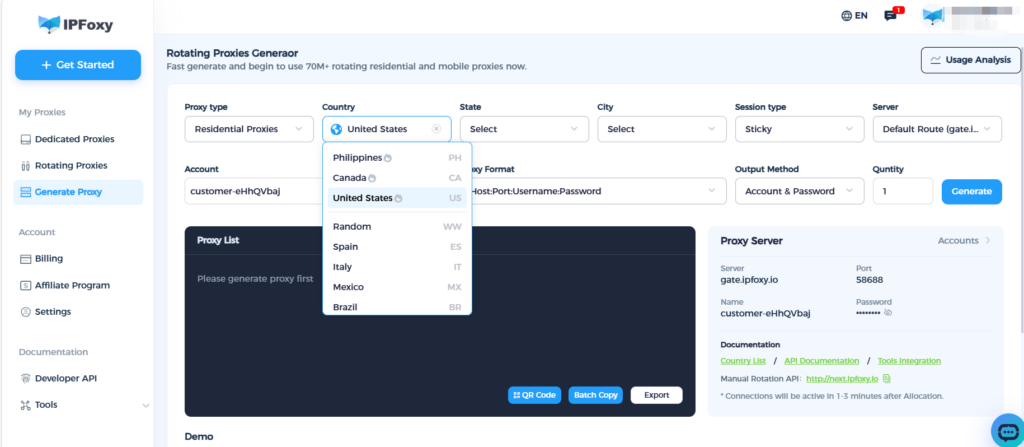
Through proxy quality testing, we selected IPFoxy‘s residential proxies to build an IP pool for this scraping task, adhering to the following proxy principles:
- Use residential or mobile proxies
- Ensure the IP matches the target country
- Control the request volume per IP
- Support session persistence
When data collection transitions from the testing phase to long-term operation, the biggest risk lies not in the code but in the stability of IPs and the environment. IPFoxy’s proxy pool consists entirely of non-abusive real residential exit nodes, with over 200 country- and city-level nodes available. It offers flexible API strategies, making it more suitable as a residential or mobile proxy network designed for data collection in such scenarios.
2.Behavior Strategy
- Lower access frequency
- Simulate page flips and redirects
- Avoid repeated paths
- Maintain a realistic browsing structure
3.Account and Cookie Management
- Use a mix of logged-in and anonymous states
- Regularly update cookies
- Avoid multiple IPs for the same account making requests simultaneously
VI. Regarding Compliance: Is TikTok Data Scraping Legal?
While some courts have ruled that scraping publicly accessible web data is legal, TikTok data scraping exists in a grey area. Its legality depends on the type of data and its intended use. In practical projects, be mindful of three points:
- Scraping public page data
- Not collecting user private information
- Not bypassing login verification
- Not for harassment or misuse
Technical feasibility ≠ Legal and ethical. Sustainable data collection must operate within the boundaries of compliance.
Conclusion
The challenge in TikTok data scraping is not just “how to write a scraper,” but how to make your scraping behavior look like that of a real user. In the short term, you can run tests by controlling frequency, mixing requests, and using proxies. In the long term, the key is IP quality, behavioral models, and environment stability. Only when the scraping environment is stable does the data itself have lasting value.