












In the era of e-commerce and AI-driven data analysis, the ability to quickly understand real user demand has become a key competitive advantage. Quora, as a high-quality Q&A platform, aggregates massive amounts of authentic user questions and in-depth discussions, and its pages frequently rank at the top of Google search results. For e-commerce practitioners, it represents a valuable source of organic traffic and market insight; for AI professionals, it serves as a rich data foundation for model training and vertical knowledge base construction.
This article provides a systematic overview of how to scrape data from Quora, helping e-commerce teams gain precise insights into buyer demand while also supplying high-quality, structured datasets for AI model training and knowledge base development.
I. What Is the Value of Quora Data Scraping?
Many e-commerce practitioners and AI professionals struggle with accurately understanding buyer demand and accessing reliable market data. As one of the largest knowledge-based Q&A platforms, Quora offers professional, high-quality content covering a wide range of products, industries, and real-world use cases.
1. E-commerce: Capturing SEO Traffic Opportunities
Quora Q&A pages often dominate Google search results. By scraping high-performing answers, you can optimize your website content while leveraging Quora’s domain authority to attract highly targeted buyers. This allows your products to gain immediate visibility and generate sustained organic traffic.
2. User Demand and Market Insights: Understanding Real Buyer Pain Points
By analyzing questions and discussions on Quora, you can directly identify user pain points and preferences, such as delivery delays, product quality concerns, or product selection difficulties. These insights enable you to refine strategies, avoid common pitfalls, improve conversion rates, and develop products that align with actual buyer expectations.
3. AI Applications: Model Training and Knowledge Base Construction
Structured Quora Q&A data can be used to train large language models (LLMs) or to build vertical knowledge bases. This approach improves AI performance in specific domains, enabling more accurate, professional responses and supporting trend analysis and data-driven research.
II. Quora Data Scraping Tutorial: Step-by-Step Workflow
1. Tool Preparation
Before scraping Quora content, it is essential to establish a stable and controllable environment. The core objectives are to simulate real user behavior, handle dynamic content, and reduce anti-scraping risks.
Python installation should use version 3.10 or later, with the local or server environment properly configured.
Required Python libraries include Selenium for browser automation and handling JavaScript-rendered content, BeautifulSoup (bs4) for parsing HTML structures and extracting key data such as questions, answers, and upvotes, and Selenium-wire to extend Selenium’s network capabilities, enabling proxy configuration for bypassing anti-scraping restrictions.
2. Understanding the Quora Page Structure
Before writing any code, it is critical to understand how Quora organizes its content in order to accurately locate Q&A data.
First, select a target question and its associated answers. This article uses the question “What is the easiest way to learn to code?” as an example and focuses on scraping all organic answers.
Next, use browser developer tools to inspect the HTML structure and identify key elements containing the required data.
The div#mainContent element contains all questions and answers and serves as the main entry point. Question text is located in the div.q-text.qu-dynamicFontSize–regular_title element. Answer content appears in the div.q-box.spacing_log_answer_content.puppeteer_test_answer_content element. Upvote counts are typically found within span.q-text.qu-whiteSpace–nowrap elements in the parent node. Promoted or advertisement answers are marked by div.q-box.dom_annotate_ad_promoted_answer and should be filtered to ensure data cleanliness.
3. Importing Data Processing Libraries
Selenium or seleniumwire is used to open pages automatically and simulate scrolling and clicking behavior. BeautifulSoup parses the HTML and extracts relevant data. The csv module stores scraping results, while the time module introduces delays to simulate human browsing behavior.
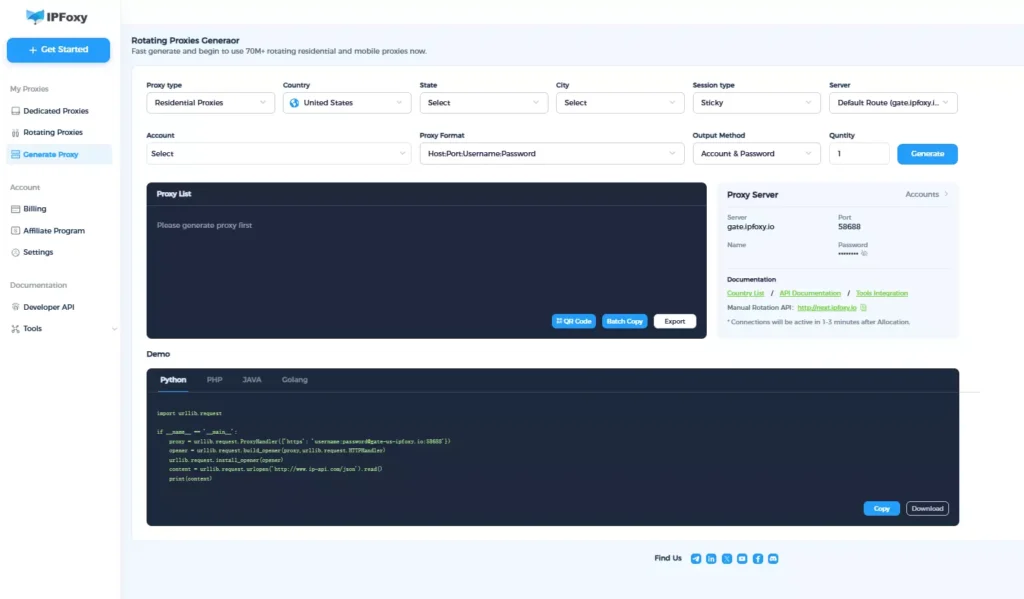
4. Configuring Proxies (Selenium Wire + IPFoxy)
Accessing Quora through proxies helps avoid blocks and restrictions while ensuring scraping stability. Rotating residential proxy solutions make requests appear as genuine browser traffic and support IP rotation to bypass anti-scraping mechanisms.
In testing scenarios, IPFoxy’s rotating proxy pool demonstrated strong performance in this use case. Its support for IP rotation and sticky sessions allows IP persistence for 15 to 30 minutes, maintaining session consistency during page loading, scrolling through multiple answers, or pagination. Its large-scale IP poohttps://app.ipfoxy.com/login?source=blogl supports high concurrency with tens of millions of IPs and customizable geographic locations and protocols. Batch API calls further improve success rates during long-term, large-scale scraping operations while reducing the risk of account association or bans.
5. Scrolling to Load Dynamic Content
Quora answers are dynamically loaded and cannot be fully retrieved without scrolling. A scroll_to_bottom() function simulates pressing the End key, ensuring that all answers are loaded before extraction.
6. Extracting Data with BeautifulSoup
The page source loaded by Selenium is passed to BeautifulSoup for parsing. Key elements such as question text, answer content, and upvote counts are located while promoted answers are filtered out. This process converts raw HTML into structured, analyzable data.
7. Saving Data to CSV
Extracted fields, including question text, answer text, and upvote counts, are written into a CSV file for further analysis. Missing values are automatically filled with default placeholders such as “0” or “No Answer.”
8. Executing the Scraping Script
The script opens Chrome, loads the target Quora page, waits for content to load, scrolls to the bottom, extracts answers, and saves the results to CSV. A try-except-finally structure ensures that the browser closes gracefully even if errors occur.
III. FAQ
Quora contains a vast amount of high-quality Q&A content covering diverse products, industries, and usage scenarios. Scraping this data helps e-commerce teams understand buyer pain points, refine product strategies, and improve SEO performance. It also provides reliable structured data for AI model training and knowledge base development, enabling more accurate analysis and decision-making.
Yes. Quora actively monitors abnormal access patterns such as frequent refreshes, rapid pagination, or excessive requests from a single IP. These behaviors may trigger captchas, access restrictions, or account bans. Using proxies responsibly, simulating real browsing behavior, and controlling request frequency can effectively reduce these risks.
When scraping high-traffic platforms like Quora, repeated requests from the same IP are easily identified as automated behavior, leading to access restrictions or bans. Proxies distribute requests across multiple IPs, simulating different users and ensuring more stable and secure data collection.
IV. Conclusion
Scraping Quora data enables a deeper understanding of market demand and user behavior, benefiting both e-commerce operations and AI-driven data analysis. By organizing and analyzing this data, teams can identify trending topics, uncover real user pain points, optimize product strategies and content planning, and build high-quality knowledge bases that enhance AI accuracy and domain expertise.
Once the methodology is mastered, Quora’s Q&A data becomes a powerful decision-support asset, driving more efficient workflows, more precise insights, and stronger long-term competitiveness.