












AI agents are evolving from simple task assistants into autonomous systems capable of executing processes, calling tools, and optimizing workflows. As trending AI automation frameworks, OpenClaw and Hermes represent two distinct directions: the former focuses on workflow execution and tool collaboration, while the latter emphasizes long-term learning and capability evolution.
Rather than a simple case of one replacing the other, they suit different business scenarios. This article compares their core technologies, capability differences, and deployment practices to help users select the right AI automation solution for their specific needs.
I. Hermes vs OpenClaw: Core Differences Between the Two AI Automation Frameworks
OpenClaw and Hermes represent two distinct evolutionary paths for AI agent automation. OpenClaw is a platform-based AI agent framework designed to connect external tools, services, and data sources, completing automated processes through task orchestration. It is ideal for scenarios with well-defined workflows that require stable execution.
Hermes emphasizes long-term memory, task feedback, and capability optimization. It leverages historical experience to improve subsequent task handling and refines its approach based on feedback. This makes it a better fit for long-running, complex analytical, and continuously optimized AI automation scenarios.
- In short:
- OpenClaw: Helps AI complete tasks more efficiently, emphasizing automated execution and business implementation.
- Hermes: Helps AI continuously improve its capabilities, emphasizing learning retention and intelligent evolution.
Core differences between OpenClaw and Hermes at a glance:
| Comparison Dimension | OpenClaw | Hermes |
| Core Positioning | Platform-based AI Agent | Self-learning AI Agent |
| Core Direction | Tool Connection & Task Execution | Experience Retention & Capability Optimization |
| Automation Method | Workflow-driven | Learning-driven |
| Target Tasks | Standardized, Repetitive Tasks | Complex, Long-term Optimization Tasks |
| Advantages | High Stability, Easy Deployment | Strong Autonomy, Continuous Optimization |
II. Hermes vs OpenClaw: In-Depth Comparison of Core Technical Capabilities
1、Task Planning and Execution Capabilities
OpenClaw utilizes a workflow-driven execution model. By using task chains, node management, and tool-calling logic, it breaks complex tasks into multiple steps. Its advantage lies in a clear execution path that is easy to control and debug, making it perfect for automated workflows with explicit rules. Hermes highlights dynamic planning capabilities. Instead of relying completely on preset workflows, it adjusts its execution strategy based on task feedback and historical outcomes. This suits tasks with complex goals and highly variable environments.
Core Difference:
- OpenClaw: Enhances the stability and controllability of task execution.
- Hermes: Increases the flexibility and adaptability of task handling.
2、Tool Calling and Automation Extension Capabilities
OpenClaw leans toward Tool Orchestration. By centrally managing APIs, databases, and third-party services, it allows agents to quickly connect to external capabilities and form complete automated workflows. Hermes focuses more on tool utilization efficiency. It analyzes historical task results to optimize tool selection, calling sequences, and execution strategies, rather than simply increasing the number of connected tools.
In short:
- OpenClaw solves “how to connect more capabilities.”
- Hermes solves “how to use capabilities more efficiently.”
3、Memory Systems and Continuous Learning Capabilities
OpenClaw focuses heavily on context management, saving current task states, execution logs, and workflow information to ensure continuous operation. This approach works well for short-cycle, fixed-workflow automation scenarios. Hermes prioritizes long-term memory. By retaining historical task experiences, it uses past outcomes to optimize future decisions, allowing the agent to progressively upgrade its capabilities during long-term operations.
| Comparison Dimension | OpenClaw | Hermes |
| Memory Type | Contextual State | Long-term Experience |
| Core Role | Ensures Task Continuity | Optimizes Future Decisions |
| Optimization Method | Workflow Adjustment | Experience-based Learning |
4、Skill Systems and Task Optimization Capabilities
OpenClaw relies on modular extensions. Developers can add features like data collection, file processing, and API calling, allowing the agent to quickly adapt to different business requirements. Hermes emphasizes skill optimization, aiming for the agent to adjust its own capabilities based on execution feedback to increase long-term task efficiency.
Therefore, the two correspond to:
- OpenClaw: Rapidly building business automation systems.
- Hermes: Exploring continuous-growth agents.
5、Deployment Cost and Maintenance Difficulty
From an engineering deployment standpoint, OpenClaw focuses on workflow configuration and system integration. Its deployment cost is relatively low, making it ideal for enterprises looking to launch AI automation tasks quickly. Hermes involves long-term memory, feedback mechanisms, and strategy optimization, which demands higher standards for data management, operational monitoring, and maintenance.
Consequently: To quickly achieve AI automation tasks: OpenClaw is easier to implement. To explore self-learning AI agents: Hermes holds more developmental potential.
III. AI Agent Deployment Practice: 3 Practical Recommendations
1、Break Down Automation Tasks Reasonably
Executing multiple goals simultaneously can easily lead to confused task logic, tool conflicts, and difficult verification. Breaking down tasks reduces the execution pressure on a single agent and improves the stability of automated workflows.
Data Collection Agent: Responsible for gathering target data and basic information. Analysis Agent: Responsible for processing data and generating analytical results. Execution Agent: Responsible for calling business tools to complete specific operations.
Among these, OpenClaw is better suited for workflow orchestration and tool collaboration, while Hermes is ideal for handling analytical tasks that require long-term optimization.
2、Build a Stable Running Environment
Beyond the agent’s inherent task capabilities, AI agents rely heavily on stable data access and network environments during actual operations, especially in multi-platform automation, data collection, and business system connections. Frequent changes in the access environment can trigger request errors, task interruptions, or unstable account statuses.
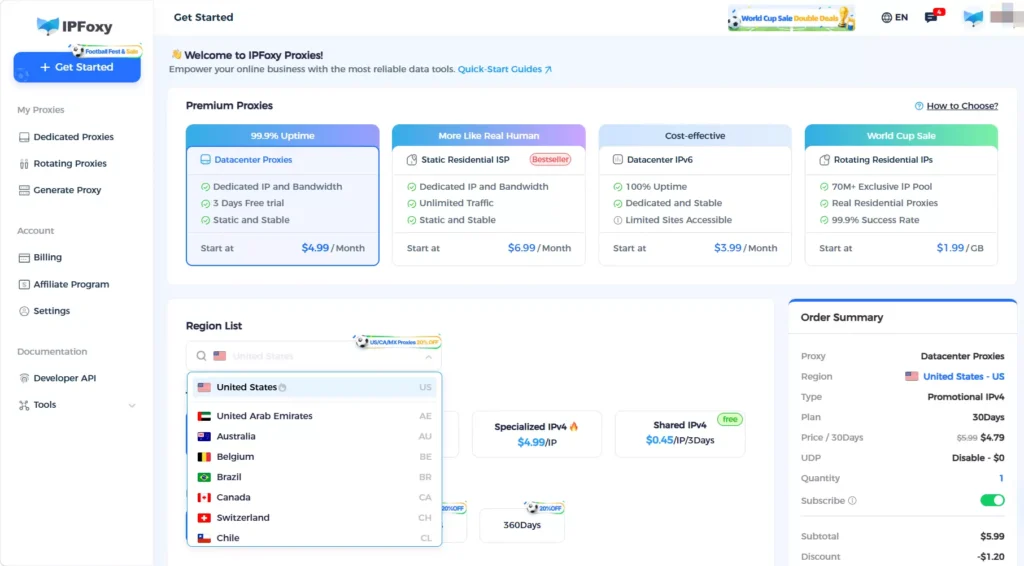
For business operations that require a fixed access environment, dedicated static residential proxies can provide stable IP support. For high-frequency data collection and market analysis tasks, rotating residential proxies can be used to switch nodes.
For instance, IPFoxy provides dedicated static residential proxy, ISP residential proxy, and rotating residential proxy services to meet the needs of various AI automation scenarios. It primarily focuses on delivering high-quality, clean proxy resources. Combined with proper device environment configurations, it helps prevent account bans and IP blacklisting issues during automated tasks.
3、Continuously Monitor and Optimize Agent Workflows
As business dynamics change and task complexity grows, agents still require continuous adjustments and optimization. This is particularly true for agents with long-term learning capabilities; without effective monitoring, they may accumulate erroneous decisions, drift from task objectives, or experience drops in execution efficiency.
- Key optimization focus areas include: Monitoring execution results: Analyzing task completion rates, root causes of errors, and anomalous nodes.
- Optimizing task workflows: Reducing repetitive operations and increasing tool-calling efficiency.
- Updating knowledge rules: Adjusting execution logic based on market changes and business feedback.
Choosing the right solution for different automation scenarios at a glance:
| Automation Scenario | Recommended Solution | Reason |
| Enterprise Process Automation | OpenClaw | Strong tool connection and workflow execution capabilities |
| Data Collection & Processing | OpenClaw | Well-suited for batch tasks |
| E-commerce Operations Automation | OpenClaw | Easy to connect with business systems |
| Market Analysis Optimization | Hermes | Well-suited for long-term learning |
| AI Research Tasks | Hermes | Better suited for complex decision-making |
| Personalized Assistants | Hermes | Can accumulate user experience |
| Enterprise-level Deployment | OpenClaw | Easy to manage and maintain |
IV. FAQ
OpenClaw and Hermes excel in different areas; there is no absolute winner. OpenClaw is more mature in task execution, tool calling, and process automation, making it ideal for rapid enterprise deployment. Hermes has the upper hand in long-term learning, complex analysis, and autonomous optimization, making it better for tasks that require continuous evolution.
OpenClaw is perfect for automated tasks with fixed workflows and high execution frequencies, such as enterprise workflow automation, e-commerce operations, data collection, API calling, and business system integration. These tasks generally have clear goals and require the AI to stably complete repetitive actions, allowing OpenClaw’s workflow management capabilities to shine.
The core advantage of Hermes lies in its long-term memory and experience optimization capabilities. It can adjust its execution strategies by combining historical task results, which improves the efficiency of subsequent tasks. As a result, Hermes performs exceptionally well in market analysis, research tasks, personalized assistants, and business scenarios that require continuous optimization.
Deploying AI agents requires looking beyond model capabilities alone; enterprises must consider task breakdown, the running environment, and workflow optimization. Properly breaking down tasks reduces agent workload, a stable network environment guarantees long-term operations, and continuous monitoring and optimization boost automation results. Selecting the right architecture based on business needs is the only way to maximize the value of AI agents.
V. Summary
In 2026, the focus of AI agent development has shifted from “single model capability” to “automation framework design.” OpenClaw and Hermes do not replace one another; rather, they provide different solutions for distinct needs. In the future, enterprises are highly likely to adopt a multi-agent collaboration model, assigning different types of agents to different tasks to create a more stable and efficient automation ecosystem.