











This article provides a detailed explanation of residential proxies, including their definition, working principles, core types, and use cases. It also offers practical guidance for selecting residential IPs and includes common FAQs, helping users choose the most suitable residential proxy solution for e-commerce, social media management, advertising, and other scenarios.
I. What is a Residential Proxy?
A residential proxy is a proxy network built using IP addresses assigned to real households by Internet Service Providers (ISPs). Unlike data center proxies, each residential IP is tied to a physical address, making requests appear as if they originate from a normal home broadband user. Websites typically recognize these requests as coming from “trusted users.”
The working principle of a residential proxy is as follows: when a user sends a request through a residential proxy, the traffic is first routed through the proxy provider’s forwarding node, then sent out via a real household broadband IP, and finally reaches the target server. The target server logs the household IP rather than the user’s real IP. The process involves three core roles:
- Client: The device initiating the request (computer, mobile, server, etc.)
- Proxy Node: The real residential IP network provided by the proxy provider, distributed globally
- Target Server: E-commerce platforms, social media, data APIs, and other target websites
II. Core Types and Use Cases of Residential Proxies
Residential proxies are not a single product but a multi-dimensional technical system. Understanding the differences between types is key to selecting the right residential IP.
1.Dedicated Static Residential Proxy vs Rotating Residential Proxy
- Dedicated static residential proxy maintains a fixed IP during use, which helps build a consistent “identity profile” on target platforms and reduces the likelihood of triggering anti-fraud mechanisms. However, static residential IPs are limited in supply and relatively costly.
Typical use cases:- Long-term social media account management (TikTok, Instagram, Facebook)
- E-commerce store daily operations
- Payment or settlement systems requiring fixed IPs
- Rotating residential proxy changes IPs automatically per session or connection, providing access to a larger IP pool. It offers flexibility and lower costs, though continuous operations may be affected.
Suitable for high-concurrency, short-session scenarios:- Large-scale data scraping
- Price monitoring
- Ad verification
- Automation tasks
2.Native Residential IP vs Non-native Residential IP
- Native IP means the IP registration location matches the actual usage location. For example, a US native residential IP shows US-based ISP info and has never been flagged as a data center or proxy exit. These IPs are ideal for scenarios requiring high geographic authenticity, such as streaming unlocks, precise ad targeting, or gaming anti-ban.
- Non-native IP refers to IPs whose registration location does not match the server location, often data center IPs repackaged as residential. These are better for general anonymity tasks, like data scraping or content access.
| Dimension | Native Residential IP | Non-native Residential IP |
| IP location match | Exact | May differ |
| Platform detection risk | Very low | Medium |
| Use case | Streaming unlock, ad targeting, strict compliance | General scraping, anonymous access |
| Cost | Higher | Lower |
3.Single-ISP vs Dual-ISP Residential Proxy
Dual-ISP residential proxies are designed for high-stability use cases. They provide two ISP routes simultaneously, so if the primary route fails, the secondary can take over in milliseconds, minimizing disruption.
Best suited for:
- Financial systems
- Automated ad platforms
- 24/7 streaming networks
- Enterprise applications with strict SLA requirements
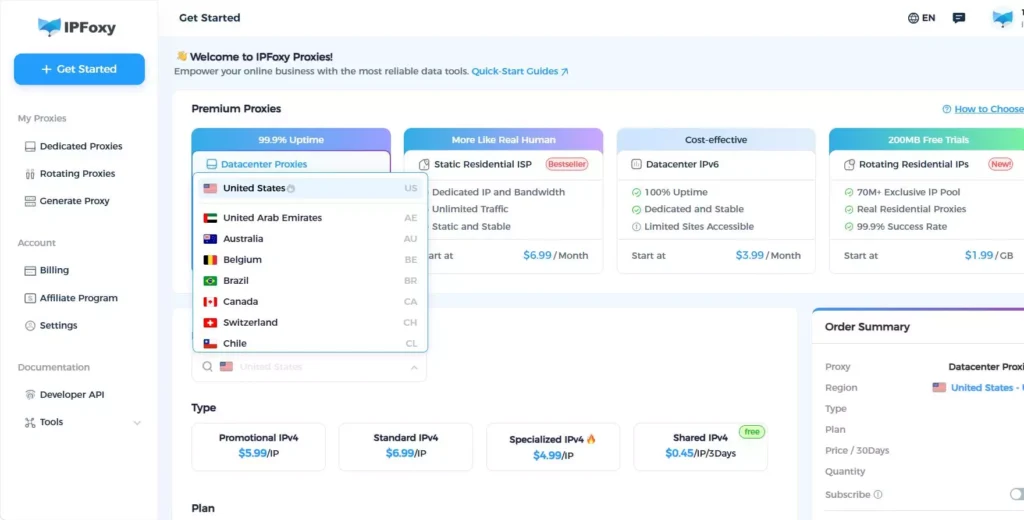
In practice, businesses may combine proxy types. For example, an e-commerce team could use static native residential proxies for core store accounts, rotating residential proxies for competitor price monitoring, and dual-ISP residential proxies for critical ad campaigns. Providers like IPFoxy Proxies offer dedicated, non-shared residential proxies with flexible protocol options suitable for multiple complex scenarios.
4.Comparison Overview
| Type | Stability | Anonymity | Recommended Use | Relative Cost |
| Dedicated static residential proxy | ★★★★★ | ★★★★ | Account management, long-term operations | Medium |
| Rotating residential proxy | ★★★ | ★★★★★ | Data scraping, ad verification | Low |
| Native residential IP | ★★★★ | ★★★★★ | Streaming unlock, precise ads | High |
| Dual-ISP residential proxy | ★★★★★ | ★★★★ | Finance, live streaming, enterprise | High |
III. How to Choose a Residential Proxy: Key Selection Criteria
1.IP Resources and Geographic Coverage
Check the size of the provider’s IP pool and coverage across countries/cities. For location-specific tasks, confirm support for city-level or ISP-level targeting.
2.Anonymity and IP Purity
The provider should support HTTPS/SOCKS5, prevent DNS leaks, and ensure IPs are from real residential ISPs. Tools like IPinfo.io or Whoer.net can verify IP authenticity.
3.Connection Performance
Focus on connection success rates, latency, and sticky session support. Maintaining login status and quickly switching IPs is crucial for high-concurrency tasks like scraping, ticketing, or ad campaigns.
4.Technical Compatibility
Ensure support for HTTP/HTTPS/SOCKS5, API access, and compatibility with automation tools (Selenium, Puppeteer, custom scraping frameworks).
5.Cost Structure and Packages
Residential proxies may be billed by traffic or per-port/account. Evaluate hidden costs like overage charges or expiration periods.
6.Compliance and Support
Choose providers with transparent, user-authorized IP sources and proper legal compliance. Service-level agreements (SLA) and responsive support are essential for enterprise use.
IV. FAQ: Common Questions About Residential Proxies
Use ping tests, HTTP request latency checks, concurrent scraping tests, or provider speed tools.
Residential proxies are widely applied in e-commerce, social media marketing, ad tech, SEO tools, fintech, market research, and more.
Residential IPs carry lower ban risks than data center IPs, but risk is not zero. Using proxies with an Anti-detect browser minimizes exposure.
V. Conclusion
With real-source origins, strong anonymity, and anti-fraud resilience, residential proxies have become a core infrastructure for e-commerce, social media, and data collection operations. When selecting proxies, focus on your business cycle and key requirements to choose the most suitable type, avoiding unnecessary costs and operational risks.