










If you run a social media matrix, frequent verification requests, abnormal login alerts, or account restrictions are often caused by issues with your proxy IP environment rather than content or operations. Shared IP exits across multiple accounts or frequent geographical IP shifts significantly increase the risk of account association.
So, how should you select proxy for platforms like TikTok and Instagram? Using IPFoxy as an example, this article breaks down proxy selection standards and configuration key points for 6 major platforms to maximize your account security.
I. Why Do Social Media Matrices Trigger Account Association?
1. Network Environment
An IP address represents the network exit point of an account. When multiple accounts share the same IP for an extended period or share highly overlapping login sources, identical network footprints are created. Similarly, if a single account undergoes noticeable cross-region logins within a short timeframe, platforms may flag it as abnormal activity. Reviewing matrix accounts should start with checking IP sources, locations, and login logs to ensure no obvious overlaps or suspicious shifts exist.
2. Device Environment
Distinct network sources do not guarantee complete account independence. Platforms evaluate additional parameters including device hardware details, browser fingerprints, and cookies. Operating multiple accounts on the same device or within highly similar environment setups leaves correlation signals. Inspections should check for shared hardware or overlapping browser configurations to resolve risk at the device level.
3. Behavioral Patterns
User behavior habits serve as another key reference alongside networks and devices. Executing highly repetitive logins, follows, likes, or posts across multiple accounts within tight time windows creates predictable behavioral traces. Monitoring login frequencies, action pacing, and operational similarity prevents matrix accounts from exhibiting synchronized activity profiles.
II. How to Choose Proxies for Social Media Matrix Management? Solutions for 6 Major Platforms
Proxy selection should follow platform risk control sensitivity, long-term vs. short-term usage, and structural match rather than price alone. Evaluation involves three core steps: identifying platform environment strictness, determining account lifecycle goals, and assigning the corresponding proxy format. Common proxy categories include:
- Free/Shared Proxy: Low cost, but shared among multiple users, making historical IP reputation uncontrollable.
- Datacenter Proxy: High speed and affordable, suitable for testing and public data scraping, but easily identified by certain social media platforms.
- Residential Proxy: Sourced from real ISP networks, matching regular user access environments for sustainable account management.
- Native Proxy: Features native regional and network attributes matching target markets, ideal for platforms requiring strict IP authenticity.
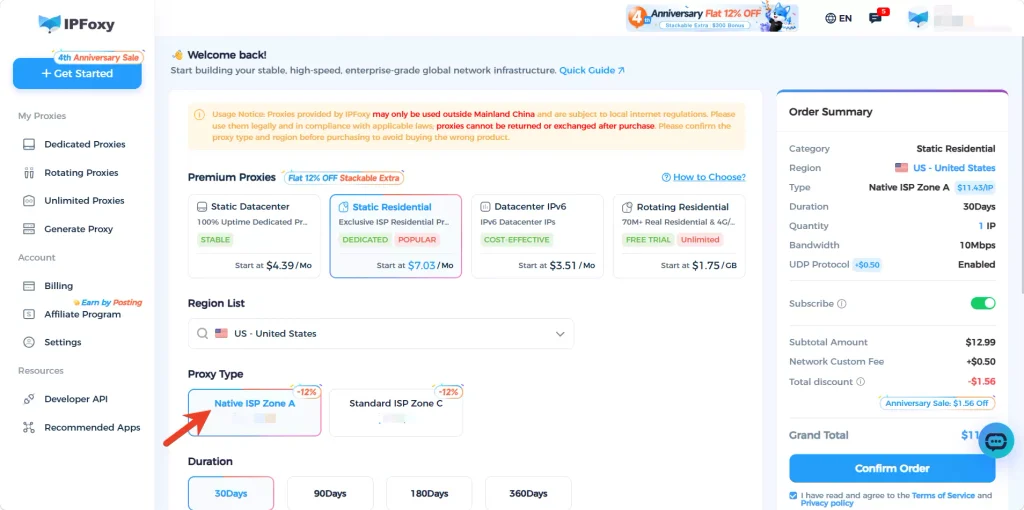
For team operations, professional providers like IPFoxy allow unified management across multiple proxy categories, including dedicated static residential proxies, rotating residential proxies, and datacenter proxies. Dedicated static residential proxies are recommended for account registration and long-term matrix management to minimize environmental changes caused by frequent exit shifts.
1. TikTok
TikTok enforces strict regional and network consistency, especially for mature accounts, live streaming, or localized targeting. Significant discrepancies between the IP location/network type and the target market increase verification triggers. TikTok operations should prioritize native residential proxies matching the target location. For example, US account setups require US native IPs verified for matching country, city, ISP, and ASN metadata post-purchase.
2. Instagram
The main risk for Instagram matrix operations is network source overlap. Running numerous accounts on shared IP generates noticeable network clustering, even without operational violations. Multi-account management requires dedicated residential proxies, particularly for core brand assets. Dedicated IP prevent shared network exits while residential properties mimic authentic user browsing.
3. X
X usage spans account operations, content consumption, and market research. Varying task requirements eliminate the need for premium proxies across every scenario. Dedicated static residential proxies provide regional continuity for posting and account maintenance, while standard proxy types suffice for public data viewing based on scale and budget.
4. Facebook
Facebook matrix structures combine personal profiles, pages, and business assets, multiplying exit IP overlap risks. Long-term access from identical IP creates explicit association signals. Sustained Facebook operations benefit from dedicated residential proxies aligned with target markets. The focus remains on eliminating unnecessary network overlap rather than constant IP rotation.
5. YouTube
Integrated with Google ecosystem security, YouTube flags sudden location and device changes. Channel management requires long-term network continuity via static residential proxies matching target demographics (e.g., US IP for US channels). Operational hygiene also involves regularly auditing Google login sessions and security alerts.
6. LinkedIn
As a professional network, LinkedIn values IP location accuracy, stability, and trust over sheer IP quantity across user profiles, company pages, and sales accounts. US residential proxies support US market coverage, while native residential proxies satisfy higher precision requirements for network identity.

III. Social Media Proxy Setup: Configuring Independent IP for Each Account
1. Proxy IP Verification
Validate new proxy IP before logging into social media accounts. Use IP lookup tools to confirm country, city, ISP, ASN, and proxy type against purchase specifications. Verify regional accuracy, expected proxy classification, and the absence of network anomalies. Discrepancies, such as datacenter ASNs appearing on residential orders, require immediate proxy replacement prior to use.
2. Proxy IP Configuration
Once verified, assign proxy to operational environments while maintaining account-to-IP mapping logs. Common configuration workflows include:
- Anti-detect browser: Combines proxy with isolated browser environments, ideal for multi-account team management requiring environment separation. Setup requires inputting IP host, port, username, and password into the anti-detect browser’s proxy settings.
- Native browser: Standard browsers lack built-in proxy configuration and require extensions like IPFoxy Proxy Manager. This suits lightweight setups managing 3–5 accounts for daily logins and account nurturing.
- Automation scripts (Playwright, Selenium): Server details are declared directly in script parameters for programmatic web tasks and automated workflows.
- Cloud phone: Similar to anti-detect browsers but tailored for mobile environments. Suitable for running social media apps on isolated mobile instances by configuring proxy details in the cloud OS settings.

3. Simulating Human Behavior
Successful setup relies on maintaining consistent, realistic network habits rather than constant IP rotation. Rapid location changes trigger suspicious activity alerts. Daily operations should maintain natural pacing across login, browsing, posting, and interaction tasks while avoiding automated action spikes. Resolve access prompts by checking network health, device status, and account security before taking corrective steps.
IV. FAQ
No. Residential proxies address network environment risks, but platforms also evaluate device integrity, account history, and behavioral patterns. While residential IPs reduce network-level triggers, they cannot guarantee absolute protection against restrictions.
Rotating residential proxies suit high-frequency page crawling and tasks requiring ongoing IP shifts. Long-term operational accounts on TikTok, Instagram, Facebook, and YouTube perform best with stable dedicated static residential proxies.
While technically possible, shared exits across matrix networks are not recommended for long-term operations. Building isolated network environments for account groups provides better protection against cross-account association.
V. Conclusion
Preventing social media matrix bans relies on constructing stable, isolated operational environments rather than searching for unbanable IP. Select residential or dedicated static residential proxies based on platform requirements while isolating accounts, devices, and network environments. Maintaining organic activity patterns remains essential for mitigating login alerts and account association risks.