












At the beginning of 2026, Google suspended a large number of Google Merchant Center (GMC) accounts with strict enforcement. Many ecommerce sellers and website advertisers were caught off guard: advertising budgets were already spent, yet accounts were suddenly suspended, products stopped showing, and ads could no longer run.
Why are GMC accounts being suspended? How should the appeal process be handled to recover accounts as quickly as possible? And how can future suspensions be avoided?
This guide provides a comprehensive breakdown of suspension causes, recovery steps, and long-term prevention strategies to help you reduce risk and restore advertising performance efficiently.
I. Analysis of Google GMC Account Suspension Causes
If you want to recover your account safely, there is one thing you must do before submitting an appeal.
1. Quickly identify the violation causing the suspension
- Log in to Google Merchant Center
- If your account is suspended, a red warning banner will appear on the homepage
- Click “Go to account issues”
On the account issues page:
- Yellow warnings indicate minor violations, such as incomplete product information or feed errors
These issues can usually be resolved by fixing the problems and submitting an appeal - Red warnings indicate serious violations, such as selling counterfeit products or using misrepresentation
These require systematic corrections; submitting an appeal without fixing the root problems often leads to a second suspension
2. Identify the most common suspension reasons in practice
Currently, 99% of GMC suspensions fall into two major categories: untrustworthy promotions or misrepresentation, and violations of Shopping Ads policies.
These are not minor issues. They result in account-level suspension. First confirm whether your suspension belongs to one of these categories. If not, continue checking the following areas.
- Website information issues
- Business address is fake, unverifiable, or displayed only as an image
- About Us page contains very little content, is copied, or inconsistent with other pages
- Shipping Policy, Return & Exchange Policy, or Privacy Policy is missing or unclear
- Contact information is hidden or cannot be copied
- Numerous spelling errors and overall low page quality
- Promotion and content violations
- Discounts or free shipping rules do not match actual conditions
- False advertising or exaggerated claims
- Ads continue running for out-of-stock products, leading to complaints
- Frequent changes to products being sold, indicating an unstable business model
- Image and creative violations
- Stolen product images or images without proper rights
- Images containing watermarks or third-party logos
- Images featuring identifiable people without authorization
- Images involving political, religious, adult, or exaggerated endorsement content
- Feed and product data issues
- Price, inventory, or material in the feed does not match the website
- Images are not white background or inconsistent with landing pages
- Brand, category, or product attributes filled incorrectly
- Fraudulent behavior and account association (high risk)
- Use of fake plugins such as fake reviews, countdown timers, fake sales numbers, or fake traffic
- Creating multiple GMC accounts to bypass review
- Using the same IP, device, or payment method, causing accounts to be flagged as associated
II. Complete GMC Account Recovery Guide With Appeal Process
First, review the official appeal workflow:
- Account issues page → Check violation type
- Click “Learn more” → Fix issues according to policy
- Click “Request review” to submit an appeal
- Wait for manual review (usually 1–3 business days)
1. Required materials before submitting an appeal
- Basic business documentation
- Business license with English translation
- Top-level domain certificate
- Trademark registration or brand authorization
- Product authenticity and originality proof
- Real product photos clearly showing the logo
- Product design drawings or sketches
- Proof of original creative materials
- Purchase records or invoices
- Proof of corrections
- Before-and-after screenshots of modified pages
- Feed update records
- Backend screenshots showing inventory, pricing, and shipping adjustments
- Sales links or customer reviews from other platforms
2. Appeal letter requirements
Your appeal letter must include:
- Clear acknowledgment of the issue
- Explanation of completed corrective actions
- A plan to prevent future violations
3. Key points when filling out the appeal form
- Contact information
- Name and email must match business license details
- It is recommended to CC a backup email, preferably a business email
- Violation type selection
- Select the correct violation category
- Choosing the wrong category may invalidate the appeal
- Issue summary
- Description of the violation
- Actions taken to resolve it
- Request for re-review
- Attachment upload
- Combine all materials into one PDF
- File naming format: GMC_Appeal_CompanyName_Date
- After submission
- Follow up by email every 3–5 days
- Check spam folders
- If rejected, revise according to feedback and resubmit after 7 days
III. GMC Suspension Prevention: How to Maintain Long-Term Stability
1. Daily operation and maintenance
From an operational perspective, prevention focuses on stability and authenticity.
Avoid frequent price changes, especially multiple adjustments within a single day (ideally no more than three). Excessive price changes are often flagged as abnormal behavior.
Do not use unknown or exaggerated third-party plugins, as plugin violations are a common cause of suspensions.
Make it a habit to download and review product diagnostics reports weekly. Identifying risk signals early and adjusting accordingly helps maintain consistent product titles, pricing structures, images, and core selling points. This consistency allows the system to build a normal business profile and reduces the chance of triggering risk controls.
2. Account security and association isolation
Account association is one of the most overlooked yet most dangerous risks in multi-account operations.
There are two key isolation strategies:
- Device isolation: use an anti-detect browser or physical device separation to ensure device fingerprints are not cross-identified
- IP network isolation: use stable, trustworthy residential proxy environments so each account operates with an independent IP address and avoids risks caused by frequent IP changes or associations
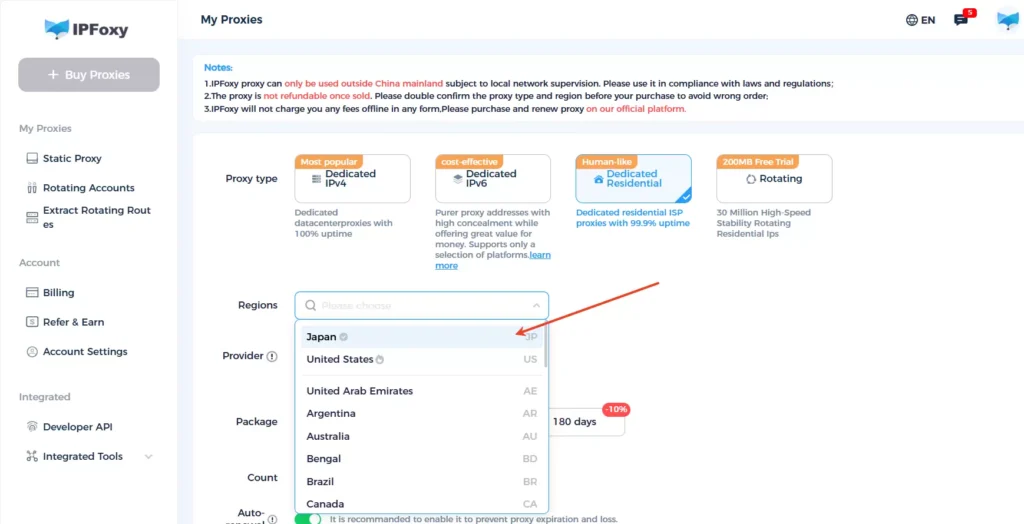
These measures ensure accounts operate in a clean environment and reinforce core account security principles. Using compliant ISP-authorized residential proxy services helps avoid unreliable networks built on bundled SDK devices, allowing operations to remain stable under strict risk-control systems.
3. Ensure merchant information meets Google requirements
Google places strong emphasis on the following areas:
- Websites must clearly display contact information, with at least two of the following: phone number, email, or address, presented in copyable text. All information must match GMC backend records, and the address must be real and searchable on Google Maps
- Shipping and logistics policies must clearly state shipping timeframes (business days or calendar days), regional shipping fees and delivery times, free shipping rules, and tax responsibility
- Return and exchange policies must specify eligibility, time limits, shipping responsibility, refund timelines, and return address
- Privacy policies must clearly explain how user data is collected and used, confirm that user data is not sold, and ensure SSL encryption is used on payment-related pages with valid contact details
- Payment methods displayed on the website must be truly available, and the checkout process must be clear and error-free
IV. Frequently Asked Questions
A: This is one of the most common suspension reasons. Google considers your store or product information insufficiently transparent or inaccurate, such as mismatched pricing, misleading descriptions, inconsistent promotions, or conflicting contact details. To resolve this, ensure all information is consistent, truthful, and supported by complete policy pages.
A: This usually means the corrections were incomplete or Google still considers trust issues unresolved, such as inconsistent information or feed mismatches. A full-site compliance review with detailed correction evidence is recommended before submitting another appeal.
A: Yes. New accounts lack historical behavior data and are more sensitive to high-frequency actions or abnormal environments. During the early stage, reduce operation intensity and ensure clean, independent network and device environments.
A: Absolutely. Sharing IPs, devices, or payment methods creates strong association signals and is a primary cause of mass suspensions. Each account should operate with an independent IP to avoid traceable links.
Conclusion
This article provides a comprehensive and practical 2026 Google Merchant Center recovery and suspension prevention guide, covering suspension analysis, self-check methods, appeal preparation and submission, daily operation practices, account security isolation, and merchant compliance management. Applying these strategies helps sellers quickly identify suspension causes, submit effective appeals, and reduce long-term suspension risks to maintain stable advertising performance.