












As one of the world’s largest fashion eCommerce platforms, ASOS is not only a hub for fashion enthusiasts, but also a key marketplace for cross-border sellers, resellers, sneaker buyers, and data analysts.
However, many users encounter issues such as 403 Forbidden errors, frequent CAPTCHA challenges, or even direct IP bans when accessing ASOS, managing multiple accounts, or using automation tools like bots and scraping scripts.
Why does ASOS have such strict anti-bot protection? Why are traditional datacenter proxies becoming increasingly ineffective, while residential proxies and static ISP proxies have become the preferred solution? This article explains the reasons behind ASOS risk control systems and explores the most reliable proxy solutions in 2026.
I. What Is ASOS & Why Does It Require High-Quality Proxies?
ASOS is one of Europe’s largest online fashion retailers, offering clothing, accessories, sneakers, and beauty products across multiple global regions. Because of its fast product updates and major seasonal discounts, the platform attracts millions of real users every day.
At the same time, its enormous traffic and commercial value also make it a major target for bulk registrations, inventory abuse, price-monitoring crawlers, and automated activities.
To prevent abuse, fraudulent orders, inventory manipulation, and malicious attacks, ASOS uses highly advanced anti-bot and anti-automation systems such as Akamai and PerimeterX.
As one of the strictest eCommerce platforms in terms of risk control, ASOS continuously analyzes several important signals in the background:
- IP reputation and ASN detection: ASOS checks the ASN of incoming traffic. If an IP belongs to cloud hosting providers such as AWS or DigitalOcean, it may immediately be identified as non-human traffic.
- Browser fingerprinting and TLS signatures: The platform compares TLS/JA3 fingerprints, Canvas fingerprints, and browser User-Agent consistency. Automation tools like Puppeteer or Selenium without proper masking are often detected quickly.
- Geolocation consistency: ASOS compares the IP location, browser language, DNS region, and account registration country. Large inconsistencies may trigger security restrictions.
- Request frequency and behavior patterns: Real users naturally pause, scroll, and interact with pages. High-frequency requests from a single IP can be rate-limited within seconds.
Common ASOS risk-control issues include:
| Risk-Control Issue | Common Cause |
| Frequent CAPTCHA challenges | Low IP reputation or suspicious traffic |
| 403 Forbidden / Access Denied | Datacenter proxies detected and blocked |
| Page loading failures or cart issues | Excessive request frequency |
| Suspicious login alerts | Frequent IP location changes |
| Checkout failures | Payment fraud protection triggered |
II. Common ASOS Proxy Use Cases in 2026
In the 2026 cross-border eCommerce environment, high-quality proxies have become essential infrastructure for automation, account management, and data operations.
1. Multi-Account Management
ASOS limits the number of accounts associated with a single environment. For resellers, purchasing teams, and eCommerce sellers, managing multiple accounts is often necessary to reduce operational risks and improve purchasing efficiency.
Dedicated proxies help assign a separate network identity to each account, reducing account-linking risks.
2. Sneaker Bots & Limited Product Drops
ASOS frequently releases limited-edition sneakers, fashion collaborations, and high-demand products. Because inventory is extremely limited, manual purchasing is often impossible during major releases.
Automation bots require large numbers of fast, clean proxies to submit concurrent checkout requests and improve success rates.
3. Regional Price Monitoring
ASOS operates multiple regional stores, including UK, US, and EU versions, each with different pricing systems, promotions, and clearance discounts.
Sellers and analysts often need geo-targeted proxies to collect accurate regional pricing data. Since ASOS aggressively blocks repeated requests from the same IP, residential proxies are usually required for stable monitoring.
4. Data Collection & Scraping
Fashion retailers and analytics companies frequently collect ASOS product trends, reviews, inventory changes, and pricing updates through automated scraping systems.
Large proxy pools help distribute requests and reduce the risk of rate limits or IP bans during high-frequency scraping tasks.

III. Best ASOS Proxy Solutions in 2026: Residential vs ISP Proxies
To reduce the chances of detection on ASOS, the key principle is simple: make every request appear like normal traffic from a real home internet user.
- Residential Proxies
Residential proxies route traffic through real household broadband networks. Their biggest advantage is a large rotating IP pool. IPs can automatically rotate every request or at scheduled intervals, making them highly effective for scraping, monitoring, and large-scale automation.
Because these IPs come from real ISPs, ASOS is far less likely to block them.
- ISP Proxies
Static ISP proxies combine the speed of datacenter networks with the trust level of residential IPs.
Their biggest advantages include fixed IP addresses, stable long-term sessions, and unlimited traffic options. They are especially suitable for long-term account management, stable logins, and checkout operations.
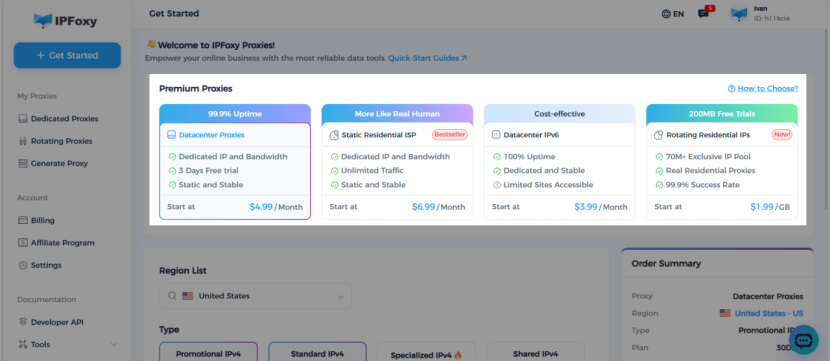
For high-risk ASOS operations, choosing a stable proxy infrastructure is critical.IPFoxy provides high-purity residential proxies, static ISP proxies, and mobile proxies designed for large-scale eCommerce automation, account management, and data collection scenarios.
| Use Case | Recommended Proxy Type | Main Advantages | Recommended Environment |
| Multi-account management & long-term account usage | Static ISP Proxies | Fixed residential IPs, stable sessions, unlimited traffic | AdsPower, Dolphin{anty} |
| Price monitoring & large-scale scraping | Rotating Residential Proxies | Large IP pool with automatic rotation | Scrapy, Puppeteer, Selenium |
| Sneaker bots & limited-edition releases | Mobile 4G/5G Proxies | Real mobile IP reputation with very high trust scores | Automation bots & scripts |
IV. How to Reduce ASOS Blocks & CAPTCHA Challenges
Besides using high-quality proxies, proper operational practices can also significantly reduce the chances of triggering ASOS risk-control systems.
1. Reduce Request Frequency
When running scraping or monitoring scripts, request concurrency should be carefully controlled. Sending too many requests in a short period can quickly trigger rate limits.
Adding random delays between requests helps simulate normal human browsing behavior.
2. Clear Cookies & Browser Cache
Once an IP becomes flagged by ASOS, associated browser cookies and local storage data may also be considered suspicious.
Before switching to a new IP, it is recommended to completely clear cookies and browser cache, or use isolated browser environments through antidetect browsers.
3. Rotate High-Quality Residential IPs
Frequent CAPTCHA challenges or repeated loading failures usually indicate declining IP reputation.
At this stage, switching to fresh residential IPs can greatly improve stability. Many professional teams combine residential or ISP proxies with antidetect browsers like AdsPower to isolate both network and browser fingerprints.
4. Maintain Regional Consistency
ASOS places significant importance on environmental consistency.
The account registration country, proxy location, browser language, and timezone settings should all remain aligned. For example, when accessing the UK version of ASOS, it is recommended to use a UK residential or ISP proxy together with en-GB language settings and a Europe/London timezone.
V. FAQ
Yes. Low-quality datacenter proxies are frequently blocked and often trigger 403 Forbidden errors or continuous CAPTCHA verification.
Checkout failures are usually caused by unstable IP sessions or mismatched billing information and IP regions.
For checkout and long-term account usage, using the same static proxy throughout the session is strongly recommended.
Yes. Datacenter IPs are much easier for ASOS to identify through ASN detection, while residential proxies carry legitimate ISP network attributes and generally achieve much higher success rates on eCommerce platforms.
VI. Conclusion
With ASOS using increasingly advanced anti-bot and anti-automation systems, relying on traditional datacenter proxies or unstable network environments is no longer effective for large-scale eCommerce operations.
High-quality residential and ISP proxies can help reduce 403 blocks, CAPTCHA interruptions, account restrictions, and checkout failures, making cross-border eCommerce and data collection operations far more stable and efficient in 2026.