











Over the past few years, TikTok and Facebook ad systems have continued to evolve, and the underlying logic of media buying has changed significantly. Simply copying creatives or applying a single-platform strategy can no longer deliver consistent results across channels.
This article systematically breaks down the key differences between TikTok and Facebook—from automation tools and core logic to practical strategies—helping you make better advertising decisions at different business stages and avoid common pitfalls.
I. Automated Ads Comparison: TikTok GMV Max vs Facebook Advantage+
1、TikTok GMV Max
GMV Max is an eCommerce-focused automated advertising tool launched by TikTok, designed to maximize gross merchandise value (GMV). It emphasizes conversion-driven optimization, using AI to automatically select placements and optimize delivery strategies, with ROI as the core objective. It is particularly suitable for performance-driven eCommerce campaigns. It helps advertisers:
- Automatically combine creatives and identify high-performing videos
- Automatically match target audiences and delivery timing
- Dynamically optimize budget allocation and delivery paths
Compared to traditional ad systems, GMV Max significantly reduces manual intervention and relies more on the volume and quality of creatives. The operational focus shifts from “structure optimization” to “content production,” making creative supply the key growth ceiling.
2、Facebook Advantage+
Advantage+ is an intelligent advertising solution launched by Facebook (Meta), aimed at improving conversion efficiency and overall return on ad spend (ROAS). It emphasizes data-driven optimization, using AI to allocate budgets, expand audiences, and optimize based on conversion outcomes. It is better suited for campaigns requiring stable performance and scalable growth. It helps advertisers:
- Automatically allocate budgets toward high-performing ad sets
- Automatically expand potential audiences to improve cold-start performance
- Automatically optimize placements and delivery paths
- Set budget limits and automated rules to control delivery fluctuations
Advantage+ reduces manual workload while still allowing strategic control over structure and setup. It relies more on accumulated account data and audience modeling. The operational focus is on “clear structure + continuous testing and optimization.”
Comparison Overview
| Dimension | TikTok GMV Max | Facebook Advantage+ |
|---|---|---|
| Core Goal | Maximize gross merchandise value (GMV) | Improve conversion efficiency and return on ad spend (ROAS) |
| Optimization Logic | Conversion-driven, AI automatically selects creatives, audiences, and timing | Data-driven optimization, AI allocates budget, expands audiences, and optimizes placements |
| Operational Focus | Creative volume and quality, focus on content production | Account structure and audience modeling, focus on structured setup and continuous testing |
| Best Use Cases | Fast product sales and eCommerce scaling | Stable conversion and scalable campaign growth |
II. Core Differences in TikTok vs Facebook Automated Ads Logic
1、Mechanism Logic
Facebook: Supports multiple optimization goals (purchase, add-to-cart, clicks, leads). The system is primarily CPM-driven (cost per thousand impressions), making it suitable for brand exposure and broad reach.
TikTok: As a video-first platform, it prioritizes content performance and emotional engagement. Completion rate and engagement metrics are key signals for distribution.
2、Content Distribution Mechanism
Facebook: Based on user historical behavior and advertiser targeting (interests, lookalike audiences, behaviors, DPA). Advertisers play a stronger role in controlling distribution, while content supports conversion.
TikTok: Driven by interest-based recommendation systems built from in-app behavior. Content determines the traffic ceiling and has higher priority than account structure.
3、Product Fit
Facebook: Suitable for a wide range of price points, especially high-repeat or longer decision-cycle products such as beauty devices, fitness equipment, home appliances, and courses.
TikTok: Better for low-priced, impulse-driven products (typically $10–$50), such as gadgets, beauty items, accessories, and daily-use products.
4、Dimension
| Dimension | TikTok GMV Max | Facebook Advantage+ |
|---|---|---|
| Core Goal | Maximize gross merchandise value (GMV) | Improve conversion efficiency and return on ad spend (ROAS) |
| Optimization Logic | Conversion-driven, AI automatically selects creatives, audiences, and timing | Data-driven optimization, AI allocates budget, expands audiences, and optimizes placements |
| Operational Focus | Creative volume and quality, focus on content production | Account structure and audience modeling, focus on structured setup and continuous testing |
| Best Use Cases | Fast product sales and eCommerce scaling | Stable conversion and scalable campaign growth |
III. How to Run TikTok and Facebook Automated Ads
1、Pre-launch Setup: Stable Network Environment
A stable network environment is the foundation of effective ad delivery. Using public or low-quality proxy environments may lead to account issues, frequent verification, or unstable data, which can negatively impact performance.
Choosing a reliable proxy service is essential, as it helps:
- Hide your real IP and improve account stability
- Match IP locations with target regions, making ad delivery more aligned with local user environments
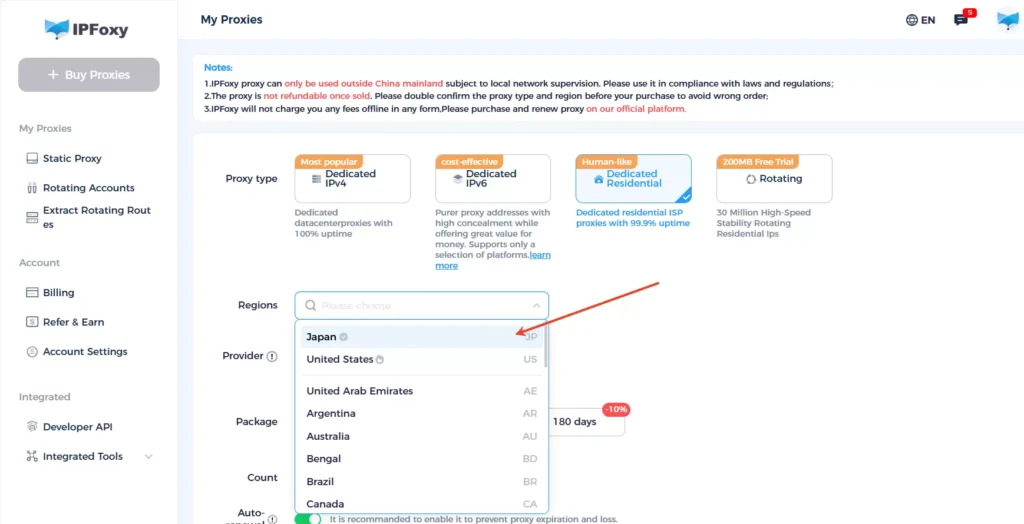
Clean and stable IPs help build long-term trust with platforms. For long-term account operations, residential proxy is the preferred choice, as it uses fixed IP addresses that better simulate real user behavior from a consistent location.
For example, many professional teams use IPFoxy residential proxy, which provides high-quality ISP resources across 200+ regions, ensuring strong stability and minimizing interruptions caused by network issues.
2、Core Strategies and Execution
(1) TikTok
Core Strategies
- In-feed ads: Capture attention within the first 3 seconds and present the product naturally
- Spark ads: Promote native posts (your own or creators’) to retain engagement data and improve authenticity
- Messaging ads: Redirect to Messenger, WhatsApp, or LINE for high-ticket or consultation-heavy products
- TopView ads: Full-screen exposure when opening the app, suitable for large-scale campaigns
- Live commerce: Combine live streaming with ads to boost conversion efficiency
Key Points
- Creative-first approach: Build a continuous content pipeline and remove low-performing assets regularly
- Trust automation: Follow system recommendations and allow at least 48 hours for learning
- Content optimization: Focus on storytelling and emotional triggers, avoid overly promotional tone
(2) Facebook
Core Strategies
- Audience types: Core audiences, lookalike audiences, and retargeting audiences
- Ad structure: Campaign → Ad Set → Ad, ensuring clarity for algorithm learning
- Automation tools: Advantage+ for audience targeting, budget allocation, and placement optimization
Key Points
- Testing and optimization: Apply the 70-20-10 rule (70% proven, 20% testing, 10% innovation); change one variable at a time in A/B testing
- Trust the algorithm: Set clear objectives and avoid frequent major adjustments
- Mobile experience: Ensure fast-loading landing pages (≤3 seconds) and mobile-friendly design
IV. FAQ
If your goal is long-term operation of key ad accounts, choose residential proxy. If you need to create multiple accounts or conduct testing that requires frequent IP changes, rotating residential proxy is more suitable. IPFoxy offers both options.
Not recommended. Multiple accounts sharing the same IP may appear strongly associated. If one account encounters issues, others may be affected. Always follow the principle of one account per isolated environment and IP
Residential proxy is recommended, as it better simulates real user environments and improves overall stability.
Conclusion
TikTok and Facebook differ fundamentally in delivery logic, tools, and use cases. Neither is inherently better—the key is aligning the platform with your product and growth stage. TikTok excels at content-driven rapid growth, while Facebook is stronger in data-driven stable conversion. By understanding these differences and combining the right creatives, structure, and environment, you can achieve sustainable long-term growth.