












As users begin to transition their search habits to direct inquiries within ChatGPT, Perplexity, or other AI tools, the focus of content competition is shifting. In the past, we cared about “ranking in the top few”; now, it is more important whether your content becomes one of the cited sources in an AI response.
This means that content is no longer just for humans to read, but must also be suitable for machines to understand, deconstruct, and restate. The optimization method formed around this goal is known as GEO (Generative Engine Optimization).
The essence of GEO is not to replace SEO, but to solve a new problem: when users no longer click links but view answers directly, do you still exist within the information chain?
I. What is GEO Optimization? Why “Being Cited by AI” is More Important Than Ranking
Traditional SEO aims to rank at the top of search results, while GEO aims to become the “information source” for AI answers.
When users ask questions in AI tools, the system typically:
- Crawls information from multiple websites
- Extracts structured answers
- Selects a few credible sources as citations
This means even if you have a ranking, if the content is not suitable for “extraction,” AI may still completely ignore your website. Therefore, the core of GEO optimization is not “attracting clicks,” but making your content better suited for machine understanding, extraction, and restatement.

II. GEO Optimization Practice: How to Make AI More Likely to Cite Your Content
1.Provide core answers in the opening summary within 60 words
When AI scans content, it first analyzes the beginning. Add a concise “Key Summary” or “TL;DR” section at the very top of the article, using 2-4 bullet points to directly answer potential reader questions.
2.Organize content using a “Question → Answer” format
AI is more likely to cite clear question-and-answer structures rather than long-form narratives. A structure that is easier to cite includes: defining the question, providing a direct answer, and then supplementing with explanations. For example, instead of saying “In actual operation, we found that processing methods in different scenarios vary…”, use: “The core goal of GEO is to make content easier for AI to cite as an authoritative answer. Methods include content structuring, credible source citation, and clear semantic expression.”
3.Make every paragraph “independently understandable”
When AI crawls content, it often does not read the whole piece but instead: splits paragraphs, extracts them individually, and reorganizes answers. Therefore, each paragraph should have a clear theme and independent semantics that do not rely on context to be understood. Ensure your content uses correct HTML header tags (H1, H2, H3, etc.) and avoid “pseudo-headers” that are only bolded via CSS. Avoid heavy use of machine-unfriendly transitions like “as mentioned above” or “next we will discuss.”
4.Enhance the “Sense of Fact” and verifiability
AI prefers citing content with data, definitions, and clear conclusions rather than pure opinions. Statistics show that paragraphs containing specific data are 30-40% more likely to be cited by AI. Add statistics with clear sources, research citations, or case studies to every important point. Using explicit values and objective phrasing increases “credibility signals” and citation probability.
5.Use Q&A and summary modules
Schema markup is a powerful tool most websites overlook. Specifically, Article and FAQ types of Schema can directly label key parts of content for AI systems. Including FAQs (with FAQ Schema), bulleted summaries, and definition paragraphs essentially helps AI pre-process the answers. These modules are highly likely to be cited directly.
6.Avoid “Marketing Language”
AI is unfriendly to strong marketing tones, such as “strongest,” “top-tier,” or “world-leading.” Expressions that are more likely to be cited are neutral, explanatory, and unemotional. GEO is essentially information engineering, not advertising copy.
III. Why You Need to Verify GEO Results Instead of Relying on Intuition
Even after implementing all optimization techniques, a key question remains: is your content consistent in the eyes of AI across different regions? This is where proxy-based GEO verification methods come into play. Many content teams face these issues: content is written and structure is optimized, but they don’t know if AI is citing it. Reasons include:
- AI results vary by region
- Different data sources are called in different access environments
- Results for the same question change over time
Without verification, you can only “guess.” Therefore, GEO needs to form a closed loop: Optimization → Verification → Adjustment.
IV. GEO Verification Methods Based on Proxy
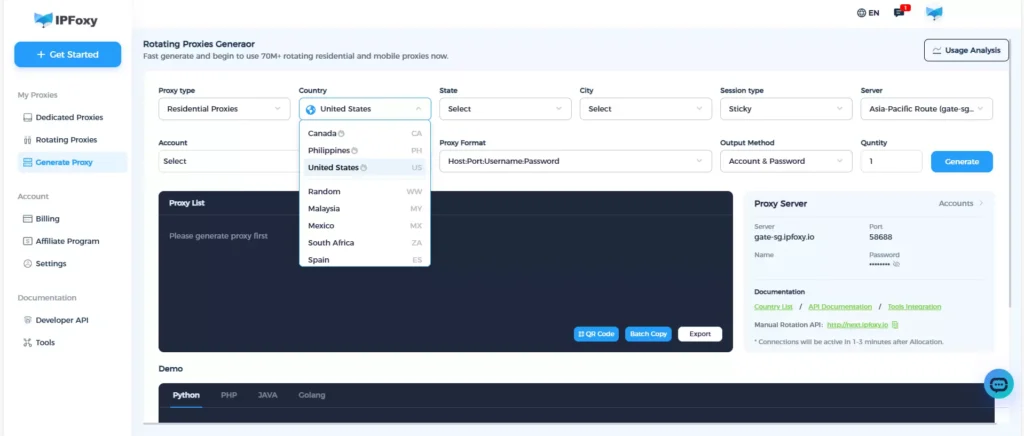
When you need systematic verification, you encounter several practical problems: high query frequency, obvious regional differences, and the risk of triggering restrictions. This is where proxy infrastructure serves as a testing and environment simulation tool. Use professional proxy services (such as IPFoxy’s residential proxies) to set up test nodes in multiple geographic locations and configure the proxy verification environment.
IPFoxy’s residential proxy pool supports 200+ countries and regions, with lines supporting city-level positioning. It is compatible with various verification scripts for periodic rotation or rotation per request to support the execution of verification scripts.
1.Simulate AI access from different regions
You can use proxies from different regions to: access AI search or Q&A tools, enter the same questions, and compare whether citation sources are consistent. Observe whether your website appears, the frequency of appearance, and changes in ranking. This verifies your content’s “regional visibility.”
2.Batch test AI citation sources
When you need to test multiple questions, such as 50 core questions to monitor citation trends, using a single exit point can easily trigger frequency limits, affecting test stability. Through a rotating residential proxy pool infrastructure, you can distribute requests and improve stability to support automated script testing.
3.Build an “AI Citation Monitoring” workflow
A simple verification process can be: periodically submit fixed questions to AI, record returned content, scrape citation sources, statistically track the number of times your website appears, and compare changes over time. This allows you to quantify whether GEO is effective and which content is more likely to be cited.
Conclusion
The goal of GEO is not to make AI remember you, but to make your content look more like the “standard answer.” When your content is closer to the answer itself in terms of structure, expression, and information format, it is more likely to become a citation source for AI.
In this process, content optimization solves “whether it can be cited,” while proxy-based verification solves “whether it is actually cited.” Only when these two links form a closed loop does GEO become more than just a concept—it becomes a continuously iterable content strategy. Truly effective GEO does not end with a single article; it involves continuous data verification to bring content closer to the way AI provides answers.