












In many scenarios such as e-commerce, social media operations, and global business access, people encountering the terms “residential proxy” and “proxy chain” for the first time often confuse them as the same concept.
In reality, they are not the same category: a residential proxy focuses more on the “exit resource,” while a proxy chain focuses on “how traffic reaches that exit.” In practical use, these two concepts often appear together not because they are similar, but because in a complete network solution, “which IP to use” and “how to access that IP” are two problems that must be solved simultaneously. This article systematically breaks down these concepts from the perspectives of principles, differences, relationships, and application scenarios.
I. What Is a Residential Proxy & Proxy Chain
1.Residential Proxy
A residential proxy refers to an IP address assigned from real home broadband networks, typically with the following characteristics:
● Real IP source (assigned by ISP)
● Closer to normal user behavior
● Higher trust level in risk control systems
● Can be divided into: dedicated static residential proxy / rotating residential proxy
In actual network architecture, it acts as the “final exit.” In scenarios requiring high environmental authenticity, residential proxies are more likely to be used as long-term solutions.
2.Proxy Chain
A proxy chain is not a type of IP. It does not provide IP resources but is a method of proxy connection.
It can be understood as: local requests do not directly reach the target exit but go through one or multiple relay nodes before being forwarded by a proxy IP to access the target website. In this process, the proxy chain solves the problem of “traffic path,” not “which IP is used.”
3.Core Comparison Table
The above explains the definitions of residential proxies and proxy chains. More intuitively, their relationship is like “address” and “route.” A residential proxy determines the final visible address, while a proxy chain determines how to reach that address.
| Comparison Dimension | Residential Proxy | Chain Proxy |
| Core Definition | IP Resource Type | Traffic Forwarding Architecture |
| Hierarchy | Egress Layer | Access Layer |
| Function | Provide Access IP | Organize Access Path |
| Provide IP or Not | Yes | No |
| Affect Path or Not | No | Yes |
| Usage Focus | IP Quality, Region | Connection Method, Link |
Because they solve completely different problems, they should not be compared in terms of superiority but understood within the same network architecture.
II. Residential Proxy vs Proxy Chain: Key Differences
1.Different Nature
The essence of a residential proxy lies in providing a relatively stable and authentic exit IP. It focuses on attributes such as source, region, cleanliness, and long-term usability.
A proxy chain, on the other hand, focuses on the connection path—whether traffic goes through relays, whether the link is stable, and whether the overall process is controllable.
2.Different Functional Layers
A stable, long-term, region-consistent residential IP is often more valuable than multiple relay layers. In other words, a residential proxy determines “who you appear to be,” while a proxy chain determines “how you get there.”
● Residential proxy determines the final outward-facing IP
● Proxy chain determines intermediate nodes
In real-world design, instead of comparing which is better, the exit resource is defined first, then whether a proxy chain is needed to optimize access.
3.IP Quality vs Network Path
In practice, many people judge proxies based on speed or accessibility, but fundamentally, a dedicated static residential proxy focuses on IP credibility, while a proxy chain focuses on link quality and path control.
Residential proxy focuses on:
● IP cleanliness
● ISP ownership
● Region authenticity
Proxy chain focuses on:
● Latency
● Stability
● Routing structure
4.Common Misconception
Many beginners assume that “more proxy chain layers = higher security,” but this is inaccurate. A more complex chain does not necessarily increase anonymity or security. In some cases, excessive relay nodes may introduce abnormal patterns and reduce stability. Therefore, equating proxy chains with “enhanced security” is a common misunderstanding.
III. The Relationship Between Residential Proxy and Proxy Chain
Although conceptually different, residential proxies and proxy chains are often used together in practice. The reason is simple: a complete network solution must address both exit and access.
If there is only an exit without a proper access path, local usage may be unstable. Conversely, without a high-quality exit IP, even a well-designed chain structure cannot meet requirements.
Common structures include:
Method 1: Local → Relay → Residential Proxy → Target Website
Suitable for:
● Unstable local network
● Need for unified access entry
Method 2: Anti-detect browser → Proxy Chain → Dedicated Static Residential Proxy
Suitable for:
● Multi-account isolation
● E-commerce / social media matrix
Method 3: Server → Multi-hop Proxy → Residential IP
Suitable for:
● Crawlers / AI automation
● Large-scale request scheduling
Their relationship is complementary, not substitutive. Residential proxies provide stable exits, while proxy chains optimize access paths.

IV. How to Choose in Different Scenarios
1.E-commerce / Multi-account Operations
Key needs:
● Anti-association
● Long-term stability
● Consistent region
Recommendation:
● Use dedicated static residential proxy
● Optionally combine with a simple proxy chain
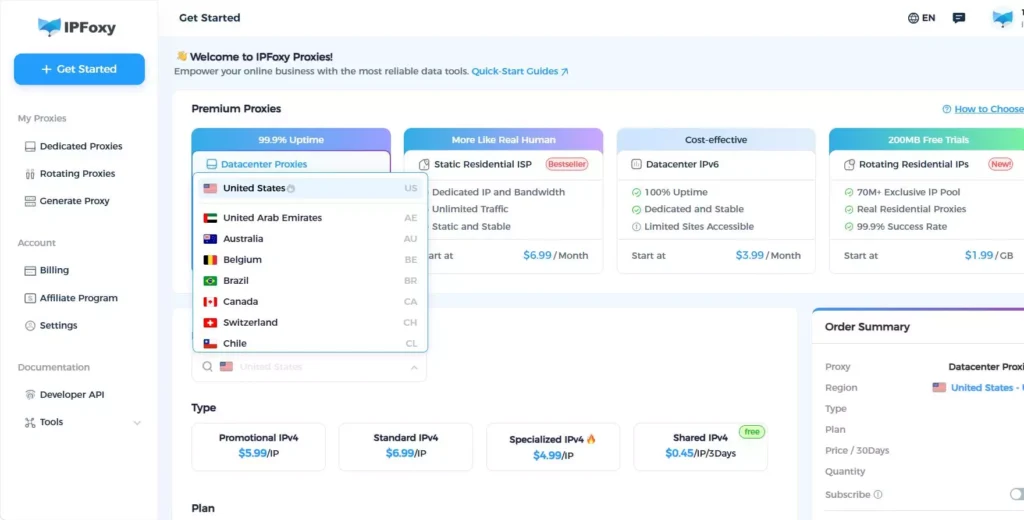
Using solutions like IPFoxy Proxies essentially builds a “fixed exit network,” ideal for long-term account operations.
2.AI Automation / Crawlers
Key needs:
● Concurrency
● IP rotation
● Anti-blocking
Recommendation:
● Rotating residential proxy
● Proxy chain for scheduling
Here, the proxy chain serves as a scheduling layer rather than the core.
3.Social Media Marketing / Advertising
Key needs:
● Environmental authenticity
● Behavioral consistency
● Stable login
Recommendation:
● Dedicated static residential IP + Anti-detect browser
● Optional lightweight proxy chain
V. Key to a Stable Environment
In long-term usage, residential proxies are only one part. Stability depends more on overall consistency, including:
● Whether the IP is fixed
● DNS consistency
● Browser fingerprint
● Login behavior
● Network path changes
This is why mature solutions emphasize the concept of a “fixed exit network.” Choosing a stable proxy like IPFoxy Proxies is just the foundation; it must be combined with a clear access path, stable routing, and a reproducible environment.
VI. FAQ
No. Security depends on IP quality, not chain length.
Not necessarily, but in complex environments, proxy chains can improve access.
Because providers encapsulate the relay logic, and users only see the final entry point.
VII. Conclusion
Residential proxies and proxy chains are often confused because they frequently appear together, but they solve entirely different problems. A residential proxy defines the final exit—“who you are,” while a proxy chain defines the access path—“how you get there.”
Once these layers are clearly understood, evaluating proxy configurations and products becomes more structural rather than superficial. A truly stable and sustainable network environment is not built on a single tool, but on the coordination of exit resources, access paths, and overall environmental consistency.