











When using proxy services, many users encounter the same questions: Proxy types may look similar, but they differ in price, billing method, and applicable scenarios. How do you choose the right one? This article answers the most common questions about IPFoxy proxy types in a Q&A format, helping you quickly determine which proxy fits your business needs.
Q1:What are the differences between IPFoxy proxy types, and how should I choose?
IPFoxy offers multiple proxy types, each differing in IP source, rotation, billing method, and risk-friendliness. Here’s a quick overview:
| Proxy Type | Billing Method | IP Type | Suitable Scenarios |
|---|---|---|---|
Static ISP Proxies |
IP-based billing |
Static Residential IP |
|
Rotating Residential Proxies |
Traffic-based billing |
Rotating Residential IP |
|
Mobile Proxies |
Traffic-based billing |
Rotating Mobile IP |
|
DataCenter Proxies (IPv4) |
IP-based billing |
Static DataCenter IP |
|
DataCenter Proxies (IPv6) |
IP-based billing |
Static DataCenter IP |
|
Concepts:
- Residential Proxy: IPs assigned from real home networks, usually provided by local ISPs. Compared with data center IPs, residential proxies have higher success rates on high-risk websites.
- Native Dual-ISP Proxy: Native IPs come from non-broadcast local ISPs, and Dual-ISP means a server uses two separate lines from different ISPs. Native dual-ISP proxies usually offer more stable and “clean” residential IPs.
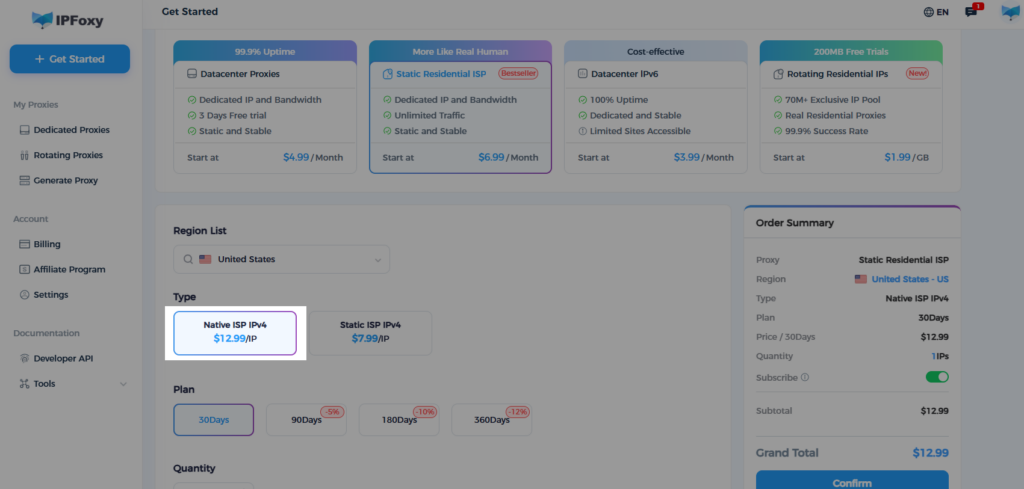
- Data Center Proxy: IPs come from cloud servers or data centers, not real home or mobile networks.
Q2:What are Zones A, B, and C? Do they affect performance?
Zones differ mainly by IP suppliers. Even the same type of data center or residential proxy may vary slightly in IP resource structure, availability, and platform compatibility.
In most cases, performance and usage are the same. Differences may matter if:
- Certain platforms are sensitive to specific IP ranges.
- Your business requires high stability or success rate.
- You need long-term optimization for a target site.
If you have specific goals or notice performance differences, contact IPFoxy support for recommendations to choose the most suitable zone.
Q3:Why do residential proxies vary in price and effectiveness?
Even among residential proxies, differences exist in:
- IP cleanliness, quality, and activity.
- Supplier network structure.
- Historical usage and reputation.
- Coverage area and available quantity.
Success rate and stability can vary, so testing against your target platforms and adjusting based on business feedback is recommended.
Q4:Should I choose IPv4 or IPv6?
IPFoxy provides both as static data center IPs. Main differences:
IPv4:
- High compatibility, works on almost all websites.
- Easy to use with no extra setup.
- Better for businesses that need stability and broad usability.
IPv6:
- Not all websites support IPv6; some platforms may not work.
- More cost-effective.
- Commonly supported platforms: Google, Facebook, YouTube, LinkedIn, etc.
IPFoxy offers a three-day free trial for IPv4/IPv6. If unsure whether your target site supports IPv6, try the trial first.
Q5:Should I choose static or rotating proxies?
Choosing depends on whether your business needs a consistent network identity.
Static Proxy:
- Fixed IP.
- Stable network environment.
- Ideal for long-term logins and continuous operations.
Rotating Proxy:
- IP rotates periodically or per request.
- Single IP usage is short.
- Suitable for high-frequency access or large-scale requests.
For account management, ad campaigns, or social media operations, static proxies are preferred. For data scraping, monitoring, or batch tasks, rotating proxies offer higher success rates and efficiency.
Q6:Can one proxy IP be used by multiple users or devices?
Generally, sharing one IP across multiple devices or accounts is not recommended:
- Concurrent activity from the same IP can trigger platform risk controls.
- Multi-account use increases correlation risk between accounts.
For multi-account or multi-task operations, assign separate IPs or use concurrency-supported proxy solutions.