












As e-commerce competition intensifies, data such as product prices, sales trends, user reviews, and competitor dynamics has become an essential foundation for businesses optimizing operations. However, different data collection goals require different technical approaches. Small-scale research, long-term monitoring, and large-scale data analysis impose distinct demands on tool selection and execution environments.
For example, retrieving your own store data is typically suited for APIs, while gathering competitor product information relies more on web scraping, e-commerce web crawlers, or automation tools. This article explores common e-commerce data scraping methods from an operational perspective and explains how to build a more stable data collection pipeline.
I. 6 Practical Methods for E-Commerce Data Scraping
1. API Data Scraping
If your goal is to collect store products, orders, or inventory data, official APIs are the top choice. Compared to web scraping, APIs eliminate the need to analyze web page structures and directly return data provided by the platform. The returned data is typically standardized and much easier to process later.
API Data Collection Steps:
- Apply for developer access and obtain an API Key or access Token.
- Call endpoints for products, orders, or inventory according to the API documentation.
- Clean the returned data and save it to a database or business system.
Note that APIs usually enforce rate limits on requests, and different platforms expose varying scopes of data. Therefore, before development begins, confirm whether the target platform offers the required endpoints and whether those endpoints fulfill your data needs.
2. Web Scraping Tools
When you need to collect public product data—such as prices, ratings, and reviews—web scraping tools offer a viable route. These tools usually allow visual selection of web page fields without requiring custom software development from scratch.
The standard operational workflow involves: Opening the target product page → Selecting required data fields → Configuring pagination rules → Executing the task and exporting data.
Web scraping tools suit quick, small-scale data collection projects. However, they rely heavily on page layouts. If a platform modifies its page structure, existing scraping rules may break, requiring fields to be reconfigured.
3. Third-Party Data Scraping APIs
These services handle web page parsing and data structuring automatically, allowing users to retrieve organized product data simply by calling an endpoint. Compared to building web crawlers in-house, third-party APIs reduce web page parsing and maintenance overhead, making them ideal for rapidly building market analysis databases.
Workflow:
- Define Data Requirements: Select data types such as products, pricing, or reviews.
- Configure Interface Parameters: Set conditions like keywords, categories, or regions.
- Receive Data: Pipe the results into a database or analytical system.
4. HTTP Web Crawlers
When large volumes of product pages must be scraped, HTTP web crawlers represent the standard approach. They retrieve web page contents by sending network requests and then extract product fields using parsing logic.
A basic Python crawler workflow operates as follows: Request Page → Fetch HTML → Parse Fields → Save Data.
Simple Example:
Python
import requests

url = "https://example.com/product"

headers = {
    "User-Agent": "Mozilla/5.0"
}

response = requests.get(url, headers=headers)

print(response.text[:500])
Once the page is retrieved, BeautifulSoup can extract product information:
Python
from bs4 import BeautifulSoup

soup = BeautifulSoup(response.text, "html.parser")

title = soup.find("h1").text

print(title)
By expanding parsing rules, you can scrape product lists, monitor prices, and analyze competitors.
In production environments, you must focus on handling:
- Page Layout Changes: Update parsing rules regularly to prevent missing fields.
- Access Limits: Control request frequency to minimize access anomalies.
- IP Restrictions: Distribute access sources to enhance task stability.
For long-running crawler tasks, integrating rotating residential proxies allows you to manage the access environment, rotating IPs to mitigate restriction risks caused by high-frequency requests from a single exit point.
5. Browser Automation
Certain e-commerce websites use JavaScript to render product information dynamically. Direct HTTP requests yield only initial HTML skeletons, missing the final rendered content. In such cases, browser automation tools are required.
The browser automation scraping workflow typically follows: Launch Browser → Open Target Page → Perform User Actions → Wait for Page Load → Extract Data.
For example, using Playwright to open a web page:
Python
from playwright.sync_api import sync_playwright

with sync_playwright() as p:
    browser = p.chromium.launch()

    page = browser.new_page()

    page.goto("https://example.com")

    print(page.title())

browser.close()
Unlike HTTP crawlers, browser automation executes clicks, searches, scrolling, and interactive actions. This makes it suitable for dynamic product pages, post-login data, and complex filtering setups. However, because it runs a full browser instance, resource consumption is higher, making it best for scenarios HTTP crawlers cannot process.
6. RPA Automation
RPA (Robotic Process Automation) is primarily used for executing fixed business workflows, such as logging into dashboards, downloading reports, and collating data. It is not a traditional data scraping method, but rather an automated process that mimics human actions.
Common applications include:
- Automatically generating sales reports
- Aggregating data across multiple stores
- Executing repetitive back-office operations
For platforms lacking official API access but possessing stable workflow steps, RPA reduces manual labor.
Comparing E-Commerce Data Scraping Methods Based on Need:
| Data Goal | Recommended Method | Practical Application | Primary Advantage |
| Products, orders, inventory data | API | Store data synchronization | Stable data, highly structured |
| Product pricing, review info | Web Scraping Tools | Competitor analysis, market research | Easy to get started |
| Multi-platform product data | Third-Party APIs | Data integration & analysis | Lowers development costs |
| Large-scale product scraping | HTTP Web Crawlers | Price monitoring, industry analysis | Strong scalability |
| Dynamic web page data | Browser Automation | Post-login data, JS pages | Supports complex interactions |
| Repetitive operational tasks | RPA | Back-office auto operations | Boosts operational efficiency |
II. How to Increase E-Commerce Data Scraping Success Rates?
1. Proxy IP Rotation Strategies
During e-commerce data collection, concentrating large request volumes on a single IP makes it easy for platforms to identify the traffic as abnormal, triggering CAPTCHAs or access bans. Therefore, access strategies must be adjusted relative to scraping scale to minimize single-exit risks.
Common optimization tactics include:
- Use Residential IP Pools: E-commerce platforms evaluate requests based on IP origins and access patterns. Compared to data center IPs, residential IPs closely resemble genuine user network environments. Furthermore, dedicated residential proxies mitigate risk from shared usage, making them ideal for long-term tasks like product scraping and price monitoring.
- Control Request Frequency: Set sensible request intervals to avoid traffic spikes over short periods.
- Distribute Traffic Sources: For high-frequency product scraping and price monitoring, rotating residential proxies enable IP rotation, spreading request origins and reducing restriction risks tied to high-frequency requests on a single IP.
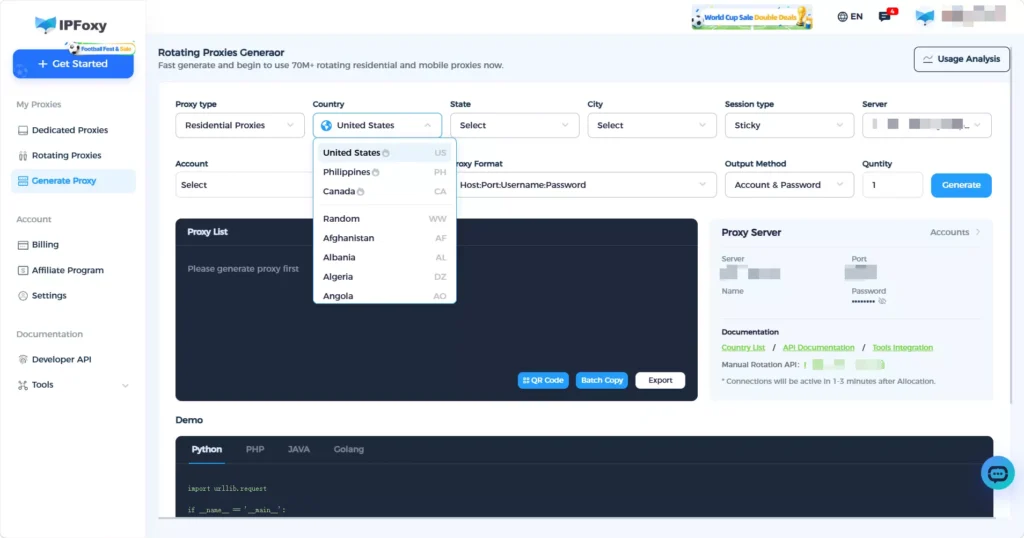
Different collection tasks demand matching proxy types. For instance, the residential proxy pools provided by IPFoxy deliver city-level targeting across 200+ regions, supporting sticky sessions and interval rotation. Integrating them into scraping scripts helps automated tasks accurately capture local data while avoiding task blocks caused by single-IP high-frequency visits.
2. Improve Data Quality & Anomaly Detection
E-commerce data scraping requires not just acquiring data, but ensuring its accuracy and usability. Web layout shifts, broken parsing logic, or network glitches can lead to missing fields or duplicate records.
During the data processing phase, consider adding these checks:
- Verify whether key fields like product price, title, and link are complete.
- Deduplicate identical product records.
- Save failed page instances to streamline troubleshooting.
- Update parsing rules promptly when page layouts change.
Only cleaned, verified data can effectively serve competitor analysis, price monitoring, and market trend forecasting.
3. Optimize Scraping Scripts & Task Scheduling
Long-running data collection pipelines require ongoing script logic optimization to prevent execution halts caused by code inefficiencies or poor task queue management.
Standard optimization measures include:
- Add Exception Handling: Catch network timeouts and page loading failures so the program does not crash completely.
- Implement Task Queues: Schedule tasks based on scraping priorities to maximize resource usage.
- Maintain Execution Logs: Record request statuses, failure reasons, and runtimes to simplify debugging.
By continuously optimizing script structures and workflows, you improve system stability while reducing manual maintenance costs.
4. Continuously Adapt to E-Commerce Platform Changes
E-commerce platforms regularly adjust page structures, API policies, and anti-scraping defenses, requiring scraping systems to undergo routine maintenance. For long-term runs, monitor changes in page elements, API endpoints, failure rates, and newly introduced verification mechanisms.
Stable e-commerce data scraping is not a one-time setup; it requires continuous adjustments to scraping rules, network access strategies, and data processing routines as target platforms evolve.

III. FAQ
Rotating residential proxies distribute request origins through automated IP rotation. They suit high-frequency product scraping, price monitoring, and tasks demanding massive request volumes, lowering the risk of restrictions triggered by intense access on a single IP.
Data errors usually stem from page structure updates, broken parsing rules, or network anomalies. Implementing data cleaning, anomaly detection, and periodic rule updates significantly boosts data accuracy.
Small-scale research can rely on visual web scraping tools, whereas large-scale, multi-platform projects typically demand a combination of APIs, crawlers, or automation frameworks. Teams should select the approach that fits their data volume and technical capabilities.
Simple data collection can be accomplished using no-code web scraping tools. Building automated, custom scraping systems generally requires knowledge of Python, HTTP requests, web parsing, and database management. For complex dynamic pages, familiarity with browser automation tools is also necessary.
IV. Conclusion
There is no single silver bullet for e-commerce data scraping; tools must be chosen based on data goals, collection scale, and target platform environments. APIs fit business data syncs, web scraping tools suit rapid research, crawlers handle batch scraping, and automation tools tackle complex dynamic pages. Long-running projects must also prioritize network stability, data quality, and platform adaptability to optimize scraping pipelines continuously.