












As AI technology continuously integrates into marketing, WhatsApp is steadily evolving from a simple instant messaging tool into an intelligent marketing platform that unifies customer inquiries, product recommendations, order tracking, and after-sales service.
For e-commerce, brand strategy, and customer acquisition teams, the opening of Meta Business AI signifies a fundamental shift in how WhatsApp operations function. AI is no longer just a basic automated reply utility; it is actively participating in the entire customer management workflow, helping enterprises elevate customer service efficiency, optimize marketing conversions, and reduce manual operational costs.
Concurrently, an increasing number of enterprises are adopting a WhatsApp multi-account operational model, establishing independent account frameworks tailored to different countries, brands, or business lines. This article explores the application value, integration processes, operational practices, and multi-account management of Meta Business AI to help enterprises swiftly execute an AI marketing upgrade.
I. New WhatsApp Trends: What Changes Does Meta AI Marketing Bring?
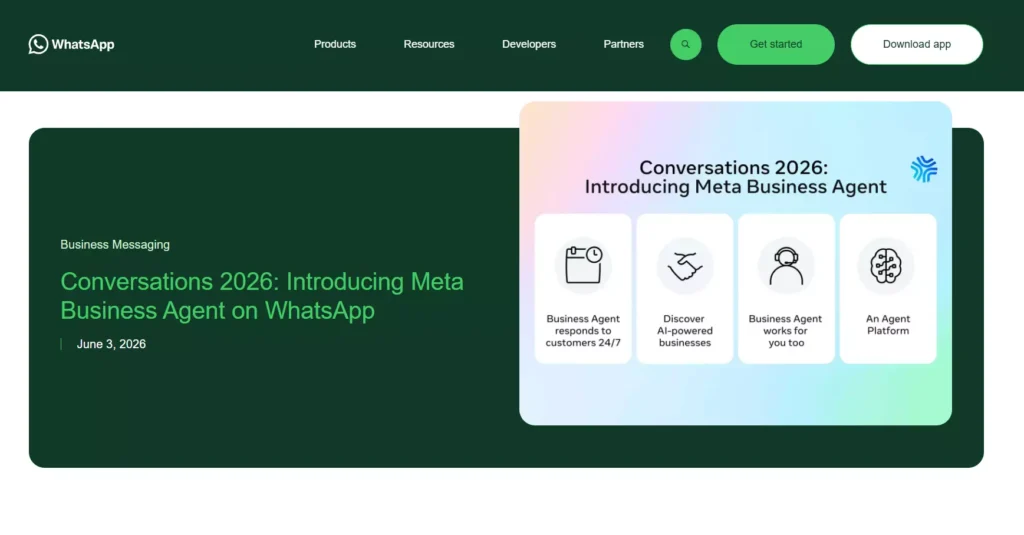
In June 2026, Meta Business AI became fully open, progressively integrating into core marketing platforms such as WhatsApp and Instagram. This transformation has accelerated WhatsApp’s evolution from a traditional messaging tool into an AI-driven customer management platform.
Compared to previous iterations, Meta Business AI can combine an enterprise’s product catalog, knowledge base, FAQ materials, and operational guidelines to accurately comprehend user intents and generate more natural, coherent dialogue. This upgrades the platform from a single communication utility into a full-link customer operational gateway covering pre-sales consultation, product recommendation, order tracking, and after-sales service.
Primary transformations:
Automated handling of customer inquiries: Fulfills 7×24 hour responsiveness, reducing manual wait times.
- More complete marketing workflows: AI participates in everything from product recommendations and order tracking to after-sales service, boosting customer conversion efficiency.
- Support for differentiated multi-account operations: Different countries, brands, or business teams can configure independent knowledge bases and reply tactics, aligning closely with localized operational needs.
However, AI capabilities do not manifest automatically. The ultimate operational performance is dictated not by the model itself, but by whether the enterprise has executed rational configurations and continuously optimized its knowledge base and operational workflows.
II. WhatsApp Multi-Account Operations: How to Integrate Meta AI?
Meta Business AI cannot be used directly simply by enabling the feature; its practical efficacy relies heavily on account permissions, knowledge base construction, and operational strategy configurations. Only by completing this foundational work can the AI output highly accurate content that aligns with brand positioning, providing robust support for subsequent marketing.
1、Verify Account Support for Meta Business AI
Enterprises must utilize WhatsApp Business and complete Meta Business enterprise verification. Because AI features are rolling out progressively, support status may vary across different regions and enterprise accounts. It is recommended to confirm whether your account has secured the relevant permissions beforehand.
Generally, the following criteria must be met:
- Utilize a WhatsApp Business enterprise account.
- Connect to the Meta Business backend and complete enterprise verification (the specific rollout scope may vary by region and account status).
- Possess explicit permissions for Meta Business AI or related AI features.
For enterprises running multiple WhatsApp Business accounts concurrently, it is recommended to manage different accounts uniformly within the Meta Business backend, facilitating subsequent configurations of AI capabilities and operational tactics.
2、Complete Foundational Configurations for Meta Business AI
The quality of AI responses depends heavily on the data provided by the enterprise rather than the underlying model itself. Therefore, prior to official deployment, prioritizing the refinement of foundational data assets is essential.
Key areas to complete:
- Enterprise introduction and brand information
- Product catalog (Catalog)
- Frequently asked questions (FAQ)
- Shipping, return, and exchange policies
- Contact information and business hours
This content serves as the vital reference data for Meta Business AI when responding to customer inquiries. If foundational data remains incomplete, the AI may fail to deliver accurate replies even if it comprehends the user’s question.
3、Train Meta Business AI to Match Brand Styles
Beyond basic documentation, the AI must learn the brand’s unique communication style. Customer communication habits vary distinctly across different countries and regions. Typically, for enterprises managing multi-account setups, different accounts are configured with different knowledge bases. For instance, the US market emphasizes rapid responsiveness, the European market focuses more heavily on after-sales specifications, and the Southeast Asian market may prioritize promotional activities and logistics updates.
Key elements to train:
- Response tone (professional, approachable, or youthful styling)
- Product selling points and brand value propositions
- Common marketing phrasing and scripts
- Linguistic and idiomatic habits of different countries or regions
Simply put, configuring distinct knowledge bases and response styles for different markets ensures that the AI outputs content aligning with local user habits, thereby elevating the customer experience.
III. WhatsApp Multi-Account Operations: Practical Guide to Boosting Marketing Efficiency with Meta AI
1、Automating High-Frequency Inquiries
In global marketing, a massive volume of customer inquiries concentrates on repetitive topics like inventory, logistics, payment methods, and after-sales policies. Although vast in quantity, these inquiries rarely require human evaluation. Relying entirely on manual customer service slows response speeds and escalates team operational costs.
Primary benefits:
- Delivers 7×24 hour online consultation services, minimizing customer wait times.
- Maintains uniform response criteria, boosting the service experience.
- Eliminates repetitive tasks for customer service agents, allowing the team to focus on complex inquiries and high-value clients.
Entrusting these standardized inquiries to Meta Business AI shortens response intervals and allows human customer service to focus on complex consults and high-value clients, increasing overall operational efficiency.
2、Leveraging AI for “Cart Abandonment Recovery” to Optimize Order Conversions
Many customers browse products or make inquiries without completing a purchase immediately, yet these users typically exhibit high purchase intent. Re-engaging them at the right moment frequently yields excellent conversion performance.
Automated marketing actions triggered by customer behavior:
- Product inventory modification notifications
- Coupon distributions and limited-time activity promotions
- Similar product or bundle matching recommendations
- Incomplete order reminders
Compared to traditional bulk broadcasting, AI combines customer consultation history and browsing footprints to generate highly personalized content, increasing the relevance of marketing messages and making it easier to elicit customer responses.
3、Utilizing AI for Continuous Customer Management to Drive Retention
For enterprises, an initial transaction is not the finish line of marketing, but the starting point of customer relationship management. Continuously nurturing existing customers boosts repeat purchase rates and strengthens brand loyalty.
Meta Business AI can help enterprises automate various daily operational tasks, including:
- Logistics notifications and order status updates
- After-sales follow-ups and satisfaction surveys
- Holiday greetings and promotional event updates
- New product recommendations and member perk reminders
Through consistent interaction, enterprises can maintain long-term connections with customers while minimizing manual operational costs, unlocking more opportunities for subsequent marketing.
4、A Consolidated Matrix of AI and Human Collaborative Operations
| Operational Phase | Meta Business AI | Human |
| Common Queries | Automated replies | – |
| Product Recommendations | Recommends based on demand | Assists in closing deals |
| Order Inquiries | Automated lookups | – |
| After-Sales Complaints | Assists in processing | Human communication |
| VIP Customer Management | Provides data support | Deep relationship operations |
| Business Cooperation | Information collection | Human negotiation |
In summary, AI is highly suited for handling standardized, high-frequency tasks, while humans manage complex communications, brand building, and relationship maintenance. Only through their synergy can WhatsApp marketing efficiency truly be elevated.
IV. 3 Critical Questions for WhatsApp Multi-Account Operations
As enterprises expand their market footprints, operating multiple WhatsApp Business accounts simultaneously has become a standard approach for operational teams. Multi-account setups enable precise operations tailored to different countries, brands, or business scenarios, but managing a larger volume of accounts increases operational complexity.
1、Standardize Operational Behaviors to Avoid Platform Risk Controls
WhatsApp evaluates whether an account exhibits anomalies across multiple dimensions, including message frequency, login behaviors, device switching, and interaction patterns. If multiple accounts execute bulk registrations, send highly concentrated marketing messages, or frequently alternate devices and login environments within a short timeframe, the system easily flags these as non-natural behaviors, triggering risk controls.
Design operational rhythms based on emulating authentic user behavior during practical operations:
- Regulate daily message deployment frequencies to avoid explosive, concentrated touchpoints.
- Maintain independent operational rhythms for different accounts instead of executing unified bulk actions.
- Avoid alternating devices or login environments frequently within short periods.
- Confine automated marketing to a rational ratio, preserving organic interactive behaviors.
- Over the long term, platforms favor stable, natural account behaviors over high-intensity, short-term marketing thrusts.
2、Isolate Authentic Account Environments to Minimize Association Risks
In WhatsApp multi-account operations, if multiple accounts run within similar or identical network environments over long periods, or frequently jump between proxy IPs of different geographical locations, the system is highly likely to categorize them as bulk operations, undermining account stability.
Therefore, during practical operations, besides utilizing authentic, clean IPs to log into accounts, multi-account operators must implement an environment-per-account isolation workflow. This ensures each account possesses an independent and long-term stable network identity, minimizing association and risk control vulnerabilities from the ground up.
Professional teams typically choose professional proxy service providers like IPFoxy to secure exclusive dedicated static residential proxies, providing independent, authentic, and long-term stable networks for different WhatsApp accounts, reducing account suspensions caused by IP anomalies.
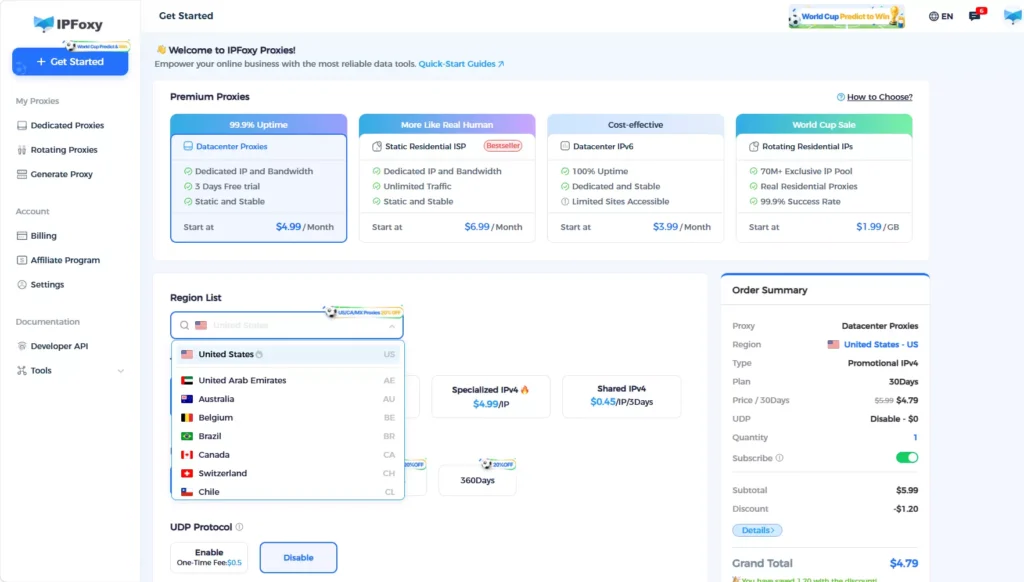
Concurrently, it is vital to note that the network environment is merely one component of an account isolation framework. To maximize stability, it must be paired with independent browser setups, fixed device login guidelines, and standardized operational procedures. Together, these elements form a complete account isolation architecture, rather than relying solely on the proxy layer to resolve all risk control issues.
3、Continuously Optimize AI Marketing Strategies to Realize Sustained Growth
Compared to account-level stability, the value of Meta Business AI leans toward continuously elevating operational efficiency. However, the prerequisite is that it must be maintained continuously, rather than being deployed once and left static over the long term.
In actual operations, AI performance varies continuously based on the quality of data inputs, the update frequency of the knowledge base, and shifting marketing strategies. Without ongoing optimization, the AI can easily drift away from operational requirements, leading to inconsistent responses or declining marketing returns.
Enterprises must establish a continuous optimization mechanism:
- Periodically refresh product details, FAQ materials, and after-sales policies to ensure data timeliness.
- Refine AI response logic and phrasing based on authentic customer conversation logs.
- Identify high-frequency inquiry topics to inversely optimize product pages and conversion paths.
- Adjust prompts and marketing strategies continuously based on conversion rate and repeat purchase metrics.
Over the long term, Meta Business AI functions as a continuously iterable operational system rather than a static utility. Only by integrating data analysis, content maintenance, and marketing strategies can AI truly become the growth engine of WhatsApp multi-account operations.
V. FAQ
It is primarily utilized to enhance customer communication and conversion efficiency. It can automatically handle customer inquiries based on an enterprise knowledge base and participate in phases like product recommendations, order tracking, and after-sales service. Compared to traditional keyword bots, Meta AI comprehends user intents and generates more natural dialogue, upgrading WhatsApp from a single communication tool into a complete customer management platform.
Enterprises must satisfy foundational WhatsApp Business usage requirements and complete Meta Business enterprise verification, while the accounts must possess permissions for Meta AI or related features. Rollout schedules vary by region; therefore, it is recommended that enterprises confirm their AI eligibility prior to deployment and manage multiple accounts uniformly within the Meta Business backend to facilitate subsequent knowledge base and strategy configurations.
Account association risks typically stem from a comprehensive evaluation across multiple dimensions, including IP address consistency, device fingerprints, login behaviors, and network environment shifts. If multiple accounts share identical network attributes over long periods or switch between different regional proxy configurations frequently, the system easily flags them as bulk operations, hindering account stability. Therefore, multi-account operations require simultaneous focus on behavioral standards and network environment isolation.
For enterprises engaged in long-term, multi-account, cross-regional operations, an independent proxy IP is a critical foundation for minimizing account association risks. Configuring a stable, independent network environment for each account significantly reduces the probability of risk control flags caused by network consistency. In practical operations, many teams utilize a dedicated static residential proxy or a static residential ISP proxy to provide long-term stable localized network environments for different accounts, thereby elevating overall account security and operational stability.
VI. Conclusion
As Meta Business AI embeds deeper into WhatsApp Business, enterprises are transitioning from traditional customer service models toward an AI-driven multi-account operational matrix. AI not only optimizes communication efficiency but has also begun participating in the full-process operations of customer inquiry, conversion, and retention.
However, during practical implementation, the performance of AI hinges on three core variables: knowledge base quality, operational strategies, and the stability of the account environment. Especially in WhatsApp multi-account operational scenarios, if standardized behavior management and independent network environments are absent, even the most complete AI capabilities cannot guarantee long-term stable operations.
Consequently, while deploying Meta Business AI, enterprises must establish a standardized operational framework combined with independent account environments to eliminate association risks from the infrastructure layer. Concurrently, by continuously optimizing knowledge bases and marketing strategies, AI can consistently deliver value across diverse markets.