











Proxy have become a vital infrastructure for global e-commerce, social media marketing, brand monitoring, AI automation, and data acquisition. However, when selecting a proxy service, many users frequently focus only on IP types such as residential proxies or ISP proxies, while overlooking another equally critical variable that impacts operational results—the proxy protocol.
In reality, even when using the identical set of proxy, HTTP proxies and SOCKS5 proxies can produce distinct variances in request success rates, connection efficiency, compatibility, and applicable scenarios due to their differing protocol mechanisms. Especially in complex operations involving AI scrapers, automation scripts, and multi-account matrices, the choice of protocol can directly dictate the execution performance of the entire project.
So, what exactly is the distinction between HTTP and SOCKS5? How should different operations choose the appropriate proxy protocol? This article analyzes these questions across three dimensions—underlying working principles, typical application scenarios, and practical deployment experiences—to help you select the proxy solution best suited to your operational requirements.
I. Why Do Proxy Protocols Affect Proxy Performance?
Many users encounter this question: why is it that when using the identical batch of residential proxy, browser access to webpages remains completely stable, yet automation tools experience frequent connection failures? Or why does the same AI scraper project encounter request anomalies under an HTTP proxy but return to normal after switching to SOCKS5?
The root cause of these phenomena is not the proxy IP itself, but rather the proxy protocol, which dictates the communication method between the client and the proxy server. Different protocols alter data forwarding mechanisms, supported network protocols, and compatibility capacities, leading to variances in final operational outcomes.
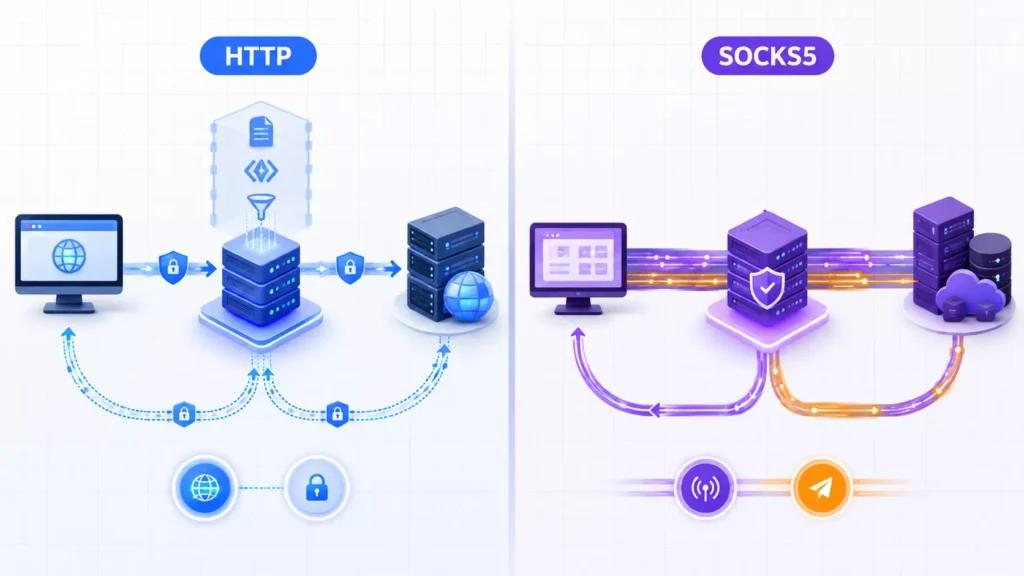
From the perspective of network architecture, the primary distinction between the two protocols lies in their operational layer:
- HTTP proxies operate at the application layer: They are primarily responsible for handling HTTP and HTTPS requests, and are specifically optimized for browser access, webpage scraping, and API calls.
- SOCKS5 proxies operate at the session layer: They do not parse specific application protocols; instead, they establish TCP or UDP data channels, allowing them to support a broader range of client types and network connections.
Simply put, HTTP proxies are superior at managing webpage communications, while SOCKS5 proxies excel at handling complex network connections.
Core Differences Between HTTP Proxies and SOCKS5 Proxies:
| Comparison Dimension | HTTP Proxy | SOCKS5 Proxy |
| Operational Layer | Application layer | Session layer |
| Supported Protocols | HTTP, HTTPS | Multiple protocols including TCP and UDP |
| Parses Requests | Yes | No, handles forwarding only |
| Browser Compatibility | Excellent | Very Good |
| Automation Tools | Average | Excellent |
| UDP Support | No | Yes |
| Multi-Account Operations | Good | Superior |
| AI Automation | Supports Web requests | Better suited for complex tasks |
Taken together, each proxy protocol possesses its own advantages, and there is no absolute superiority:
- HTTP proxies are better suited for standard Web communications: When operations primarily revolve around webpage access, API calls, and webpage data acquisition, an HTTP proxy can directly process HTTP requests, offering simpler deployment and compatibility with the browser ecosystem.
- SOCKS5 proxies are better suited for complex network environments: When operations involve desktop clients, multi-protocol communications, persistent connections, or automated software, SOCKS5 typically delivers higher compatibility and stability.
- Proxy protocols do not alter the quality of the proxy IP: High-quality residential proxies remain the core variable dictating anonymity and stability, while the protocol primarily affects data transmission methods and applicability scope.
II. How to Choose Between an HTTP Proxy and a SOCKS5 Proxy?
When selecting a proxy protocol, you should not merely compare the protocols themselves; instead, you must evaluate them in combination with your specific operational scenarios. Different operations utilize different network protocols, and their requirements for proxy protocols vary distinctly. For enterprises with global operations, webpage acquisition, multi-account management, AI automation, and data monitoring often correspond to different optimal proxy solutions.
1、Webpage Data Acquisition
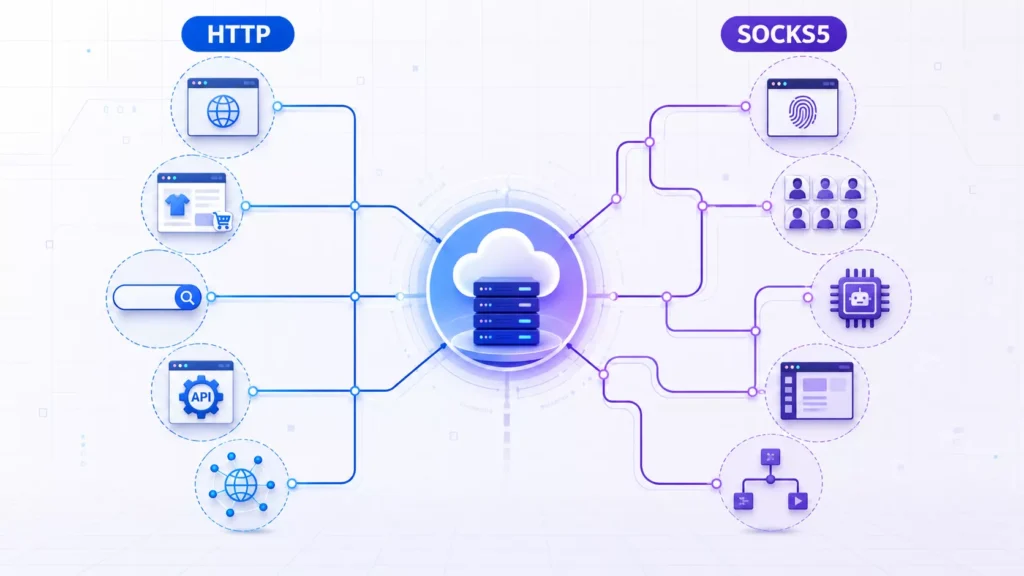
Whether conducting product data harvesting, price monitoring, or SEO data analysis, most web scraping fundamentally consists of HTTP or HTTPS requests. Therefore, HTTP proxies possess an inherent advantage for webpage access, as they can directly process request headers, cookies, caches, and the HTTPS establishment process.
For instance, when executing product data acquisition on platforms like Amazon, Shopify, or Shopee, the majority of requests belong to standard Web requests, where HTTP proxies often deliver a more stable access experience.
This advantage manifests primarily in the following aspects:
- Higher browser compatibility: Chrome, Firefox, and mainstream browser automation frameworks natively support HTTP proxies, lowering deployment costs.
- More convenient HTTP request management: Request headers, cookies, redirects, and caches can be configured flexibly, making it easier to emulate authentic user access behaviors.
- Applicable to the vast majority of web scraping projects: This includes standard operational scenarios such as product data harvesting, news scraping, SEO data analysis, and API calls.
- Simpler request paths: For operations involving only webpage access, there is no need to introduce additional protocol conversions, which helps improve overall request efficiency.
2、Account Operations on High-Risk Control Platforms
In recent years, major digital platforms have continuously upgraded their risk control strategies. Relying solely on independent IPs is no longer sufficient to meet account isolation requirements. Consistency across browser environments, proxy protocols, and network behaviors also heavily impacts account stability.
Because SOCKS5 proxies operate at a lower network layer, they are compatible with browsers, desktop clients, anti-detect browsers, and various automation utilities, offering higher flexibility in multi-account operations. For running multiple accounts on platforms like Facebook, TikTok, Instagram, and X, SOCKS5 is often the more common deployment setup.
This manifests primarily in the following aspects:
- Support for more client programs: It can be applied not only to browsers but also to desktop software, social media clients, and automated operational tools.
- Compatibility with more network protocols: When operations involve non-HTTP communications, SOCKS5 makes it easier to maintain a stable connection.
- Suitability for prolonged online operations: It better satisfies persistent connection requirements for ad account management, social media matrix operations, and automated clients.
- Easier integration with anti-detect browsers: Within independent browser environments, SOCKS5 proxies help establish a more complete network isolation setup.
3、Automation Tools and AI Scrapers
With the growing adoption of AI agents, RPA, and browser automation technologies, a complete automated workflow rarely performs webpage access alone; it often requires simultaneous connections to browsers, APIs, databases, and third-party services.
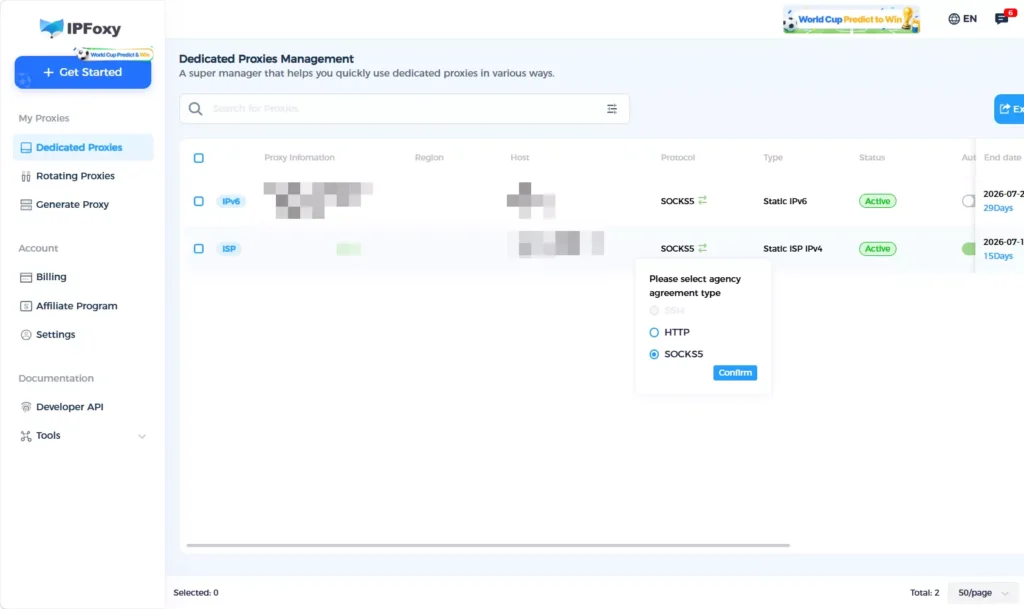
For example, an AI product monitoring system might execute webpage scraping, AI content analysis, interface calls, and data storage concurrently, with different modules utilizing different communication methods. Consequently, an increasing number of enterprises are adopting proxy solutions that support dual protocols, dynamically switching the proxy protocol based on the specific task.
Dual-protocol deployment delivers the following advantages:
- Webpage acquisition utilizes HTTP proxies: This maintains browser access efficiency and improves compatibility for standard Web requests.
- Automation programs utilize SOCKS5 proxies: This satisfies the network connection requirements of desktop applications, AI agents, and complex clients.
- Eliminates repetitive proxy resource procurement: A single proxy account can fulfill multiple operational needs, maximizing resource utilization.
- Easier scaling of AI workflows: When new automated modules are added to operations, the proxy protocol can be switched directly without redeploying the proxy network.
Therefore, for operations that simultaneously involve webpage acquisition and AI agents, supporting dual protocols has become a vital capability for proxy services.
Selecting Proxy Protocols Across Different Operational Scenarios:
| Operational Scenario | Recommended Protocol | Reason for Recommendation |
| Product Data Acquisition | HTTP Proxy | Standard Web requests, simple deployment |
| API Calls | HTTP Proxy | More convenient request management |
| Browser Automation | HTTP Proxy | High compatibility with frameworks like Selenium and Playwright |
| Social Media Multi-Accounts | SOCKS5 Proxy | Better suited for complex network connections |
| Anti-Detect Browsers | SOCKS5 Proxy | Superior environmental isolation effects |
| AI Agents | SOCKS5 Proxy | Supports a wider range of communication protocols |
| AI Web Scraping | HTTP + SOCKS5 | Flexible switching based on specific modules |
| Enterprise Global Operations | Dual-Protocol Support | Fulfills long-term operational expansion needs |
From the perspective of enterprise deployment trends, dual-protocol support has steadily become a vital capability for proxy services. Particularly in the context of global operations moving continuously toward automation, the capacity to flexibly switch proxy protocols will help enhance overall operational efficiency.
III. Proxy Protocol Selection Guide: 3 Practical Principles
After understanding the applicable scenarios for HTTP proxies and SOCKS5 proxies, you must also comprehensively evaluate the collaborative relationship between proxy protocols, proxy IPs, and the operational environment during actual deployment. Only by combining these three elements rationally can you balance stability, compatibility, and subsequent expansion capabilities.
1、Proxy Protocols Must Coordinate and Match with Operational Scenarios
There is no absolute superiority between HTTP proxies and SOCKS5 proxies; instead, each is optimized for different network communication methods. Therefore, protocol selection should be built upon operational requirements, rather than blindly chasing a protocol simply because it offers more functions or broader compatibility.
During actual deployment, you can follow this approach:
- Operations centered on Web requests: For webpage data acquisition and API calls, prioritize HTTP proxies to enhance compatibility with standard Web requests.
- Operations involving desktop applications, AI agents, or multi-account management: Select SOCKS5 proxies to better adapt to complex network communication environments.
- Hybrid operations: Choose a proxy service that supports dual HTTP and SOCKS5 protocols, enabling you to switch the proxy protocol flexibly based on different tasks.
2、Proxy Protocols, Proxy, and Tool Environments Require Coordinated Configuration
The proxy protocol is merely one part of the proxy network. Even if you select the appropriate protocol, an irrational configuration of proxy IPs or the running environment can still impair operational stability.
When deploying, it is recommended to focus heavily on:
- Selecting high-quality proxy: Utilizing authentic network environments like residential proxies or ISP proxies generally improves access stability more effectively than simply changing the proxy protocol.
- Verifying tool compatibility: Browsers, automation frameworks, AI tools, and anti-detect browsers may vary in their support levels for HTTP and SOCKS5.
- Maintaining proxy environment consistency: Browser fingerprints, proxy protocols, IP addresses, and account environments should be configured collaboratively to minimize anomalous access signatures.
- Conducting tests before deployment: Verify connection success rates, response speeds, and compatibility first before gradually expanding operational scale.
3、Balancing Current Operational Needs with Subsequent Expansion Capabilities
As web scraping, AI automation, and browser automation operations continue to evolve, an enterprise’s proxy requirements will alter continuously. If a proxy service supports only a single protocol, introducing new operations later may necessitate restructuring the proxy architecture, thereby increasing deployment costs.
Therefore, when choosing a proxy service, besides focusing on IP resources and node coverage, you must also evaluate the service’s expansion capabilities.
- Support for dual HTTP and SOCKS5 protocols: Fulfills distinct operational requirements across webpage acquisition, automation tools, and AI workflows.
- Compatibility with mainstream development tools: Adapts to browser automation frameworks, AI utilities, and anti-detect browsers, reducing repetitive configurations.
- Unified management of proxy resources: The identical batch of proxy IPs can switch proxy protocols flexibly based on different operations, maximizing resource utilization.
- Support for long-term operational expansion: As automated projects grow, there is no need to re-procure proxy resources or adjust the overall proxy architecture.
For teams engaged in long-term global operations, preference is typically given to professional residential proxy services like IPFoxy that support dual protocols. These services are compatible with mainstream automation frameworks, AI tools, and anti-detect browsers, helping enterprises flexibly configure their proxy environments across diverse operational scenarios to support automated projects and large-scale deployments more efficiently.
IV. FAQ
The proxy protocol itself does not directly dictate speed. Ultimate performance is primarily influenced by factors such as proxy IP quality, network environments, target servers, and node locations. For standard Web requests, HTTP proxies typically offer better efficiency; for complex network connections, the compatibility and stability of SOCKS5 proxies provide a clear advantage.
If your operations primarily involve webpage scraping, API calls, and browser automation, an HTTP proxy is the more common selection. If desktop applications, AI tools, or complex automated tasks are involved, it is recommended to prioritize a SOCKS5 proxy.
No. HTTP proxies are specifically optimized for Web requests and retain distinct advantages in browser compatibility, request management, and deployment efficiency. The two protocols should be paired rationally according to operational needs.
As web scraping, AI automation, and multi-account operations progressively converge, a single project often needs to manage multiple types of network communication concurrently. Supporting dual HTTP and SOCKS5 protocols allows teams to switch proxy methods flexibly based on different tasks, improving compatibility while lowering overall operational and maintenance costs.
V. Conclusion
There is no absolute superiority between HTTP proxies and SOCKS5 proxies; the key lies in whether they match the operational scenario. HTTP proxies are better suited for standard Web requests such as webpage data acquisition and API calls, whereas SOCKS5 proxies are more appropriate for complex network environments like multi-account operations and automation tools. As global operations evolve continuously toward automation and intelligence, proxy solutions supporting dual protocols are becoming the choice of an increasing number of enterprises.
In practical deployment, besides selecting the appropriate proxy protocol, you should comprehensively evaluate proxy IP quality, tool compatibility, and operational expansion needs. Only by coordinating the configuration of the proxy protocol, proxy IP, and running environment can you elevate network stability, access efficiency, and overall operational performance, providing more reliable network support for the long-term development of global operations.