












Ecommerce sellers entering the Southeast Asia market often face a key decision between Shopee and Lazada. The two platforms differ in traffic distribution, user base, entry requirements, and cost structure. Understanding these differences is the first step to acquiring customers effectively.
With changes in the Southeast Asia ecommerce landscape in 2026, the rapid rise of TikTok Shop is also reshaping the market. Sellers now need not only to choose the right platform, but also combine localization strategies, campaign timing, and a stable network environment to maximize traffic and optimize costs.
I. What’s New in Southeast Asia Ecommerce in 2026
In 2026, the Southeast Asia ecommerce market is still growing, but the competitive landscape is shifting, with noticeable changes in traffic allocation and customer acquisition methods.
Shopee still holds the largest market share, but its growth has slowed. Increased competition and higher platform commissions have further compressed profit margins for low-price strategies. In contrast, Lazada is more suitable for long-term operations, but also comes with higher entry requirements and stricter standards.
The biggest shift comes from the rapid growth of TikTok Shop. By combining short-form video and livestreaming, TikTok has shortened the user decision-making process by connecting content discovery directly with instant purchases.
Overall, competition has evolved from platform-based competition to a model shift between search-driven ecommerce and content-driven ecommerce. Sellers must now develop both keyword-based traffic strategies and content-driven acquisition capabilities.
II. Shopee vs Lazada: Which Platform Should You Choose
For sellers entering Southeast Asia, understanding the differences between Shopee and Lazada is essential for building the right strategy.
1. Platform positioning and growth direction
- Shopee: A traffic-driven platform focused on scale and user activity, suitable for rapid customer acquisition
- Lazada: A brand-driven platform focused on quality and user experience, better for refined and long-term operations
2. Traffic structure and acquisition methods
- Shopee traffic: Primarily driven by keyword search, allowing fast traffic growth through product listings and SEO optimization
- Lazada traffic: Driven by platform recommendations and content distribution, relying more on product quality and store ratings
3. User behavior and purchasing patterns
- Shopee users: Price-sensitive, highly responsive to promotions, and more likely to make impulse purchases
- Lazada users: Focus on product quality and brand, with higher average order value and stronger repeat purchase behavior
4. Entry requirements and platform rules
- Shopee: Lower entry barriers, faster approval, suitable for beginners
- Lazada: Stricter requirements, higher standards for business qualifications and service quality
5. Cost structure and profit margins
Shopee cost structure:
- Commission ranges from approximately 2%–6.5% depending on category
- Additional fees include around 2% payment processing and 1%–5% service/technical fees
- New stores may enjoy commission-free periods, but promotions and price competition reduce margins
Lazada cost structure:
- Commission starts around 5%–6.5%
- Additional costs include 2%+ payment fees and VAT in some markets
- Higher costs but more stable structure, with higher order values and more controllable profit margins
III. Shopee vs Lazada: Practical Operation Strategies
In 2026, rising traffic costs mean sellers must shift from blind product testing to algorithm-driven operations.
1. Deep SEO optimization
Search traffic remains the most stable source of orders. A recommended structure is “core keywords + functional attributes + localized long-tail keywords.”
- Shopee: Update keyword lists weekly based on trending search data from the Seller Center
- Lazada: Complete all optional attributes and use AI tools to optimize multilingual titles for better long-tail exposure
2. Visual marketing and conversion optimization
Static images are no longer enough. Visual experience directly impacts conversion rates.
- Shopee: Focus on promotional atmosphere using short videos and livestreams, combined with labels like “limited-time deals” to drive impulse buying
- Lazada: Focus on brand presentation using AI-generated 3D models and AR features. High-quality product pages, especially in LazMall, significantly increase engagement and perceived value
3. Marketing tools and traffic conversion
Leverage platform tools to build a full funnel from acquisition to repeat purchases.
- Shopee: Use flash sales as a core driver, combined with bundle discounts and add-on deals to increase order value and maintain activity
- Lazada: Focus on full-channel marketing. Use Lazada Affiliate to drive traffic from platforms like Facebook and YouTube, and optimize ROI with integrated promotion tools
4. Operational environment security and risk control
In real operations, frequently switching between multiple Shopee or Lazada accounts under the same network environment, or using abnormal IP locations for ads, can easily trigger platform risk alerts, leading to:
- Unexpected drops in search rankings
- Rejection of promotional campaign applications
- Account linkage issues, potentially resulting in mass account suspension
For scalable operations, it is essential to build a standardized environment isolation SOP:
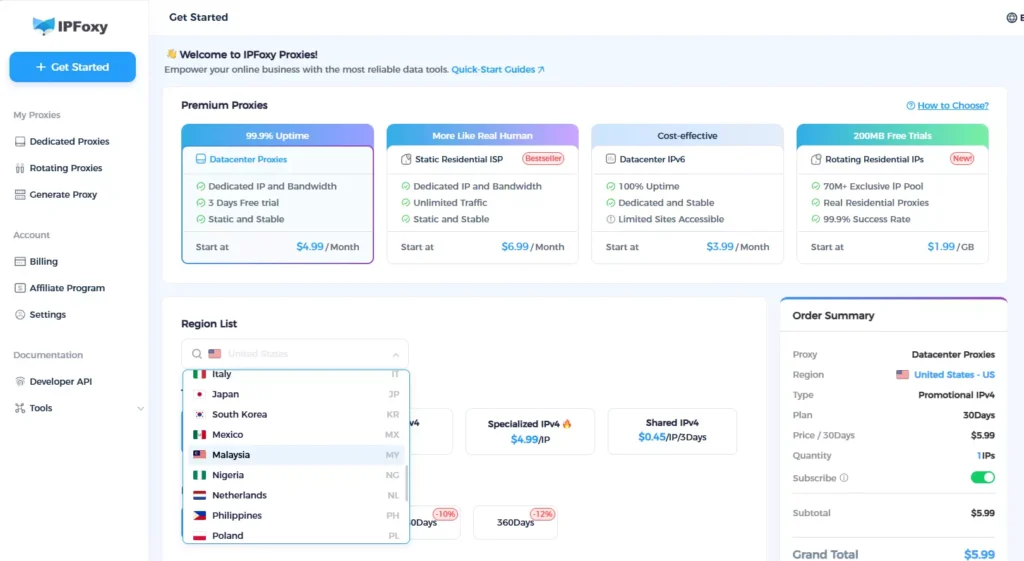
- Dedicated ISP static IP: Localized stores are more likely to gain local traffic. Each account should be assigned a clean, real, and location-matching IP to reduce hidden risks such as traffic suppression and risk control triggers. Many professional teams use IPFoxy’s dedicated static residential proxy as the underlying network infrastructure to ensure account stability and performance
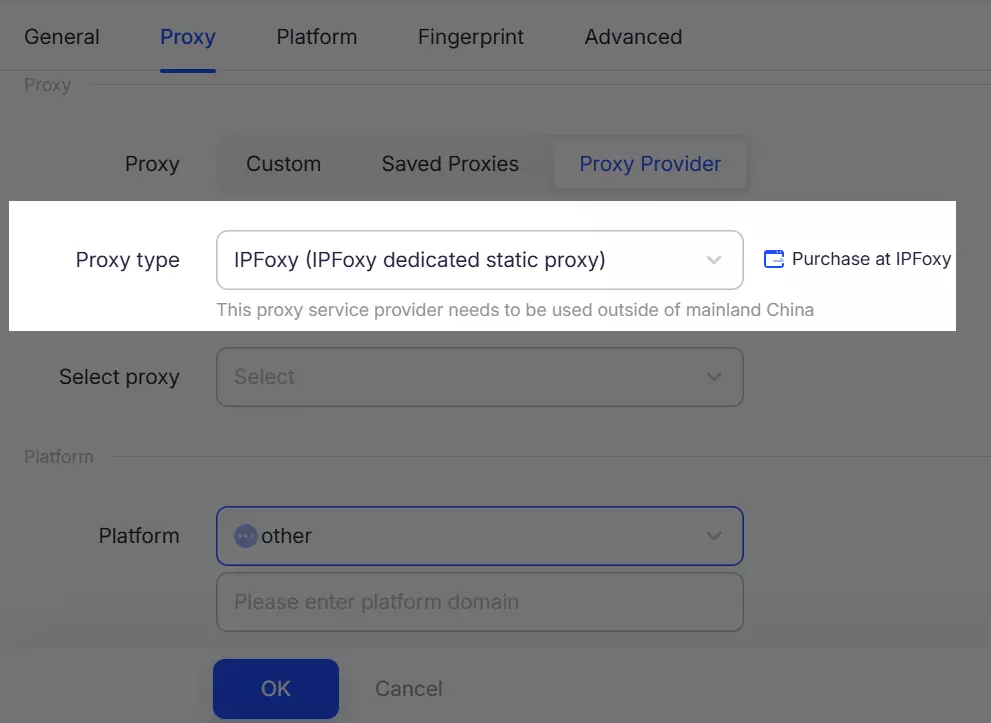
- Browser fingerprint isolation: Clearing cookies alone is no longer sufficient. In multi-account setups, IP isolation must be combined with an Anti-detect browser to generate unique fingerprint environments for each account. By integrating IPFoxy proxy settings into each profile, a “one store, one environment, one IP” structure can be achieved, eliminating account linkage risks
5. Fulfillment and after-sales management
Logistics performance and customer feedback directly impact long-term store ranking.
- Shopee: Focus on response speed and shipping time. Use official warehouse support to reduce costs and improve customer retention through active communication
- Lazada: Maintain high on-time delivery rates. Prioritize official warehouses for faster delivery and use AI customer service tools to monitor feedback and re-engage high-value customers
IV. FAQ
Shopee offers more flexible payouts but depends on delivery confirmation timing. Lazada has a more stable structure but stricter compliance requirements.
Shopee: Recommended ad spend is 5%–10% of GMV to maintain traffic flow
Lazada: Recommended 8%–12% budget for brand promotion and affiliate marketing to reach higher-value audiences
There may be overlap where the same users are reached on different platforms. It is recommended to adjust content timing and formats across platforms to create complementary traffic flows.
V. Conclusion
Shopee and Lazada each have distinct advantages. Shopee is ideal for rapid traffic acquisition, product testing, and short-term conversions, while Lazada is better suited for brand building, higher order value strategies, and long-term growth.
By combining multi-platform strategies with localized operations, sellers can achieve sustainable growth and optimize profitability in the competitive Southeast Asia ecommerce market.