












TikTok’s traffic dividend remains strong in 2026. However, for new creators, breaking through quickly is not easy. Many accounts fail not because of poor content quality, but due to improper environment setup, abnormal behavioral signals, or unclear positioning during the early stage. These issues prevent the system from assigning accurate labels, leaving accounts stuck in low-weight traffic pools.
The core of TikTok account growth lies in simulating real-user operating environments and maintaining highly vertical content output. This guide systematically breaks down the full process of launching a new account—from environment setup and account positioning to content creation and viral strategies—helping beginners complete cold start growth within 7 days and scale traffic efficiently.
I. How to Prepare Before Launching a TikTok Account
TikTok evaluates new accounts primarily based on three types of data: device fingerprint, network trajectory, and behavior patterns. Conflicting signals among these factors can directly impact initial account weight.
1.Network and IP Environment
The platform evaluates account stability through historical login locations and access trajectories. Frequently changing geographic IP locations may be flagged as abnormal behavior, leading to traffic restriction or suspension. Many “zero-view” accounts are marked as high-risk and fail to enter the normal recommendation pool.
Recommendation: Use a static, dedicated, and clean residential proxy. For accounts targeting the U.S. market, fix a specific city-level IP node and maintain a consistent long-term login path.
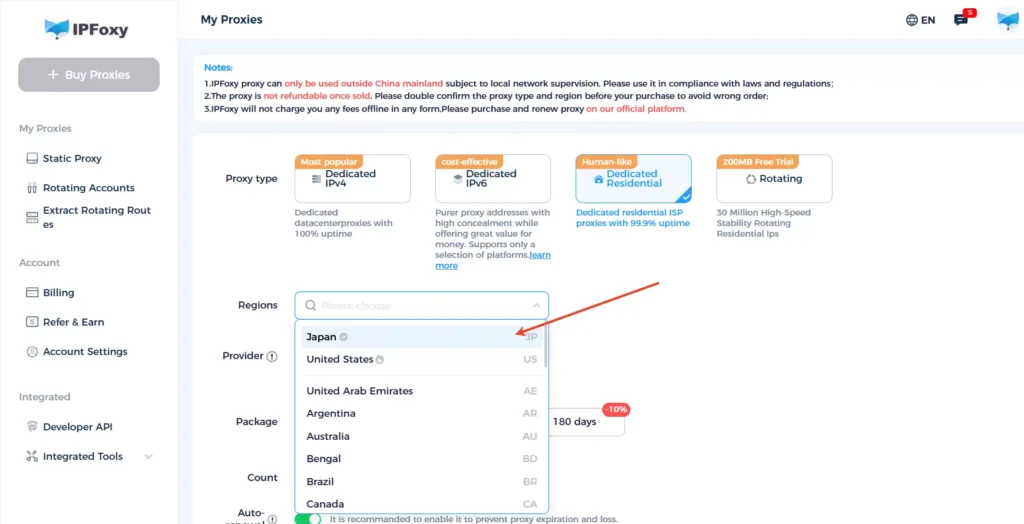
Proxy IP Tool: IPFoxy’s residential proxy service provides native IPs and dual-ISP resources, featuring low IP fraud scores and high purity. It is designed to improve traffic distribution accuracy and reduce the risk of traffic restrictions.
2.SIM Card and Device Information
Simply disabling mobile data does not remove carrier information. Devices can still detect SIM data. If the IP shows a U.S. location while the device carrier indicates another region, the system may detect environmental inconsistencies.
Recommendation: Use an overseas SIM card or physically remove the SIM card to keep the device in a “no SIM” state. Disable location services to avoid conflicts between IP location and device GPS data.
3.Time Zone and Language Settings
Language, time zone, and DNS settings must match the target market. For example, targeting the U.S. requires an English system interface and a U.S. city time zone—not just changing the in-app language. Many accounts adjust language settings but forget to synchronize time zones, triggering abnormal login detection.
Recommendation: All environment parameters should form a closed-loop logic—IP, time zone, language, and DNS must remain unified and stable over time.
4.Account Registration and Download Path
It is recommended to register accounts using mainstream email services such as Gmail or Outlook. Email registration offers better stability and cost control compared to overseas phone numbers, and verification success rates are typically higher.
New accounts are not advised to register directly with overseas phone numbers. Costs are higher, and some virtual numbers may be flagged as high-risk sources.
For iOS devices, log in to the App Store using an Apple ID that matches the target market before downloading TikTok. Android devices should install the official APK version and avoid switching installation packages frequently, as unstable download paths may be recorded as environmental inconsistencies.
II. How Should Beginners Operate a New TikTok Account?
1.Define Your Niche Clearly
Choosing a specific niche is the foundation of long-term operation. Publishing random content without a clear category may generate temporary traffic, but the resulting follower base will lack structure and conversion value.
The more specific the niche, the clearer the algorithmic labeling. For example: budget home cooking, golden retriever training tutorials, or product research breakdowns—instead of broad topics like food or side hustles. Precise labeling improves recommendation accuracy and follower quality.
2.Find Benchmark Accounts
After defining your niche, identify mid-tier accounts within the same field as reference samples. These accounts have already validated the market and built stable content styles with user feedback data.
Focus on structural analysis rather than imitation:
- Hook strategy in the first seconds
- Content pacing and structure
- Comment section engagement design
- Posting frequency and timing
Analyzing proven content structures shortens testing cycles and increases content validation efficiency.
3.Vertical Consistency Determines Label Stability
TikTok’s recommendation system relies on label matching. If account direction changes frequently, the system repeatedly rebuilds labels, reducing recommendation efficiency.
Profile photo, username, and bio should align with the niche. Visual branding itself forms part of the account’s labeling. Inconsistent style weakens professional recognition.
During the nurturing phase, maintain vertical consistency:
- Spend 3–7 days after registration performing stable browsing behavior before mass posting.
- Search industry keywords and product terms within your niche.
- Watch competitor videos fully.
- Like, comment, and save moderately.
- Maintain 15–30 minutes of consistent daily usage.
Relevance + continuity are critical. If future positioning is pet training, browsing unrelated comedy content during the nurturing phase may lead to incorrect interest modeling.
The platform evaluates authenticity through watch completion rate, interaction frequency, and session duration. Continuous natural browsing within the same niche helps reduce risk scores and establish industry labels early.
III. How to Build a Viral TikTok Account
1.Account Testing and Screening
The launch phase is also a critical cold-start traffic testing period.
Beginners can register multiple accounts under the same niche and publish different content directions to improve the efficiency of identifying high-potential accounts.
Evaluation standard: If the average views of videos during the first three days exceed 500, the account shows growth potential and is suitable for refined operation.
2.Viral Video Production Strategy
Content sourcing: In the early stage, you may collect materials from platforms such as Facebook, Instagram, YouTube, and X, then combine 4–5 sources for creative editing.
Video structure:
- First 3 seconds: strong hook
- Middle section: core value delivery
- Ending: call to action
Product display duration should be controlled within 3–7 seconds. Total video length should remain under 15 seconds, as longer durations may reduce conversion efficiency by approximately 35%.
Editing techniques: Use jump cuts, transitions, mirroring, speed adjustments, and visual effects to improve watch completion rates and viewing experience.
IV. Frequently Asked Questions
Maintain a stable posting rhythm. It is recommended to publish 1–2 videos per day and avoid bulk uploads. Use trending hashtags and participate in trending topics to help the system recognize content direction and push it to the correct audience.Avoid frequently deleting videos due to low views. Deletions disrupt data continuity and may reduce account weight, affecting future traffic distribution.
Monitor first 5-second retention rate, view count, and comment engagement. If five consecutive videos receive fewer than 300 views, consider switching accounts or adjusting positioning.During the early stage, avoid rushing monetization. Focus on creating viral content and building a follower base of 500–1000 users to establish long-term growth stability.
TikTok has strict requirements for node and network purity. Unstable or low-quality proxy environments often result in zero views. If switching accounts restores traffic, the issue likely lies in the network setup. Ensure IP and system parameters form a stable closed-loop environment to achieve normal traffic distribution.
Conclusion
Successful TikTok account growth depends on the organic integration of three core elements: environment consistency, vertical positioning, and content stability. Every step—from IP node configuration and time zone alignment to behavioral modeling and label building—directly influences account weight and recommendation efficiency.
Through scientific nurturing, precise positioning, and viral content strategies, beginners can quickly accumulate followers during the cold-start phase, test the market, identify high-potential accounts, and build a solid foundation for future monetization. By mastering and strictly executing this 7-day SOP, new accounts can break through the zero-view barrier and enter a stable growth trajectory.