











In Facebook advertising, choosing the right account type is the very first step of risk control.
Many advertisers make critical mistakes at the beginning:
- Using a personal ad account when a business account is required
- Frequently switching account types without understanding the rules
The result is often the same: ads never scale, and accounts get restricted first.
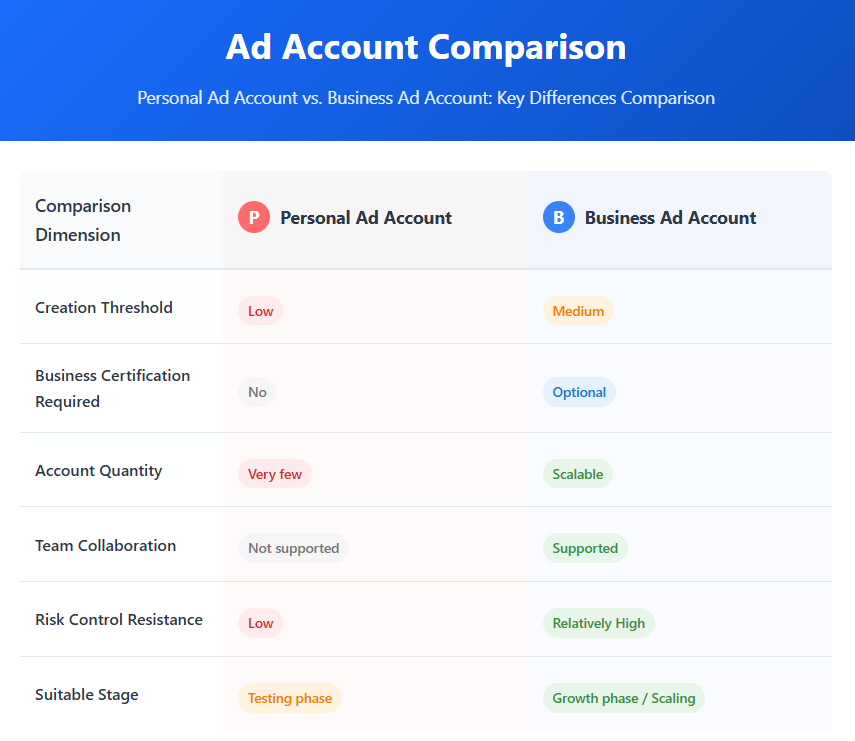
This article breaks down the application process, usage differences, suitable scenarios, and common pitfalls of Facebook personal ad accounts and business ad accounts (Business Manager), helping you make a safer decision from the start.
I. What Is a Facebook Personal Ad Account and Who Is It For?
- What is a personal ad account?
A personal ad account is directly attached to a Facebook personal profile. Ads can be launched without creating a Business Manager.
Key characteristics include:
- Linked to a personal Facebook account
- No business verification required
- Low entry barrier and simple setup
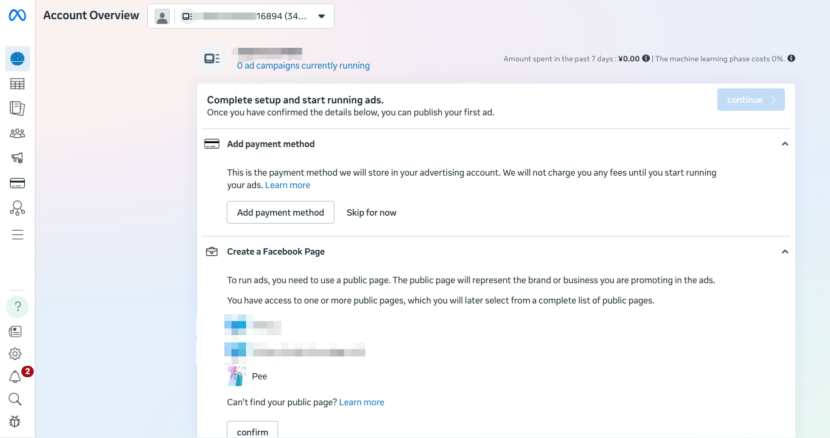
- Application process for a personal ad account
The basic steps are:
- Register and warm up a Facebook personal account (avoid very new profiles)
- Log in to Facebook Ads Manager
- The system automatically creates an ad account under the personal profile
- Add a credit card or PayPal
- Create and launch ads by selecting objectives, audiences, and placements
Note: Not all personal accounts are granted advertising access immediately. Facebook decides based on account quality.
- Core advantages and limitations of personal ad accounts
Advantages:
- Quick setup
- No business documents required
- Suitable for early testing or individual projects
Key limitations:
- Very limited number of ad accounts
- Restricted functionality: no team collaboration, limited asset management, no Pixel creation, weak data tracking
- High risk sensitivity: if the personal profile is restricted, the ad account is affected as well
- Low spending limits: daily and total spend caps make scaling difficult
- Who should use a personal ad account?
Individual sellers or beginners
Early-stage testing of a single product or market
No multi-account or team collaboration needs
A personal ad account is best viewed as a testing tool, not a long-term advertising solution.
II. What Is a Facebook Business Ad Account (BM) and Who Is It For?
- What is a business ad account?
A business ad account is created and managed through Facebook Business Manager (BM), which provides centralized asset control.
Business Manager itself is not an ad account. It is a management hub that can control:
- Ad accounts
- Pages
- Pixels
- Domains
- User permissions
- Application process for a business ad account
The standard process includes:
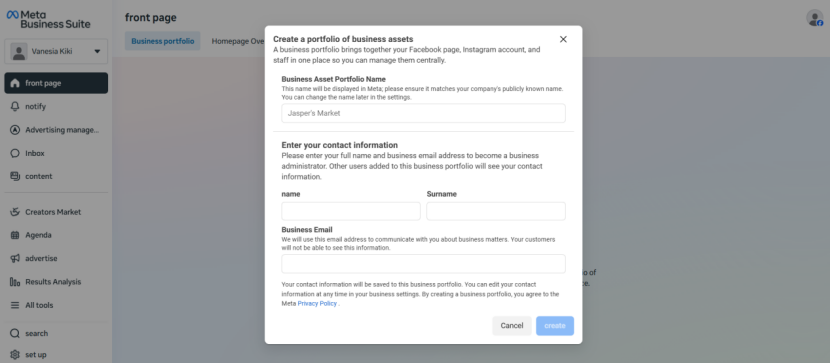
(1) Create a Business Manager
Visit business.facebook.com, and click “Create Account.” Register using a real business email and business name.
Complete business verification by submitting official documents such as business licenses, utility bills, or domain ownership proof. This step is not mandatory but significantly improves account stability.
(2) Create an ad account within BM
Go to the Ad Accounts section in BM and select “Add” → “Create a New Ad Account.”
Set key information and assign roles:
- Ad account name should clearly reflect the business
- Time zone cannot be changed after setup
- Currency is permanent and should match settlement needs
(3) Add a payment method
Choose prepaid or postpaid billing. New accounts typically start with prepaid options. Payment methods must be verified.
(4) Connect assets and launch ads
Add Facebook Pages and Instagram accounts to BM
Create Pixels or set up Conversion API for tracking
Start ad creation through Ads Manager
- Core advantages of business ad accounts
- Separation from personal profiles
- Ability to create multiple ad accounts
- Support for team collaboration and permission control
- Better suited for long-term and multi-project operations
- Stronger overall resistance to restrictions compared to personal accounts
- Common misunderstandings about business ad accounts
Problems often arise not from having a BM, but from:
- Overloading one BM with high-risk assets
- Using the same login environment across multiple BMs
- Admins with historical risk issues
BM is not immunity; it must be used correctly.
III. How to Improve Long-Term Stability of Facebook Ad Accounts
- Account quality always comes first
Both personal and business accounts are vulnerable to:
- Running ads immediately on new profiles
- Abnormal or aggressive behavior
- Accounts with problematic history
Avoid purchasing so-called “ready-made business accounts” from unofficial sources. These often use fake information and are highly unstable.
- One account, one stable environment
Facebook evaluates authenticity using multiple signals, with network environment being a major factor:
- Proxy type (residential or data center)
- Login location stability
- Shared environments across accounts
At the business ad account stage, environment-related risks can affect the entire BM. Many advertisers therefore assign:
- Dedicated static residential proxy
- Location aligned with the target market
- Long-term, fixed usage without frequent changes
In practice, experienced advertisers often combine an Anti-detect browser with a dedicated static residential proxy to isolate environments. IPFoxy provides dedicated static residential proxy services backed by real ISP networks, reducing abnormal logins and location drift, making them suitable for long-term use across BMs, ad accounts, and Pages.
For multi-account or team operations, a stable proxy environment effectively reduces account pressure.
- Strict isolation for multi-account operations
- Avoid frequent switching between ad accounts
- Do not reuse the same environment across different projects
- Avoid creating multiple BMs under the same environment
4. Allow accounts to grow naturally:
- Start with small budgets
- Avoid frequent core setting changes
- Scale creatives and spend gradually
- Ensure full compliance with Facebook policies to build healthy spending history
IV. Final Thoughts
Many Facebook advertising failures are not caused by product or copy issues, but by choosing the wrong account structure from the start.
In short:
- Personal ad accounts are suitable for short-term testing
- Business ad accounts are designed for long-term and scalable advertising
If your goal involves brand building or managing multiple projects, a stable ad account structure is the foundation of sustainable growth.