












At the recent Google I/O 2026 conference, Google officially introduced the new Gemini 3.5 model lineup and debuted Gemini 3.5 Flash.
The most surprising part of this release is that, although positioned as a lightweight “Flash” model, its performance surpasses the previous flagship “Pro” model across multiple major benchmarks. That is exactly what this article will break down in detail.
I. Gemini 3.5 Flash: What Are the Core Upgrades?
Positioned as Google’s “most powerful agent and coding model so far,” its main strengths can be summarized as: cutting-edge intelligence, ultra-fast reasoning, and deep optimization for AI Agents.
1.Breakthrough “Lightweight Yet Powerful” Performance
In official benchmark tests, Gemini 3.5 Flash even outperformed the previous flagship model Gemini 3.1 Pro:
- Real-world coding capability: Achieved an Elo score of 1656, a benchmark focused on economically valuable real-world engineering tasks rather than simple logic problems.
- Terminal operation capability: Scored 76.2%, significantly improving its ability to complete complex multi-step tasks in real terminal environments.
2.Extreme Inference Speed and High Cost Efficiency
- 4× faster output: Its token generation speed reaches up to 4 times faster than comparable frontier models, and on certain optimized platforms, even up to 12 times faster.
- Lower cost with higher efficiency: Although its API pricing is slightly higher than the previous Flash generation, it still costs less than half of comparable flagship models while offering similar capabilities. Combined with cache discounts of up to 90%, it is highly suitable for large-scale AI Agent deployments.
3.Built Natively for AI Agents
The core of an AI Agent is a closed-loop workflow involving multi-step planning, tool usage, and self-correction. Gemini 3.5 Flash introduces underlying optimizations specifically for this workflow:
- Thinking Retention: The model automatically preserves intermediate reasoning processes across multi-turn conversations. In later interactions, it can continue previous reasoning chains without requiring developers to modify the API. This significantly improves long-term tasks such as iterative debugging and code refactoring.
- Flexible Thinking Levels: Google removed the previous thinking_budget parameter and introduced four adjustable reasoning levels:
Minimal: Optimized for simple queries such as chats and quick Q&A.
Low: Low latency, suitable for lightweight coding and analysis tasks.
Medium (default): Balances speed and quality, ideal for complex coding and AI Agent workflows.
High: Maximizes reasoning capability for advanced mathematics and difficult agent tasks.
4.Powerful Multimodal and Long-Context Capabilities
- Long-context support: Supports up to 1 million input tokens and up to 65,000 output tokens.
- Multimodal function responses: Allows images, audio, and other multimodal content to be directly embedded into custom Function Calling outputs, reducing issues such as reasoning leakage and output degradation found in earlier versions.
Gemini 3.5 Flash is not just a minor update. It represents Google’s attempt to build a moat around “high intelligence + ultra-fast speed + lower cost,” pushing large models beyond chatbots and toward fully capable AI Agents that can perform real tasks autonomously.
5.Gemini 3.5 Flash vs GPT vs Claude
Here is a quick comparison:
| Model | Key Advantage | Best Use Cases | Recommendation |
| Gemini 3.5 Flash | 1M-token context, 4× output speed, excellent cost efficiency | Large-scale AI Agent deployment, full codebase analysis, long video/audio processing | Best for speed and throughput |
| GPT-4o / mini | Strong ecosystem, excellent everyday conversation, balanced multimodal abilities | Productivity assistants, creative marketing, companies deeply integrated with the OpenAI ecosystem | Best for all-around experience |
| Claude 3.5 / 4.x | Strong coding quality and logical reasoning, natural writing style | Production-level coding, academic writing, advanced logic correction | Best for accuracy and reasoning |
In simple terms: Claude excels in deep reasoning and code quality, GPT leads in ecosystem integration and balanced performance, while Gemini 3.5 Flash dominates in long-context processing, extreme speed, and cost efficiency.
II. How to Start Using Gemini 3.5 Flash
1.Network Environment Setup
Gemini 3.5 Flash is gradually rolling out for public access and API integration. However, in real-world usage, Google still applies strict risk control policies against abnormal login environments, frequent node switching, and low-quality shared IPs.
For users requiring long-term stable access, API debugging, or multi-region testing, a stable and clean network environment can directly affect the overall experience.
As a result, some developers use professional proxy services as supporting infrastructure. For example, IPFoxy Proxies provides real residential proxy solutions that can simulate local network environments in multiple regions, helping users build more stable access environments for web apps, AI Studio, Gemini API, and related scenarios.
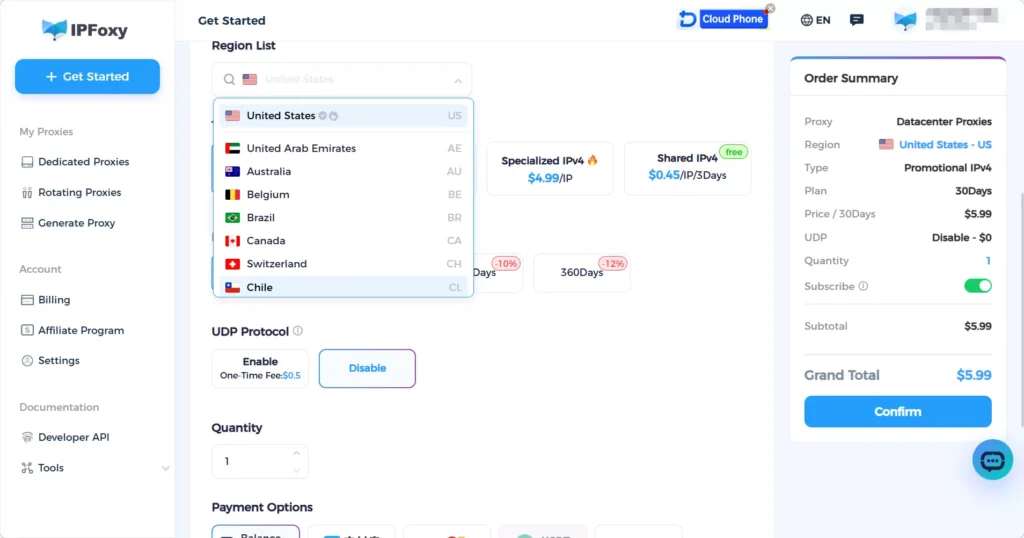
After optimizing the network environment, users can choose different access methods depending on their needs.
2.General Chat and Multimodal Experience
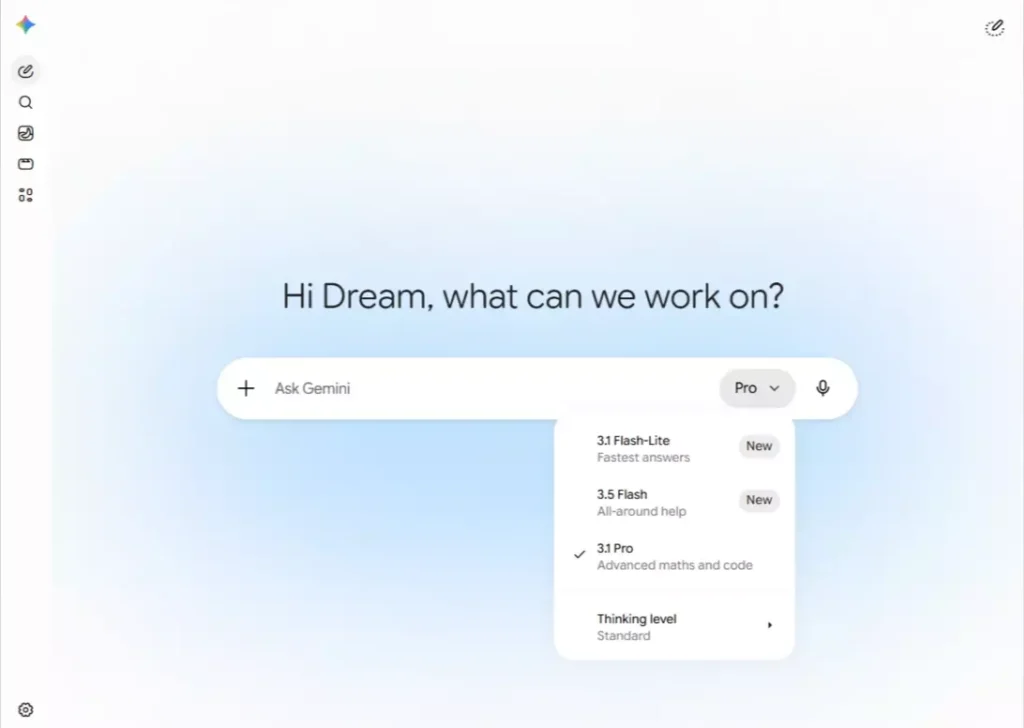
Users can directly visit the official Gemini website or use the mobile app.
Subscribed users can select the latest Gemini 3.5 Flash model from the model dropdown menu at the top of the interface.
3.Advanced Development and API Usage
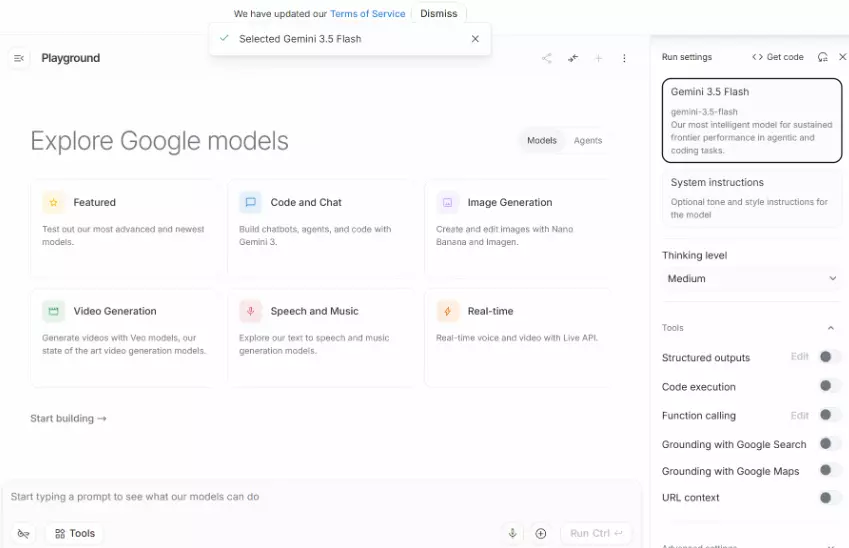
For advanced API integration and developer-focused long-context capabilities, users can access Google AI Studio.
After signing in with a Google account, switch to Gemini 3.5 Flash (Preview) in the “Model” selector panel.
III. Advanced Gemini 3.5 Flash Usage Tips
Understanding the model is only the first step. To fully unlock Gemini 3.5 Flash’s potential, developers should optimize how they use it. The following five areas are among the most practical advanced techniques.
1.Prompt Structure Optimization
Clearly separate “system instructions” from “task descriptions.” Caching frequently reused system prompts can reduce repeated token costs by up to 90%.
Structured outputs such as JSON Schema are also more token-efficient than free-form text because the model generates more concise responses.
2.Long-Context Optimization
When uploading large codebases or long documents, place stable and reusable content—such as source files and background materials—at the beginning of the context for caching purposes, while dynamic questions should appear near the end.
In multi-step AI Agent loops, context size grows continuously. A five-step workflow may consume 2–3× more tokens than the original prompt, so budget planning is important.
3.Coding Optimization
For code generation tasks, Medium or High thinking levels are recommended.
For lightweight tasks such as code completion or formatting, switching to Low or Minimal can significantly reduce latency and cost.
4.AI Agent Workflow Optimization
Take advantage of Thinking Retention to avoid repeatedly sending reasoning chains during multi-turn AI Agent workflows.
Use lightweight models for simple subtasks, while reserving Gemini 3.5 Flash for complex decision-making stages. Avoiding maximum-level reasoning on every request is one of the most effective ways to control AI Agent costs.
When using the Gemini API, developers often encounter rate limits and unstable network conditions during AI Agent testing. Some teams use rotating residential proxy solutions from IPFoxy Proxies to assign independent network exits to different agents, making multi-region testing and automated task management easier.
5.UI Generation Optimization
When generating frontend components, clearly specify the target framework (such as React + Tailwind), interaction logic, and responsive requirements in the prompt.
Combining these instructions with multimodal inputs such as UI screenshots can greatly improve first-pass generation quality.
IV. FAQ
Yes. Compared with traditional chatbot models, Gemini 3.5 Flash places much greater emphasis on long-context handling, multi-step reasoning, and tool-calling capabilities, making it highly suitable for automation agents, workflow orchestration, and multi-turn task execution.
Gemini 3.5 Pro has reportedly been delayed until June 2026, and Google has already started internal testing.
In scenarios involving frequent API requests, long-running automation tasks, and multi-account collaboration, shared network environments can easily trigger rate limits or abnormal request detection.As a result, many AI automation teams use rotating residential proxies, browser isolation, and independent network environments to improve AI Agent workflow stability, especially for global AI testing and automation tasks.
V. Conclusion
The significance of Gemini 3.5 Flash goes beyond being “a faster model.”
It breaks the traditional hierarchy of AI models: a lightweight product outperforming flagship models on key business benchmarks while maintaining lower operational costs. This signals that AI infrastructure competition is shifting from a pure “capability race” to an “efficiency race.”
For developers, now is an excellent time to integrate it into production environments. For ordinary users, if you have already opened the Gemini app, you are probably using it already.