












As platform risk control mechanisms continue to evolve, IP addresses have become a key factor in detecting account associations and abnormal behavior. Whether in e-commerce, multi-account management, data scraping, or AI automation tasks, frequently changing or shared IPs can trigger platform detection and affect account stability and security. As a result, proxies are becoming essential for various business scenarios. This article explains the differences between rotating proxy and dedicated static proxy and their suitable use cases.
I. What Are Rotating Proxy and Dedicated Static Proxy?
1. Rotating Proxy
A rotating proxy automatically changes the IP address for each request or after a set interval (such as 30 minutes or 24 hours). These IPs usually come from a large IP pool, helping avoid detection or bans caused by repeated use of a single IP.
Working principle:Each time a device connects to the internet, the Internet Service Provider (ISP) assigns a currently unused IP address. When the connection ends, the IP returns to the pool for future allocation. Rotating proxy changes IPs every few minutes to several hours, effectively bypassing certain anti-scraping mechanisms.
Core advantages:Suitable for large-scale requests, reducing the risk of bans and improving data collection efficiency. Typically lower cost.
2. Dedicated Static Proxy
A dedicated static proxy refers to an IP that remains unchanged for a long period, usually bound to a single user or account. It simulates a real user’s long-term network environment and is ideal for scenarios requiring stable connections, such as continuously running automation tasks.
Working principle:Dedicated static proxy is manually assigned and configured by the ISP to a specific device. Once configured, the IP remains fixed unless manually changed.
Core advantages:More aligned with platform risk control rules and offers higher account stability. Suitable for long-term operations and multi-account management.
To better understand the differences, the comparison below summarizes key factors:
| Comparison | Rotating Proxy | Dedicated Static Proxy |
| Flexibility | Frequently changes, highly flexible | Fixed address, lower flexibility |
| Stability | IP rotation, lower stability | Fixed IP, very stable |
| Anonymity | May still be traceable | High anonymity and isolation |
| Cost | Lower cost due to shared pool | Higher cost due to exclusivity |
| IP Change | Automatic rotation | Long-term fixed |
| Suitable Scenarios | Frequent environment switching | Long-term stable connection |
II. Rotating Proxy vs. Dedicated Static Proxy: How to Choose by Scenario
Choosing between rotating proxy and dedicated static proxy depends on business requirements, including request volume and whether real-user simulation is needed.
1. Scenarios Suitable for Rotating Proxy
(1) Data Scraping / CrawlersScrapers
typically send large volumes of requests to target websites. Rotating proxy reduces the risk of IP blocking by automatically rotating IPs. This improves efficiency and stability during data collection.
(2) Market Research
Market research often requires collecting user behavior data across multiple channels. Rotating proxy simulates different users and locations, helping gather more comprehensive insights.
(3) SEO Monitoring
SEO professionals frequently check search results from different locations. Search engines may restrict repeated queries, and rotating proxy allows location simulation for accurate results.
(4) Ad Verification
After launching advertisements, teams often verify whether ads display correctly across regions. Rotating proxy enables fast location switching for ad validation.
(5) AI Automation Data Collection
AI automation often sends high-frequency requests across multiple platforms. Using the same IP continuously may trigger detection. Rotating proxy distributes requests across multiple IPs, reducing risk and improving stability.
2. Scenarios Suitable for Dedicated Static Proxy
(1) E-commerce Multi-Account Management
Platforms often detect account association through IP addresses. Shared or frequently changing IPs can trigger risk control mechanisms. Dedicated static proxy provides a consistent login environment and improves account stability.
(2) Social Media Matrix Operations
Multiple social accounts require long-term stable login environments. Frequent IP switching may be flagged as suspicious. Dedicated static proxy provides independent environments for each account.
(3) Long-Term Account Operation
Accounts such as advertising or business accounts require consistent network environments. Dedicated static proxy ensures stable connections and reduces risk of verification or restrictions.

III. How to Choose a Proxy Provider
Proxy quality varies widely across providers. Poor-quality proxy services may still cause account issues or connection failures. Consider the following factors:
1. IP Type (Residential Proxy vs Data Center Proxy)
Residential proxy originates from real household networks and appears more authentic to platforms. It is suitable for account-based operations requiring stability.
Data center proxy comes from server environments. While faster and cheaper, they are easier for platforms to detect and are better suited for short-term tasks.
For long-term operations, dedicated static residential proxy is generally recommended.
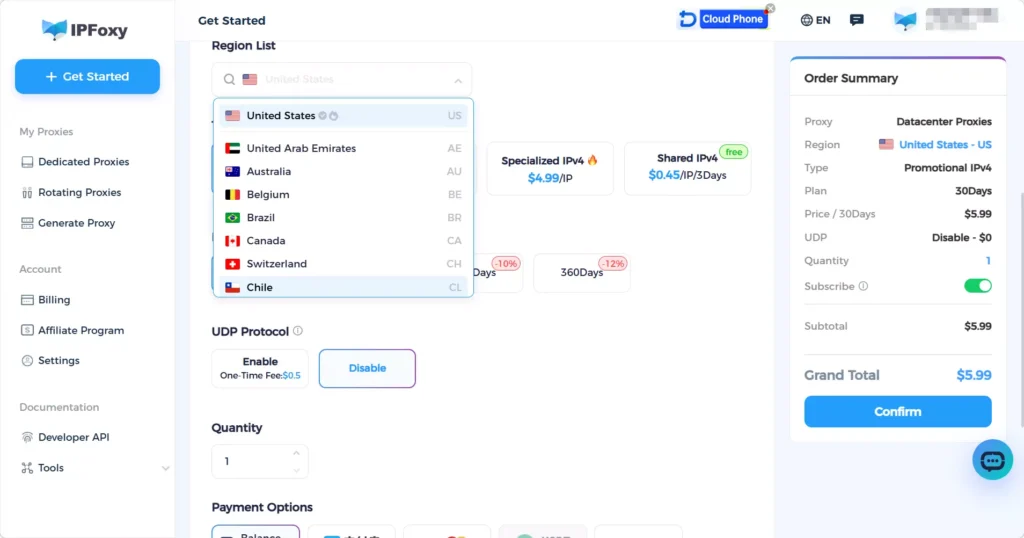
Professional providers such asIPFoxy Proxies offer dedicated static residential proxy that simulate real user environments and help reduce account association risks.
2. IP Exclusivity
Shared proxy vs dedicated proxy directly affects security:
Shared proxy: Used by multiple users, higher contamination riskDedicated proxy: Used by a single user, cleaner and more stable
For multi-account scenarios, dedicated proxy is recommended.
3. IP Cleanliness
IP history affects trust level. Previously flagged IPs may increase risk.
Use platforms like IPinfo or IPapi to verify proxy quality before deployment.
4. Stability and Connection Quality
Low-latency and stable connections are essential for long-running automation tasks.
5. Geographic Coverage
Different businesses require IPs from different regions. Providers with wide geographic coverage offer greater flexibility.
IV. FAQ
Not mandatory, but dedicated static proxy provides independent environments and reduces account association risk.
Rotating proxy itself does not cause issues, but frequent switching or poor IP quality may trigger platform risk controls.
Dedicated static residential proxy originates from real household networks, while data center proxy comes from server environments and is easier to detect.
V. Conclusion
Rotating proxy and dedicated static proxy each have their own advantages and use cases. Dedicated static proxy is suitable for fixed environments and long-term connections, while rotating proxy is better for mobile environments and high-frequency tasks. Choosing the right proxy based on business needs helps improve efficiency, stability, and resource management.