











Buying social media accounts is normal now. Agencies, media buyers, dropshippers, affiliate guys, anyone running at scale — they buy accounts instead of burning weeks warming up fresh profiles. The catch is that most marketplaces selling these accounts are garbage. Buy from the wrong one and you get recycled, shared, or already-flagged accounts that die the second you log in. This guide cuts through it: which marketplaces actually deliver accounts that survive, and how the ten biggest names really stack up.
We didn’t rank these on marketing fluff. We looked at what actually decides whether an account holds up: where it came from (origin), how many platforms a seller covers, how fast they deliver, how you pay, what happens when something breaks, and whether a human picks up when you need help. Every platform gets the honest treatment — what’s good, what’s not — so you can pick the right one for your job instead of chasing a “best” badge. And before the list, we cover the stuff that trips people up: the common traps, the account tiers, what to check before you pay, and how to keep accounts alive once they’re yours.
Quick answer: Best place to buy social media accounts in 2026? Depends what you’re doing. For all-round quality and the widest range, AccsZone came out on top in our comparison — they make accounts in-house (56,000+ orders to 9,600+ buyers) and deliver instantly, so you can check live-or-dead the moment you log in. Buying in bulk? Their sister site AccsBulk is built for wholesale. Want one premium influencer account? SWAPD or SocialTradia. Gaming or niche stuff? PlayerUp, Z2U, G2G. Buying a whole business with accounts attached? Flippa. Whatever you pick, judge it on origin, delivery speed, and support — and never run a bought account without a clean proxy and an anti-detect browser.
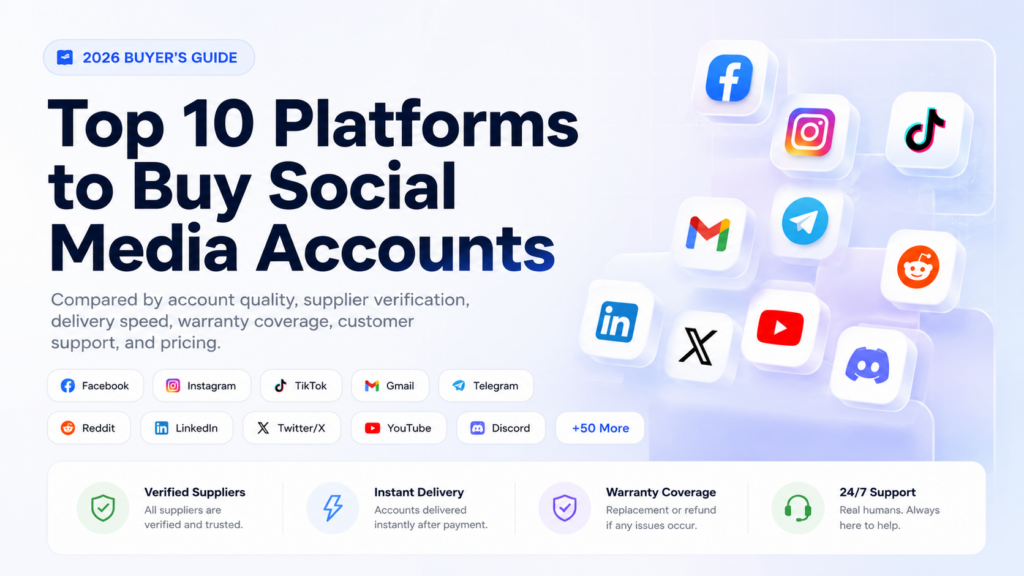
Before the list, let’s name what actually goes wrong. Nearly every horror story you’ll hear comes down to one of these five:
- Recycled or shared accounts. The classic. The account’s already been used, flagged, or sold to three other people before you — so it’s dead within hours. This is everywhere on open marketplaces where nobody controls quality and any random seller can list whatever they’ve got.
- Account reclamation. You buy it, you pay, and a few days later the original owner recovers it with the recovery email or phone and locks you out. Escrow doesn’t fully stop this — it’s baked into how peer-to-peer selling works.
- Payout and payment messes. Escrow’s only as trustworthy as the company holding your money. PlayerUp’s a textbook case — piles of complaints from sellers waiting weeks or months to get paid, and buyers who got “refunded” in site credit instead of actual money.
- No warranty, no recourse. Tons of cheap bulk sellers offer zero replacement policy. Account dies? That’s your problem now.
- Slow delivery. Escrow and middleman handoffs can drag for hours or days per account. If you’re buying volume, that’s a dealbreaker.
The thing nobody tells you: origin and warranty beat price every time. A $1 account that dies tomorrow costs you more than a $3 account that runs for months. Keep that in your head as you read on.
How we ranked these platforms
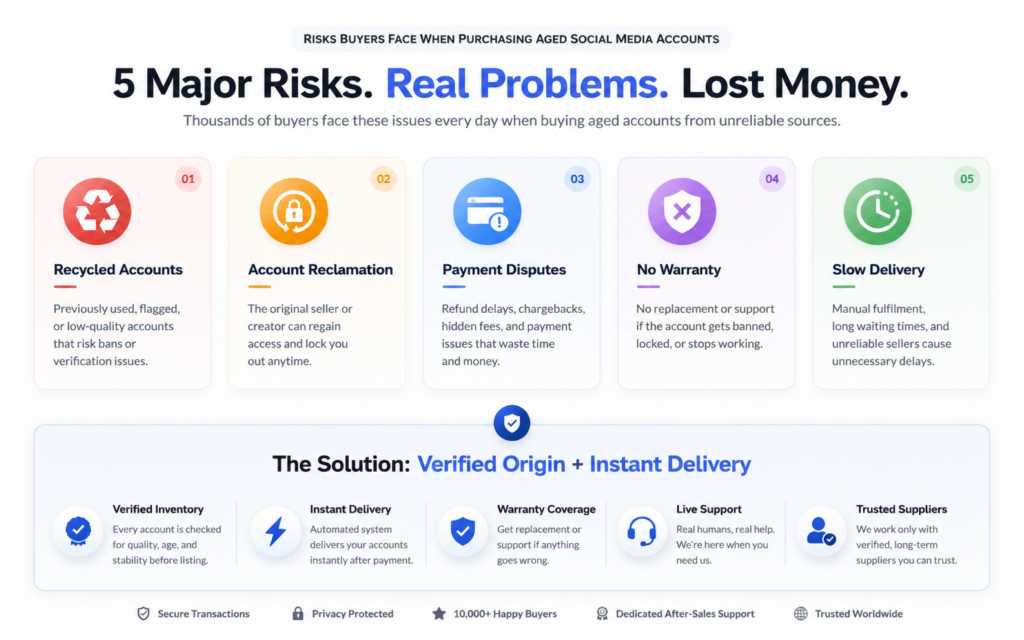
We scored every platform on six things, and weighted account quality and warranty the heaviest because that’s what actually burns people:
- Account quality & origin — made and verified in-house, or just listed by some anonymous seller?
- Category breadth — how many platforms and account types can you get in one place?
- Delivery — instant and automatic, or slow manual/escrow?
- Payment — what they take, and how safe it is.
- Warranty & support — is there a real replacement policy, and does anyone actually answer you?
- Reputation — what real buyers and sellers say, not what the seller says about itself.
Account types and quality tiers, explained
Here’s where a lot of people screw up: they buy the wrong tier for the job, then blame the seller when it dies. Account quality isn’t one thing — it’s a ladder. Know the ladder and you’ll know whether an account lasts months or dies on day one.
PVA (phone-verified accounts)
Fresh accounts verified with a real phone number. Cheap, fine for low-stakes volume work — sign-ups, light posting, throwaway stuff. Zero history, so they’re the easiest to flag if you hammer them or run ads right away. Treat them as disposable and warm them up first.
Softreg accounts
Soft-registered, made in bulk with barely any verification. Bottom of the ladder — cheapest, dies fastest. Good for volume plays where you already expect to lose a chunk and you’ve priced that in.
Aged accounts
Registered months or years ago and left to sit or lightly used. Platforms trust age, so these take more activity before they get flagged. This is the sweet spot for most people — enough trust to actually work with, without paying premium money.
Aged + activity / with friends or followers
Aged accounts that also carry real signals — friends, followers, a posting history. They behave like a real person, so they survive the rough stuff. That’s why they cost more. Think Facebook accounts with friends, or Instagram with 1,000+ real followers.
Premium / regional accounts
Top of the ladder. Aged premium profiles from high-trust regions — USA Facebook accounts registered 2007–2015, for example. Rare, expensive, and what you reach for when longevity and geo-trust really matter: established ad accounts, high-spend campaigns. Stock is always tight on these.
Simple rule: match the tier to the risk. Throwaway task? PVA or softreg. Ongoing work? Aged. High-trust, high-spend, long-term? Aged-with-activity or premium regional. Paying premium prices for disposable work is wasting money; using softreg for serious work is wasting accounts.
A buyer’s checklist: 7 things to verify before you pay
This is what people who’ve been doing this a while check on any new seller. Run it on every platform below:
- Origin. Made and verified in-house, or listed by some anonymous third party? In-house is the best predictor that the account survives.
- Warranty in writing. Is there a clear replacement window with the conditions spelled out? No warranty means it’s all on you.
- How they deliver. Instant with full credentials, or a slow manual/escrow handoff? Check what you actually get — login, email access, recovery details.
- Recovery details. On higher-trust accounts, can you change the recovery email and phone right away to stop the original owner clawing it back?
- Real reviews. Look for reviews on sites and forums the seller doesn’t control, not just glowing testimonials on their own page. Cross-check independent review sites and the industry forums.
- Payment safety. Does payment go through the platform’s checkout or proper escrow? Never wire money to some guy’s personal Telegram, no matter how good his screenshots look.
- Support test. Ask a question before you buy. A fast, sharp reply pre-sale tells you what help you’ll get when something breaks after.
Red flags: how to spot a marketplace to avoid
See two or more of these? Walk:
- Prices way below market — that’s almost always recycled, shared, or stolen accounts.
- No written replacement policy, or vague “no refunds” wording.
- Payment only by direct crypto to a personal wallet or Telegram, no real checkout.
- No reviews anywhere independent, or a trail of unresolved payout and refund complaints.
- Pressure plays — “last stock,” “pay now” — trying to rush you off-platform.
- No straight answer on where the accounts came from or how they were made.
#1 by our criteria — AccsZone
👉AccsZone took the top spot in our comparison, and the reason is structural, not hype: unlike most names on this list, they make their own accounts in-house instead of running a venue where anonymous sellers dump whatever they’ve got. Accounts get built on country-specific IPs with real phone numbers and managed mobile proxies, and the Facebook, Instagram, Gmail and LinkedIn profiles get checked for activity patterns and device consistency before they ever hit the catalog. Origin is the number-one thing that decides how long an account lives, and that’s what pushed AccsZone to the top of our scoring.
Second reason: range. AccsZone covers 40+ account categories across six groups — social, email, messaging, dating, finance, entertainment — plus proxies, VPN, VPS and RDP. If you need a whole multi-account stack, getting it from one seller with one production standard beats stitching it together from five sellers of who-knows-what quality. It’s not the right call for everyone (the limitations below are real), but on our weighted criteria it scored highest.
For scale: AccsZone’s own platform data shows 56,000+ orders fulfilled to 9,600+ registered buyers, backed by 200+ verified suppliers across 60+ categories and 100+ sub-categories — plus a self-reported replacement rate of under 1%, which tells you more about account quality than raw order numbers ever could.
What you can buy
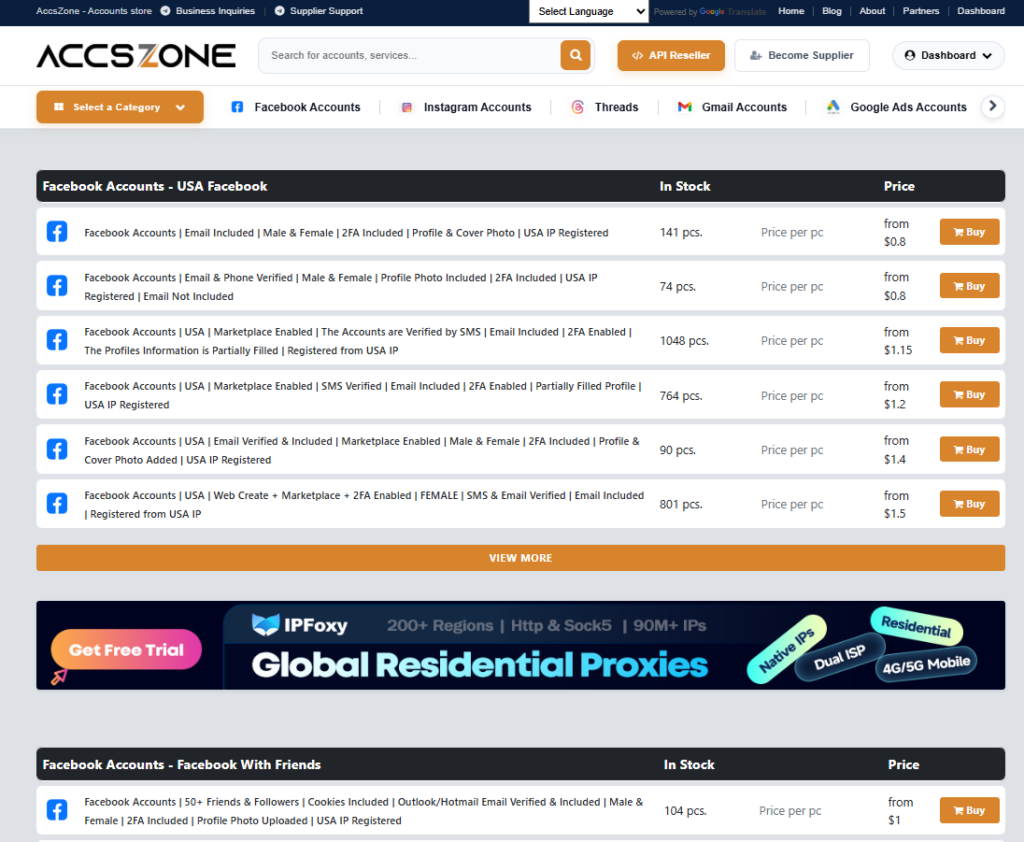
- Social: Facebook (PVA, aged, USA, aged USA 2007–2015, premium, regional, Ads, with friends), Instagram (aged, with followers, regional, with cookies), TikTok, X/Twitter, LinkedIn, Reddit, Threads, Truth Social, Bluesky, Snapchat, Pinterest
- Email: Gmail (aged, new, SMTP, mixed-country), Outlook, Yahoo, GMX, Apple
- Messaging: Telegram (account, aged), Discord, WhatsApp
- Dating: Tinder, Bumble, Hinge, Badoo, OkCupid, POF, Grindr, BLK
- Finance: CashApp, PayPal
- Entertainment: Steam, Twitch, Spotify, Netflix, YouTube channels
- Services: Proxy, VPN, VPS, RDP, Google Ads, Google Voice PVA, Trustpilot, Indeed
Pricing (indicative)
Pricing’s transparent and scales with quality. At the time of writing, entry-level USA Facebook accounts start around $0.86 each; marketplace-enabled USA Facebook with 2FA, SMS & email verified runs about $1.15–$2; aged premium USA Facebook (2007–2015) climbs into the hundreds per piece; Instagram with real followers runs from a few dollars depending on niche and follower count. Every listing shows live stock and a “from” price per piece.
Strengths
- In-house production with verification — not an anonymous reseller model
- Widest category coverage in this comparison (40+ categories, 6 groups)
- Instant automatic delivery — lets buyers verify live/dead on login
- Pre-login replacement or refund on faulty accounts
- 24/7 human live-chat support (English)
- Proxies/VPN/VPS available alongside accounts
- API for resellers and a verified supplier program
Limitations
- Premium aged inventory (e.g. 2007–2015 USA Facebook) is limited in stock and priced at a premium
- Not aimed at buyers who only want a single high-follower influencer profile (see SWAPD/SocialTradia)
- Crypto-only checkout (Cryptomus, NOWPayments) — no card or PayPal option
- No post-login warranty — once an account logs in successfully, it’s considered delivered as described
Best for: agencies, media buyers, dropshippers and SMM operators who want consistent quality and everything from one supplier.
#2 — AccsBulk
👉AccsBulk is AccsZone’s wholesale sister site, built for people buying in volume. Same quality standards, same catalog, but set up for big orders — cheaper per unit at scale, an account manager, and custom or recurring orders for agencies and resellers. If AccsZone is the retail front door, AccsBulk is the warehouse out back.
Strengths: lower per-unit cost at volume; same in-house quality standards as AccsZone; account-manager support for custom/recurring orders.
Limitations: geared to bulk — less suited to one-off single-account buyers; best value only unlocks at higher quantities.
Best for: agencies, resellers and high-volume media buyers.
#3 — AccsMarket
AccsMarket is one of the busiest account stores out there and an old name in bulk social and email. Its thing is volume and cheap prices across the mainstream platforms. The downside: quality and lifespan are all over the place compared to an in-house producer, and if you buy a cheap bulk lot and it’s bad, good luck getting much back.
Strengths: very large inventory across mainstream platforms; competitive bulk pricing; established, widely recognised brand.
Limitations: quality varies by lot; cheaper accounts can be short-lived; limited warranty depth; less category breadth beyond core social/email.
Best for: buyers who prioritise volume and price over guaranteed longevity.
Sources: PlayerUp complaints documented on Sitejabber and ComplaintsBoard.
#4 — PlayerUp
PlayerUp is one of the oldest account marketplaces going, known for its human “middleman” escrow and a massive spread of listings, including a big social and Reddit section. The middleman setup does genuinely stop obvious delivery scams. But the complaints pile up — sellers stuck waiting weeks or months to get paid, buyers “refunded” in site credit instead of real money. Independent review sites bear this out: ratings sit low (around 2.4–2.9/5) with a recurring theme of delayed seller payouts and credit-converted refunds, and the fees sting (buyers pay roughly 10% on top of the listing price).
Strengths: human middleman verifies delivery before fund release; enormous selection including niche and Reddit accounts; 12+ year track record.
Limitations: widespread seller payout-delay complaints; refunds sometimes converted to site credit; high combined fees; slow, escrow-paced transactions; dated interface.
Best for: buyers chasing a niche listing they can’t find elsewhere, using a payment method with its own dispute process.
#5 — SWAPD
SWAPD is the curated, higher-end option for premium digital assets — big social accounts, pages, channels, even domains. Listings get vetted and deals run through a moderated escrow, which makes it one of the safer P2P-style spots for an expensive single buy. Flip side: it’s built for premium one-offs, not bulk sourcing, and the fees and price floors are steep.
Strengths: strong vetting and moderated escrow; good for high-value single assets; professional dispute handling.
Limitations: not designed for bulk or budget buying; high fees and minimum price points; narrower account-type range.
Best for: premium single-asset transactions where vetting matters more than price.
#6 — G2G
G2G (Gamer2Gamer) is one of the biggest global digital-goods marketplaces, best known for game currencies, top-ups and accounts, with a decent social and other-accounts section alongside. Multi-seller model with escrow-style buyer protection, 24/7 support, and a wide range of payment methods, so it’s accessible just about anywhere. Like any open marketplace, quality is whatever the individual seller decides — so check each vendor’s rating and reviews before you hand over money.
Strengths: huge global reach; escrow-style buyer protection; 24/7 support; wide payment range.
Limitations: social-account depth thinner than its gaming side; quality varies by seller; vetting required.
Best for: gaming-adjacent and niche listings where you’ll vet the seller.
#7 — Z2U
Z2U is a broad digital-goods marketplace — game accounts, top-ups, currencies, and a spread of social accounts. Multi-seller model with escrow, so there’s plenty of variety, but quality is whatever each individual seller decides it is. Nobody’s controlling it centrally, so vet your seller hard before you buy.
Strengths: wide variety of listings and niche items; escrow on transactions; multiple payment options.
Limitations: quality varies sharply by seller; buyer must vet each vendor; support and disputes can be slow.
Best for: buyers hunting niche listings who’ll vet sellers individually.
#8 — SocialTradia
SocialTradia is Instagram-focused, specialising in vetted aged accounts with real attention to verification and secure transfer. Sellers have to verify before a listing goes live, which cuts down the fake and stolen accounts you’d hit on a fully open market. Quality in its lane is solid — but it’s Instagram-only by design, so it’s no help if you need a multi-platform stack.
Strengths: verified, aged Instagram inventory; seller verification reduces fake listings; escrow-backed transfers and 24/7 support.
Limitations: Instagram-only; no email, messaging, dating or service categories; premium pricing on quality accounts.
Best for: Instagram-only buyers sourcing mid-size niche accounts.
Source: Flippa’s unverified-listing and inflated-metric history documented at Investors Club.
#9 — Flippa
Flippa is the biggest marketplace for online businesses and digital assets — websites, stores, SaaS, apps, domains, newsletters — and plenty of listings come with established social accounts bundled into the business. You get AI valuations, Escrow.com, verification badges, and due-diligence checks on the bigger listings. It can surface undervalued accounts attached to a real business, but it’s not an account store: no dedicated section for cheap social accounts, listing quality is all over the place, anything under $50k isn’t auto-verified, and the platform has a documented history of unverified, inflated-metric and scam listings. Do your homework before you commit.
Strengths: huge marketplace with Escrow.com protection; AI valuations and financial verification on larger listings; can find accounts bundled with profitable businesses.
Limitations: not a dedicated account marketplace — requires digging; inconsistent listing quality and documented scam-listing history; high fees plus escrow charges.
Best for: buyers acquiring a whole online business where the social accounts come bundled in.
#10 — Sebuda
Sebuda is a dedicated social-account escrow marketplace, and the buyer protection is genuinely strong: the admin verifies the seller’s credentials and runs a 16-point security check before any money moves, plus there’s a structured OG-email handover window (24 hours, with a 14-day verification path on some listings) to cut reclamation risk. Covers seven platforms — Instagram, TikTok, YouTube, Telegram, Facebook, Twitter/X, Pinterest — plus game accounts, with good filters and fast 24/7 support. Watch-outs: it’s newer and still building a name, accounts are seller-owned so quality varies, and it’s escrow-paced not instant, with a $10 minimum and around 5% commission.
Strengths: admin-verified credentials + 16-point security check before release; structured OG-email handover reduces reclamation risk; good filters and fast 24/7 multilingual support.
Limitations: newer platform, reputation still forming; seller-owned accounts so quality varies; escrow-paced, not instant; mainly social platforms only.
Best for: single social-account purchases where escrow security and OG-email checks matter.
Full comparison table
| # | Platform | Model | Coverage | Delivery | Warranty | Best for |
| 1 | AccsZone | In-house producer | 40+ categories | Instant/auto | Pre-login | All-round, multi-platform |
| 2 | AccsBulk | In-house (wholesale) | Wide | Auto + manual | Yes | Bulk & wholesale |
| 3 | AccsMarket | Marketplace | Mainstream | Mostly instant | Limited | Volume & price |
| 4 | PlayerUp | P2P escrow | Very wide | Escrow (slow) | Middleman | Niche listings |
| 5 | SWAPD | Curated escrow | Premium assets | Escrow | Moderated | Premium one-offs |
| 6 | G2G | Multi-seller | Gaming + social | Escrow | Buyer prot. | Gaming-adjacent |
| 7 | Z2U | Multi-seller | Wide (varies) | Escrow | Varies | Niche hunting |
| 8 | SocialTradia | Curated | Instagram only | Escrow | Yes | Aged Instagram |
| 9 | Flippa | Business mkt | Bundled accts | Escrow | Escrow+verify | Whole-business deals |
| 10 | Sebuda | Social escrow | 7 social platforms | Escrow (24h) | 16-point check | Verified single buys |
For a quick at-a-glance scorecard, the table below rates each platform on the criteria that matter most. Ratings are qualitative (High / Medium / Low) from our hands-on comparison — relative strength within this group, not absolute scores.
| Platform | Breadth | Delivery | Buyer protection | Support | Best-fit buyer |
| AccsZone | High | High (instant) | Medium (pre-login) | High (24/7 live) | Multi-platform operators |
| AccsBulk | High | High | Medium | High (acct mgr) | Bulk buyers |
| AccsMarket | Medium | High | Low | Medium | Volume buyers |
| PlayerUp | High | Low (escrow) | Medium | Low | Niche listings |
| SWAPD | Low | Low | High | Medium | Premium assets |
| G2G | Medium | Low | Medium | Medium | Gaming-adjacent |
| Z2U | Medium | Low | Medium | Low | Niche hunting |
| SocialTradia | Low | Low | High | Medium | Aged Instagram |
| Flippa | Low | Low | High | Medium | Whole-business deals |
| Sebuda | Low | Low | High | Medium | Verified single buys |
What the order data shows about account longevity
Most guides stop at opinion. But because AccsZone makes its own accounts and tracks every replacement, its order data gives a rare look at which account types actually hold up — and that’s useful no matter where you end up buying.
What 56,000+ orders tell us (AccsZone fulfilment data). Across 56,000+ orders to 9,600+ buyers, AccsZone’s replacement rate runs at under 1% — meaning more than 99 out of 100 accounts work as delivered, no replacement needed. For a category where “dead on arrival” is the standard complaint everywhere else, that number is the whole argument for buying from an in-house producer instead of an open marketplace. The reason it’s that low comes down to one thing: origin. Accounts built in-house on real phones and managed proxies, then verified before listing, clear platform checks far better than recycled or softreg accounts pulled from who-knows-where.
The lesson holds wherever you buy: age and verification are what keep an account alive. If you need the account to last, paying up for an aged or verified tier almost always works out cheaper than constantly replacing dead cheap ones.
Pro tip: The number-one mistake people make is running multiple accounts off the same IP. Even premium aged accounts get linked and nuked when they share an IP — so it’s one clean residential or mobile proxy per account, matched to the account’s region, from day one. No exceptions.
What separates a reliable marketplace — and how AccsZone measures up
Forget brand names for a second. Three things tell you whether a marketplace is worth coming back to or worth avoiding — and they apply to every platform on this list. AccsZone scored highest in our comparison, so we’ll use it as the example, but run these checks on anyone.
1. Made, not just resold. How long an account lasts comes down to how it was made. A seller that controls production — country-specific IPs, real phone numbers, managed mobile proxies, activity and device checks before listing — gives you a far more predictable result than an open market where you inherit whatever some anonymous guy uploaded. AccsZone’s in-house; most P2P sites aren’t.
2. One place for the whole stack. If you’re running multi-account ops you need Facebook, Instagram, Gmail, LinkedIn, Telegram, the lot — plus the proxies to run them. Getting all of it from one seller with one quality standard beats playing the quality lottery across five vendors. AccsZone’s 40+ categories cover it; narrower sites mean you’re piecing it together.
3. Instant checks and a human on support. Instant delivery means you check the account right away instead of finding out it’s dead later. Add a real person on live chat and a bad account becomes a quick swap instead of a fight. AccsZone delivers instantly with 24/7 live chat; escrow sites trade that speed for a slower, middleman process.
One thing on reviews: review-site scores are a decent sanity check, but they’re not the thing to bet on for an account marketplace — scores get pushed both ways and they barely tell you anything about how long accounts last. What actually matters is where the accounts come from, how fast you get them so you can check them, and whether a human answers when something’s wrong. Weigh those first, every time.
A closer look at how AccsZone operates
Since AccsZone topped our scoring, here’s how it actually works in practice — and these are the same questions worth asking of any marketplace you’re sizing up.
Account categories & quality tiers
Everything’s sorted into clear categories and quality tiers so you grab exactly the trust level you need — fresh PVA for throwaway tasks, aged/regional/premium for the serious long-term stuff. Facebook alone runs PVA, aged, aged-with-friends, USA, regional, premium and Ads accounts; most other platforms follow the same new → aged → premium logic.
Delivery: automatic and instant
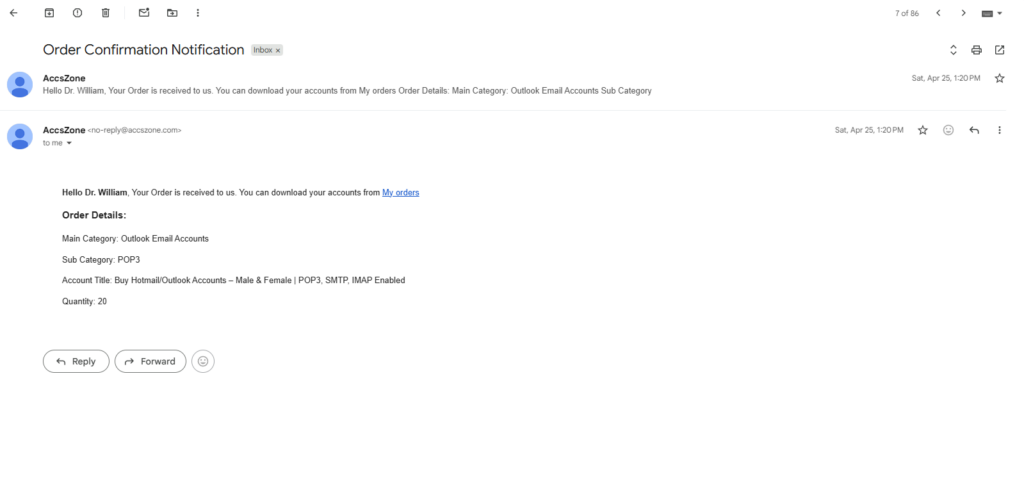
In-stock accounts drop automatically and instantly the second your payment clears, full credentials right there in your dashboard. That’s on purpose — you log in and check live-or-dead immediately instead of sitting around for a manual handover. Custom and bulk orders get handled manually with support so the spec’s right before anything ships.
Payment
AccsZone is crypto only, run through Cryptomus and NOWPayments — no cards, no PayPal. Crypto keeps checkout fast and payments final, but yeah, it won’t suit you if you need traditional payment methods. And the usual rule on any marketplace: pay through the official checkout only. Never send funds to some private contact off-platform, no matter how legit the screenshots look.
Replacement & refund policy
The policy’s simple and built around instant delivery. You get the account right away, so you check it right away. If it’s faulty, dead or suspended before or at first login, hit the 24/7 live chat and AccsZone will replace or refund it. That’s the window the warranty covers — the account being good as delivered.
Once you’ve logged in successfully, the account’s proven good and the warranty’s done. After that AccsZone has no idea how you’re using the account, so the risk is on you — and a good account that’s already logged in isn’t refundable. So the move is: check it the moment it lands, and flag anything through live chat inside the 24-hour window before you actually start using it. Most questions are already answered on the AccsZone FAQ page. For what it’s worth, AccsZone says fewer than 1% of orders need a replacement — which says more about the in-house production than any sales pitch could.
Support: 24/7 human live chat
You get a self-serve dashboard for instant orders plus 24/7 human live chat (English) and a ticket system for replacements, refunds, custom orders and questions. There’s always a real agent on — that’s who you ping the second an account looks off. There’s also a reseller API and a verified supplier program running on a 50% commission split.
How to keep purchased accounts alive
The seller sets your starting quality; how you run the accounts decides how long they last. Three habits matter most:
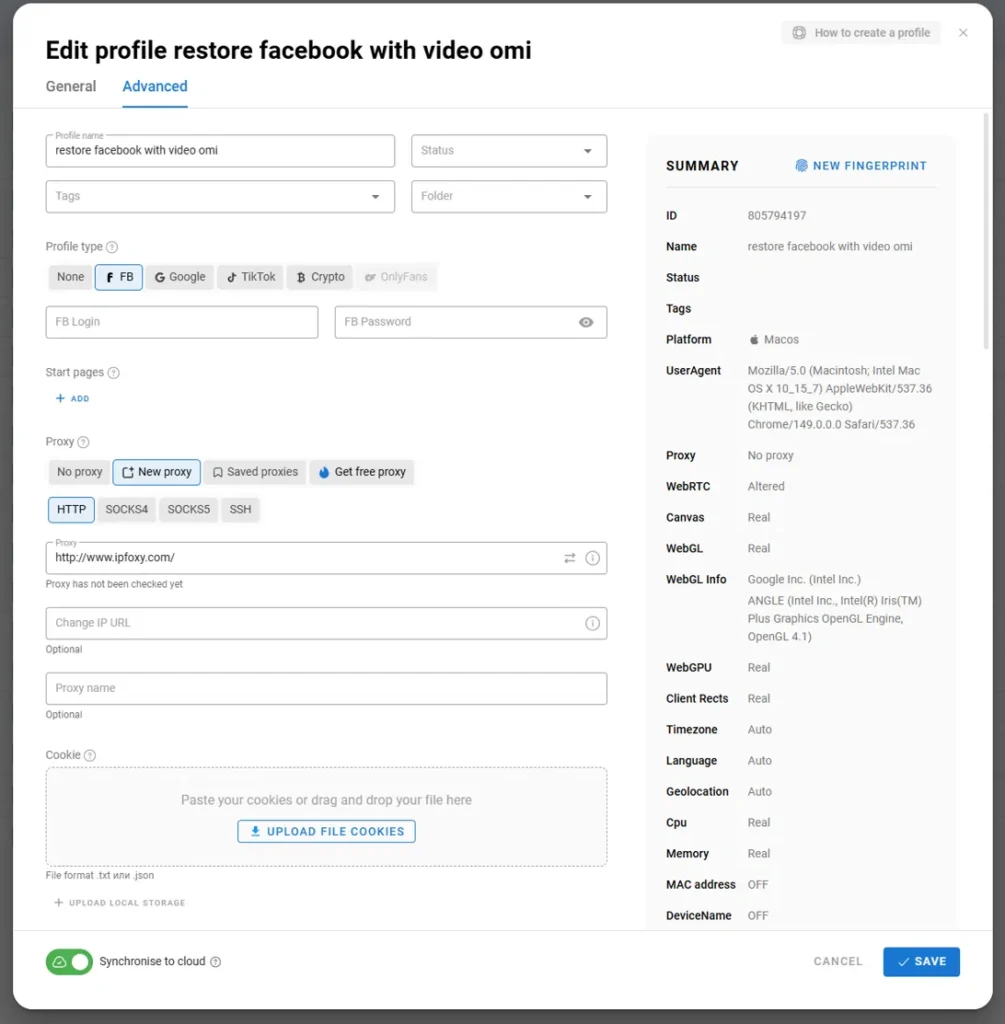
- One clean proxy per account. Residential or mobile IPs matched to the account’s region stop the cross-account linking that gets you mass-banned. (AccsZone sells compatible proxies right alongside the accounts.)
- Run an anti-detect browser. Separate fingerprint per profile so platforms can’t tie your accounts together through device data.
- Warm up before you scale. Let new accounts rest and behave like a normal user — browse, like, follow gradually — before pushing heavy activity or ad spend through them.
Pro tip: Don’t floor it on day one with a freshly bought account. Platforms watch for sudden activity spikes from accounts with no recent history. A 3–7 day warm-up of light, human-looking activity massively cuts your early-ban odds — even on aged accounts that just changed hands.
Frequently asked questions
It can be — if you buy from a marketplace that controls quality and you run the accounts right afterward. The two things that decide it are origin (in-house, verified accounts last way longer than recycled bulk junk) and how you operate them (clean proxies plus an anti-detect browser). A clear replacement policy is a good sign the seller actually stands behind what they sell.
Mostly yes — platforms like Facebook (Meta), Instagram, TikTok and X all restrict account transfers and multi-accounting in their terms. So there’s always some platform-side risk wherever you buy. You knock that risk down with quality (aged, verified profiles), clean dedicated proxies, an anti-detect browser, and a slow warm-up. Know the terms of whatever platform you’re working before you scale up.
What should I look for when choosing where to buy?
Origin and quality, a clear replacement policy, decent category range, honest pricing, fast delivery so you can check on the spot, and support that actually answers. Steer clear of anyone with no replacement terms, no real reviews, or prices way under market — that’s almost always recycled or shared accounts.
PVA = phone-verified, fresh accounts verified with a real number — cheap, fine for low-stakes work, easiest to flag. Softreg = bulk-made with barely any verification — cheapest, dies fastest. Aged = months or years old, more platform trust. Premium / aged-with-activity = real history (friends, followers, posts), survives the rough stuff, costs the most. Match the tier to how risky the task is.
Retail vs wholesale — which do I need?
Retail (like AccsZone) is for individuals and small teams buying modest amounts with instant self-serve delivery. Wholesale (like AccsBulk) is for bulk buyers who need volume at lower per-unit pricing, usually with an account manager and custom orders.
Do I need proxies to use purchased accounts?
Yes — clean residential or mobile proxies, one per account ideally, matched to where the account was registered. Platforms treat the IP as part of who you are, so running a bunch of bought accounts off one IP is the fastest way to get them linked and banned. Pair them with an anti-detect browser for separate device fingerprints.
How can I avoid an account being reclaimed by the original owner?
Reclamation — the original owner clawing the account back through the recovery email or phone — is a built-in risk on P2P marketplaces. Cut it down by changing the recovery email, phone and password the moment you log in, turning on 2FA under your own details, and sticking to sellers that hand over OG email access or make accounts in-house instead of reselling someone else’s.
How fast is delivery, and what do I actually receive?
On modern stores like AccsZone, in-stock accounts land automatically and instantly after payment, credentials in your dashboard so you can check them right away. Custom and bulk orders go through support manually. Escrow P2P marketplaces are slower because a middleman has to verify every transfer before release.
Is it safe to pay with cryptocurrency for accounts?
Crypto’s the standard for most account marketplaces because it’s fast and final. It’s safe when it goes through the platform’s official checkout or a known processor (AccsZone uses Cryptomus and NOWPayments). The real danger is paying a person directly — never send funds to a personal wallet or Telegram contact outside the checkout, no matter how good their screenshots or reviews look.
What happens if an account stops working?
Depends on the seller’s policy. With instant-delivery stores you check on the spot: if it’s faulty, dead or suspended before or at first login, a marketplace like AccsZone replaces or refunds it via live chat. Once it logs in clean it’s generally counted as delivered as described, and post-login use is on you — so check it immediately and flag any problem inside the stated window before you actually start using it.
How do I keep purchased accounts from getting banned?
Three habits do most of the work: one clean proxy per account matched to its region, each account in its own anti-detect browser profile, and a gradual warm-up before any heavy activity or ad spend. Quality at purchase sets the ceiling — how disciplined you are decides how close you get to it.
People also ask
Where is the safest place to buy Facebook accounts?
Safest bet is a marketplace that makes or verifies its own accounts instead of reselling anonymous listings, and that lets you check them on instant delivery. In our comparison AccsZone came first for Facebook on origin and delivery; escrow sites like SWAPD or Flippa fit high-value single buys. Whatever you use, change the recovery details on first login and put the account on a clean proxy.
Are aged Instagram accounts worth it?
For most commercial use, yeah. Aged Instagram accounts carry more trust than fresh ones and take more activity before they get reviewed — that’s why they cost more. Worth it when you need the account to stick around. For disposable high-volume stuff, cheaper fresh accounts can work out better even though more of them die.
What is a PVA account?
PVA means “phone-verified account” — verified with a real phone number when it’s made. Cheap and fine for low-stakes tasks, but they’ve got no history so they’re the easiest tier to flag if you push them hard. Warm them up before any serious use.
Yes. Nothing you buy is ban-proof — buying and multi-accounting break platform terms to begin with. Ban risk drops hard with quality (aged, verified), clean dedicated proxies, an anti-detect browser and a slow warm-up, but it’s never zero. Treat accounts as working assets, not permanent ones.
Making your own is cheaper per account but slow and high-attrition at scale — fresh self-made accounts are the easiest for platforms to spot. Buying aged or verified accounts skips the warm-up and starts you from a higher trust level, which is why agencies and media buyers buy when they need volume fast. Trade-off is the cost and having to vet your supplier.
Summary
There’s no single “best” marketplace for everyone — it comes down to what you’re buying and why. For niche or gaming-adjacent listings, PlayerUp, Z2U and G2G have the widest selection. SWAPD’s for premium single buys, SocialTradia’s strong on aged Instagram, Flippa fits anyone buying a whole business with accounts attached, and Sebuda gives you structured escrow with OG-email checks for one-off buys.
Across our weighted criteria — origin, breadth, delivery, payment, warranty and support — AccsZone came out on top overall, mostly on its in-house production and category range, with wholesale sister site AccsBulk covering the volume buyers. Whatever you pick, judge it on how the accounts are made, how fast you can check them, and whether a human answers when something breaks — and run every account on clean proxies, separate browser profiles and a proper warm-up.