












You carefully produced a video — the script was polished repeatedly, the visuals looked sharp, the title was clickable, and even the thumbnail was designed to attract attention. After uploading it, you refreshed the page with excitement… Views: 0.
The issue may not be your content. You may have skipped one critical step: proper YouTube account warm-up.
This guide breaks down the complete YouTube account warm-up methodology for 2026, from algorithm logic to a practical 30-day workflow, helping you build a high-authority channel favored by YouTube’s recommendation system from day one.
I. Why YouTube Account Warm-Up Matters So Much
Compared with previous years, YouTube’s 2026 algorithm is far more advanced. It no longer evaluates only the content itself — it also analyzes account behavior. Accounts with stable interests, authentic activity patterns, and consistent engagement behavior generally receive stronger distribution priority.
This means the behavior path during the warm-up stage directly affects how the algorithm identifies your account. The main purposes of account warm-up include the following:
1.Enter the Recommendation Pool Faster
New channels usually receive almost no proactive recommendations. Properly warmed-up accounts, however, are significantly more likely to receive impressions on their first uploads.
2.Increase Channel Trust and Authority
YouTube maintains hidden trust metrics for every account. Consistent and natural account activity helps improve these signals, directly influencing the initial distribution volume of new videos.
3.Reach Monetization Requirements Faster
To join the YouTube Partner Program (YPP), channels must meet both subscriber and watch-time requirements. Higher-authority channels usually achieve these milestones more efficiently.
4.Build Long-Term Competitive Advantages
Within the same niche, professionally warmed-up channels tend to establish more stable organic traffic and stronger long-term visibility.
II. The 4 Core Factors That Affect YouTube Account Warm-Up
1.Content Behavior
This is one of the most direct ways the algorithm evaluates account quality, including:
Watch completion rate: Avoid constantly skipping or fast-forwarding videos.
Search behavior: Search keywords should align with your channel niche.
Stable content preferences: YouTube builds an “interest graph” based on your viewing habits.
2.Interaction Quality
Interaction quality matters more than interaction quantity. Recommended behaviors include:
Meaningful comments: Leave comments with actual opinions instead of emojis or single-word replies.
Sharing behavior: Sharing videos to other platforms signals genuine social activity.
Subscribe-to-unsubscribe ratio: High unsubscribe rates can negatively affect account trust.
Playlists and saves: Adding videos to playlists is considered a strong engagement signal.
3.Device and Login Environment
This is one of the most overlooked — yet most important — parts of account warm-up:
Stable IP address: Frequently switching IP locations may trigger risk-control systems.
Unique device usage: Multiple accounts on the same device can lead to account association risks.
Consistent login timing: Avoid abnormal spikes of activity at unusual hours.
Browser and app environment: Official apps and mainstream browsers are recommended over third-party tools.
4.SEO Content Structure
While warming up the account, your content should also follow solid YouTube SEO practices:
Title keyword placement: Put core keywords near the beginning of the title whenever possible.
Description structure: Include the main keyword within the first two lines and keep descriptions above 200 words.
Tag strategy: Combine precise long-tail keywords with broader category keywords.
Subtitle files: Uploading SRT subtitles improves accessibility while also providing text signals to the algorithm.
Chapter timestamps: Structured timestamps improve content organization and user experience.
III. YouTube Account Warm-Up Workflow: The 30-Day Model
Phase One: Behavior Training Period (Days 1–7)
Before officially warming up the account, you should first create a stable and realistic operating environment. Factors such as IP location stability, whether the IP belongs to a real residential broadband network, and whether the login environment remains consistent all influence YouTube’s initial trust evaluation.
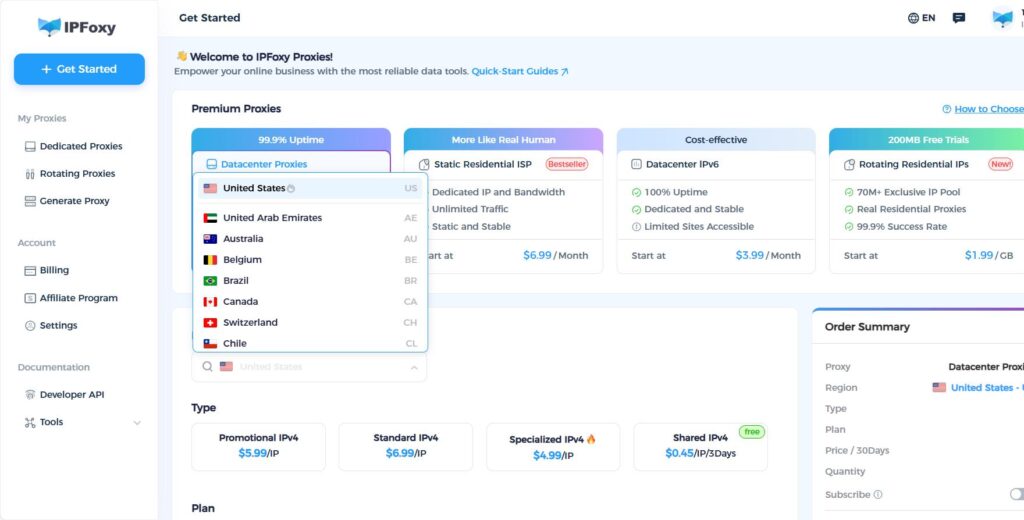
Free proxies can easily lead to account bans or traffic restrictions. You can obtain real residential IPs from professional global proxy provider IPFoxy Proxies and configure them on your devices, whether mobile or desktop, to create a stable IP environment backed by real residential broadband networks, making your account appear more natural and authentic to the platform.
(1) Recommended daily actions (30–45 minutes):
Search for 3–5 keywords highly related to your niche.
Fully watch at least 1–2 videos after each search (target watch completion above 70%).
Leave one or two meaningful comments with at least 15 words.
Subscribe to 3–5 leading channels in your niche.
Naturally browse YouTube’s homepage recommendations.
(2) Important notes:
Do not perform excessive interactions within a single day.
Avoid logging multiple warming-up accounts on the same device.
Keep the network environment stable and avoid frequent IP switching.
Phase Two: Niche Label Building Period (Days 8–15)
The main goal of this phase is to strengthen niche consistency so YouTube can assign clear topic labels to the account.
(1) Recommended daily actions (40–60 minutes):
Continue watching videos related to your niche.
Create 1–2 playlists related to your channel topic and gradually add high-quality videos.
Leave valuable comments on leading channels within your niche to attract real engagement.
Share one or two videos to your other social platforms.
(2) Key indicators during this stage:
Homepage recommendations should become heavily focused on your target niche.
Your subscription list should clearly reflect a consistent topic category.
(3) Important notes:
Do not upload videos during this phase, as publishing too early may interrupt behavioral data accumulation.
Avoid buying fake engagement services. Even so-called “real-user” engagement services often produce unnatural behavior patterns.
Phase Three: Content Validation Period (Days 16–30)
The goal of this stage is to publish initial videos and evaluate how account authority affects content distribution.
(1) Recommended publishing schedule:
Days 16–18: Publish the first video using medium-competition long-tail keywords.
Days 21–23: Publish the second video while maintaining niche consistency.
Days 25–28: Adjust the third video topic based on performance data from the first two uploads.
(2) Core actions during this phase:
Bring initial traffic to new videos through natural traffic sources during the first 48 hours.
Continue regular viewing and interaction behavior after uploading videos.
Monitor “Reach” metrics in YouTube Studio and aim for an impression click-through rate above 3%.
(3) Important notes:
Do not upload multiple videos at once. Spacing uploads helps YouTube build separate testing samples for each video.
At the beginning, focus more on validating topics and SEO strategies than on perfect production quality.
Actively reply to comments within the first 24 hours after publishing.
After completing the 30-day warm-up model, channels usually enter a relatively stable stage. The following metrics can help evaluate whether the account is performing healthily:
| Metric | Unseasoned Account | Healthy Account |
| Day 1 impressions | 0–50 | 200–1000 |
| CTR | < 1% | 3%–8% |
| Avg. view completion | < 20% | > 40% |
| Sub conversion rate | < 0.1% | > 0.5% |
| Homepage organic traffic | Near zero | > 15% |
IV. FAQ
For brand-new accounts, the basic warm-up process generally takes 21–30 days. Accounts with previous abnormal activity may require 45–60 days for recovery.
No. Excessive interactions are often recognized as bot-like behavior. Real user activity naturally contains fluctuations and rhythm. The purpose of account warm-up is to build authentic usage patterns, not maximize action volume.
Strongly discouraged. YouTube’s risk-control systems can track device fingerprints, and multiple accounts on the same device may trigger account association risks. If multiple accounts must be managed, separate devices and independent network environments are recommended.
V. Conclusion
YouTube account warm-up is not about exploiting loopholes — it is about understanding and respecting how the platform’s algorithm works. In 2026, YouTube’s ecosystem has become increasingly sophisticated, and the platform is far better at identifying authentic behavior patterns.
Accounts attempting to bypass the trust-building process through shortcuts are finding it increasingly difficult to achieve sustainable organic growth.
At its core, effective YouTube account warm-up follows one principle: make your account behave like a real, focused, and valuable user on the platform.