












In e-commerce, social media operations, and data collection, proxy has become an essential tool. However, when choosing between residential proxy and datacenter proxy, many users are still confused: is a fast datacenter IP better, or is a “human-like” residential IP more reliable?
This article explains the differences from IP source, platform risk control, and business scenarios, helping you quickly understand both and choose the most suitable proxy type for different platforms.
I. How to Distinguish Residential Proxies and Datacenter Proxies
Residential proxy IPs come from household broadband networks and are part of real user environments. From a platform’s perspective, requests using residential proxy look like normal user activity, making them more natural and less likely to be detected or restricted.
Datacenter proxy IPs come from cloud servers or data centers and belong to server networks. These IPs are more likely to be treated as automated or bulk requests, which can trigger CAPTCHA or risk control mechanisms. They are typically used in scenarios requiring high concurrency and fast data processing.
Core Differences: Residential vs Datacenter Proxies
| Key Dimension | Residential Proxy | Datacenter Proxy |
|---|---|---|
| IP Nature | Real household network | Data center server |
| Platform Perception | Looks like real users | Looks like automated traffic |
| Risk Level | Low (fewer blocks/CAPTCHAs) | High (more restrictions) |
| Speed | Slower | Faster |
| Cost | Higher | Lower |
| Use Cases | Accounts / Ads / E-commerce | Crawling / Data / API |
II. In-Depth Comparison: Residential vs Datacenter Proxies
- IP Source
- Residential proxy IPs come from real household networks, making them closer to natural user behavior.
- Datacenter proxy IPs come from cloud infrastructure (such as Google Cloud Platform) and are typically classified as server traffic, resembling automated requests.
- Performance Differences
- Residential proxies rely on real networks, offering higher authenticity but limited by bandwidth and potential node variability.
- Datacenter proxies provide higher bandwidth, lower latency, and stronger concurrency, making them suitable for large-scale, high-frequency tasks.
The core difference is: datacenter proxies focus on efficiency, while residential proxies focus on availability and success rate.
2.1 Speed (Latency / Response Time)
- Datacenter proxy: 10–50 ms, throughput up to 100+ Mbps
- Residential proxy: 50–200 ms, relatively higher latency
2.2 Request Success Rate
- Datacenter proxy: ~40% – 85%
- Residential proxy: ~85% – 99%
2.3 Concurrency
- Datacenter proxy: supports hundreds to thousands of concurrent requests
- Residential proxy: typically 1–5 concurrent requests per IP
- Cost Differences
- Residential proxies rely on real devices and distributed networks, requiring higher maintenance and resource management costs.
- Datacenter proxies are built on server infrastructure, making them easier to scale and more cost-effective.
- Platform Detection Differences
- Platforms evaluate more than IP type, including ASN, request frequency, behavior patterns, IP distribution, and historical activity.
- Residential proxies have distributed, real-user origins and align with natural behavior patterns, making them lower risk in strict environments.
- Datacenter proxies often show concentrated IP ranges and consistent request patterns, increasing the likelihood of being flagged as automated traffic.
III. How to Choose the Right Proxy Type
- Define Your Task Type
1.1.Data-oriented tasks
Such as large-scale scraping, SEO data collection, API calls, performance monitoring, or stress testing.
Focus: efficiency and scale → datacenter proxy is more suitable.
1.2.User-behavior tasks
Such as account login, social media operations, ad verification, multi-location access, or long-term behavioral simulation.
Focus: authenticity and success rate → residential proxy is more suitable.
- Evaluate Platform Risk Control
2.1.High-risk platforms
Strict IP checks, frequent CAPTCHAs, higher account restrictions.
Residential proxy is recommended to improve success rate.
2.2.Medium/low-risk platforms
Less sensitive to IP identity, focusing more on speed and response.
Datacenter proxy offers better cost-performance.
| Platform Type | Risk Level | Recommended Proxy |
|---|---|---|
| TikTok / Facebook / Instagram | Very High | Residential |
| Amazon / Shopee | High | Residential |
| Google Ads / Ad Platforms | High | Residential |
| General Websites / Blogs | Low | Datacenter |
| API / Data Interfaces | Very Low | Datacenter |
- Consider Anonymity, Stability, and Cost
3.1.Anonymity
Residential proxies offer better anonymity and are harder to detect, while datacenter proxies are more easily identified as server traffic.
3.2.Stability
Datacenter proxies provide more stable network connections, suitable for long-running, high-frequency tasks. Residential proxies may fluctuate but perform better in long-term usability and avoiding restrictions.
3.3.Cost
Datacenter proxies are more affordable and scalable, while residential proxies are more expensive but provide higher success rates and security. A practical approach is to use residential proxies for critical actions and datacenter proxies for data processing.
IV. How to Choose a Proxy Provider
- Residential Proxy
Key factors to consider:
- IP pool size: whether it covers required regions
- IP purity: whether IPs are clean and not blacklisted
- Fraud score: likelihood of being flagged
- Success rate: stability and CAPTCHA frequency
- Real source: whether IPs come from real household networks
Using IPFoxy as an example, its residential proxy offers over 90 million IPs across 200+ countries and regions. Tests show low fraud scores, indicating real and high-quality IP sources. This results in higher success rates and better simulation of real user behavior, reducing risks in high-risk environments.
- Datacenter Proxy
Key factors to consider:
- Latency and speed
- IP purity
- Concurrency support
- Cost-performance ratio
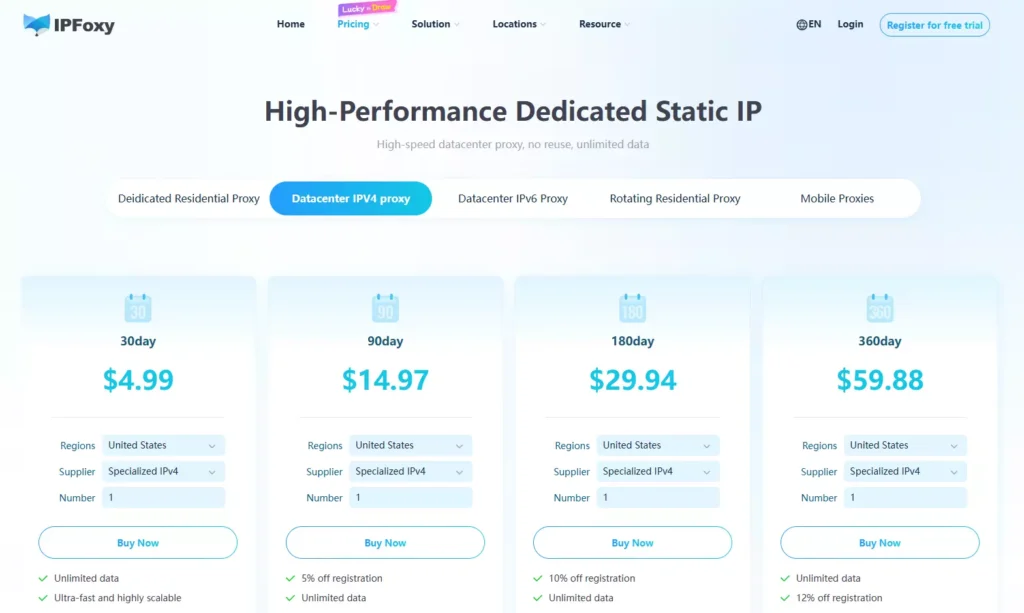
IPFoxy provides dedicated datacenter proxies with clean IPs, competitive pricing, and support for both IPv4 and IPv6. These are well-suited for large-scale data tasks, scraping, API calls, and high-concurrency operations.
V. FAQ
The key difference lies in IP source and usage outcome. Residential proxies use real user networks, offering lower risk and higher success rates but slower speed and higher cost. Datacenter proxies use server IPs, offering high speed and low cost but higher detection risk.
Not always, but the risk is higher on strict platforms. Since they originate from server networks, they are more likely to be flagged as non-human traffic, especially under high-frequency or abnormal behavior.
Residential proxy is recommended. It better simulates real user behavior, reducing detection risk and improving account stability.
Conclusion
The core differences between residential and datacenter proxies lie in IP source, risk level, speed, and cost. Residential proxies provide higher success rates and are ideal for account operations and high-risk platforms, while datacenter proxies offer better performance and cost efficiency for large-scale data tasks. Choosing the right proxy depends on task type, platform sensitivity, and the balance between efficiency and reliability.