












Many people face the same problem when choosing a proxy: cheap ones don’t perform well, while high-performance options are too expensive. Is there a solution that is both stable and cost-effective? In 2026, datacenter proxies remain the mainstream choice for large-scale data scraping and automation tasks.
This article compares six leading datacenter proxy providers across performance, pricing, pros, and cons, helping you quickly find the best solution for your budget and business needs.
I. 2026 Best Datacenter Proxies: Quick Comparison
| Provider | Starting Price | Success Rate | Response Time | Uptime | Supported Protocols |
|---|---|---|---|---|---|
| Bright Data | Shared $14/month+ | 99.96% | 0.26s | 99.99% | HTTP(S), SOCKS5 |
| Oxylabs | Shared $12/month+ | ~99%+ | 0.25s | 99.9% | HTTP(S), SOCKS5 |
| IPFoxy | Dedicated $3.99/month+ | 99.95% | 0.28s | 99.99% | HTTP(S), SOCKS5, SSH |
| Decodo | Shared $3.5/month+ | 99.98% | ≤0.3s | 99.9% | HTTP(S), SOCKS5 |
| Webshare | Shared $2.99/month+ | 98%+ | 0.7s | 99.7% | HTTP(S), SOCKS5 |
| IPRoyal | Shared $1.8/month+ | ~99% | 1.1s | 99.9% | HTTP(S), SOCKS5 |
II. Best Datacenter Proxy Providers in 2026: Comparison & Review
Datacenter proxies are IP addresses hosted in data centers. Unlike residential proxy, they are not assigned by Internet Service Providers (ISPs) but generated via cloud servers. This makes them faster and more cost-effective. However, compared to residential proxy, they are easier to detect.
Bright Data
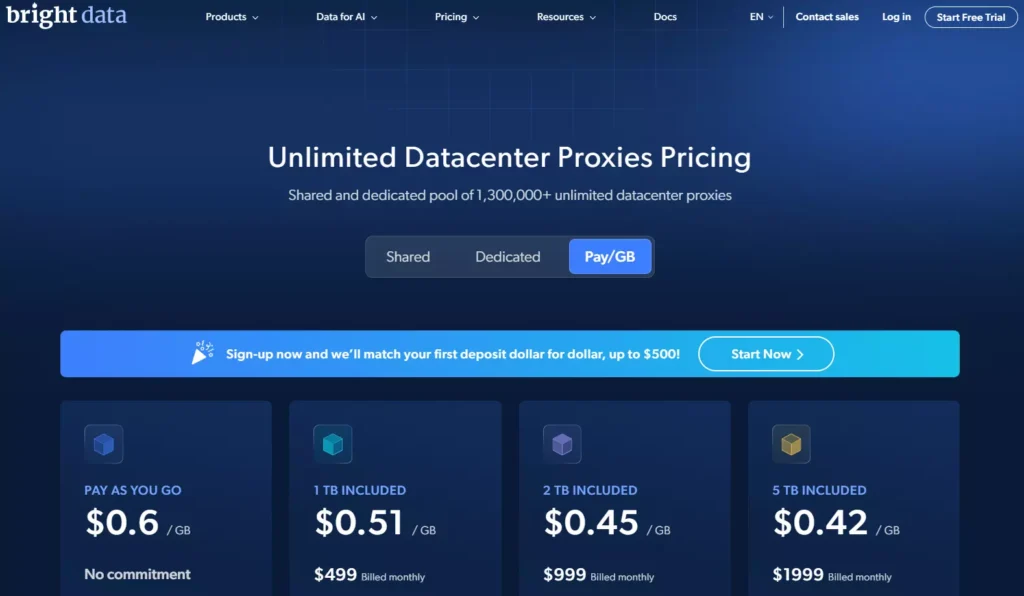
Bright Data is one of the largest proxy providers, offering over 770,000 datacenter IPs across 98 countries. It supports both shared and dedicated proxies and provides advanced data scraping tools, making it suitable for large-scale operations.
Advantages:
- Large IP pool with country/city/ASN targeting
- Stable performance with high success rate and low latency
- Highly scalable, supports massive request volumes
- Custom routing and automatic IP switching
Performance: average response time ~0.26s; success rate ~99.96%; uptime 99.99%; protocols: HTTP(S), SOCKS5
Disadvantages:
- Complex pricing structure
- Enterprise plans require manual contact
- Strict verification process
Pricing:
Shared proxies: $14/IP/month or ~$0.9/GB
Dedicated proxies: $22/IP/month
Oxylabs
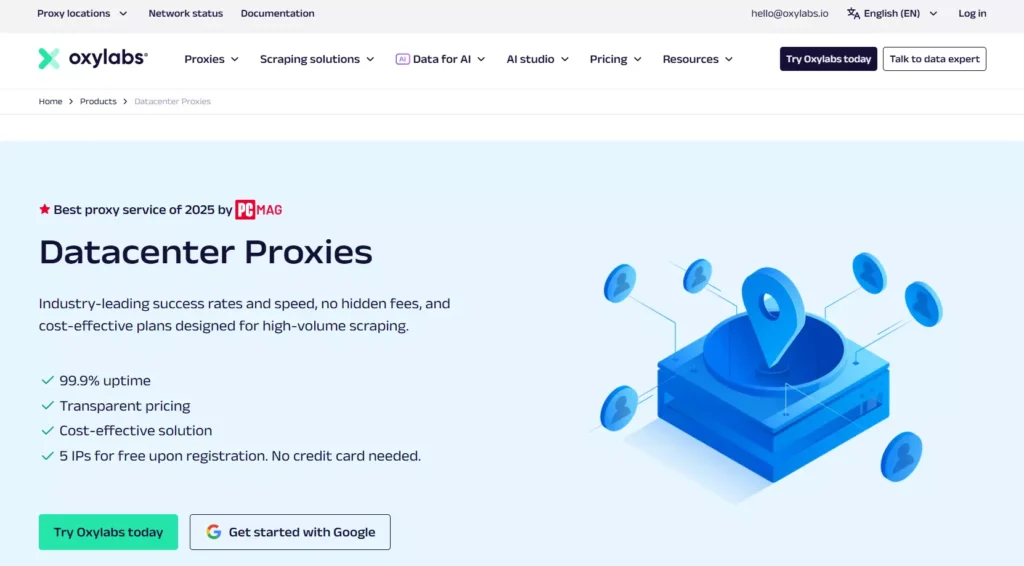
Oxylabs offers around 2 million dedicated datacenter IPs, one of the largest pools available. It also provides ~40,000 shared IPs across 188 countries with city-level targeting, suitable for high-quality IP requirements.
Advantages:
- Massive dedicated IP pool with low block rates
- IP rotation and precise geo-targeting
- High bandwidth support
- Advanced dashboard and strong customer support
Performance: low latency, high throughput (~7.03 MB/s); response time ~0.25s; uptime ~99.9%; protocols: HTTP(S), SOCKS5
Disadvantages:
- Higher pricing for entry and mid-tier plans
- No free trial
- Limited shared IP pool
Pricing:
Shared proxies: from ~$12/month or ~$11.80/month (traffic-based)
Dedicated proxies: ~$20.25/month
IPFoxy
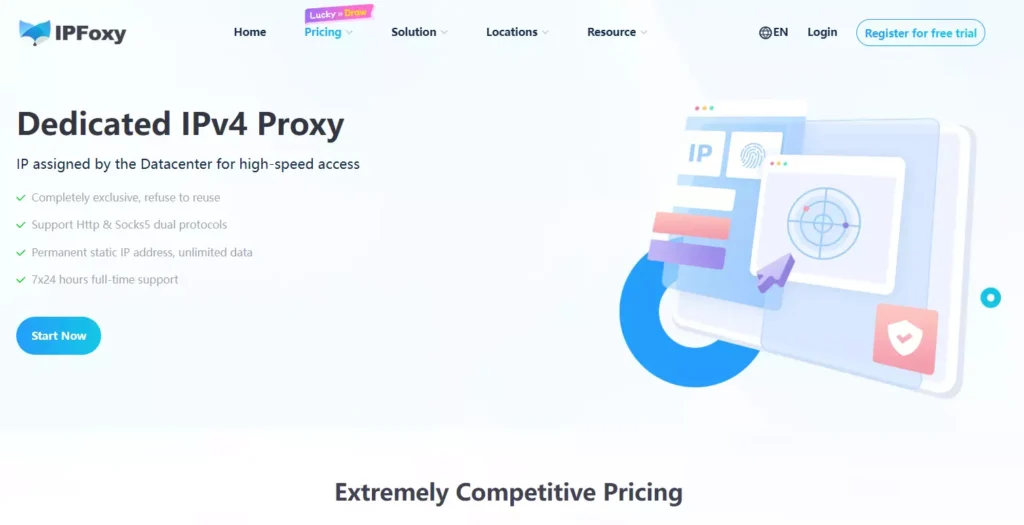
IPFoxy is a newer provider focused on high cost-performance balance. It offers a pool of 90 million IPs across 200+ countries, with high-quality, low-abuse IPs and clear product structure, ideal for small to mid-sized teams.
Advantages:
- Large IP pool with global coverage
- Supports IPv4 and IPv6 for flexible use cases
- All proxies are dedicated, offering high quality at near shared pricing
- Unlimited traffic and multi-device support
- Free trial and simple pricing
Performance: response time ~0.28s; success rate ~99.95%; uptime 99.99%; protocols: HTTP(S), SOCKS5, SSH
Disadvantages:
- Fewer advanced features
- Higher cost for small-scale purchases
Pricing:
IPv4: from $4.99/month
IPv6: from $3.99/month
Decodo (formerly Smartproxy)
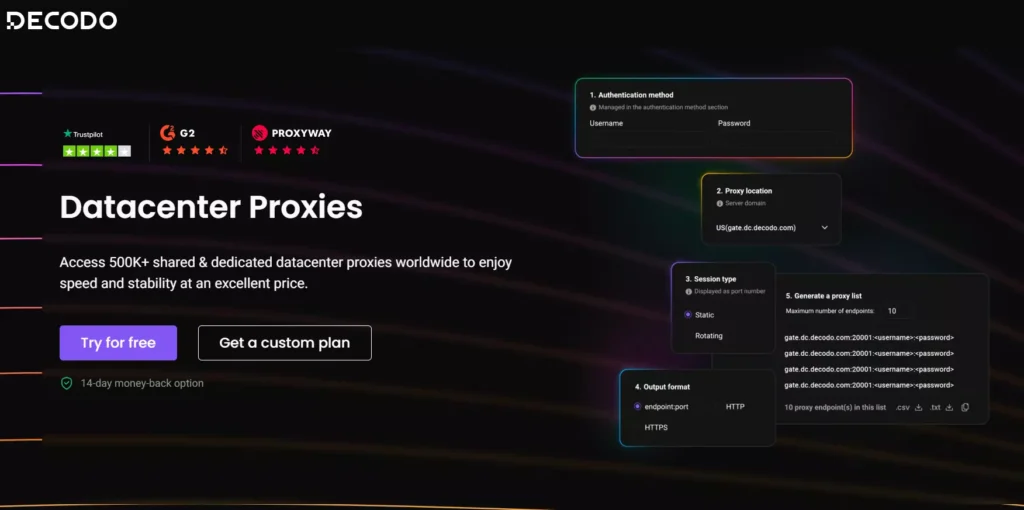
Decodo provides 500,000+ datacenter IPs and supports both IP-based and traffic-based pricing. It balances cost and performance, making it a popular choice for developers and small businesses.
Advantages:
- Cost-effective for mid-scale usage
- Supports IP rotation or static proxy
- Unlimited traffic for dedicated plans
- Easy-to-use dashboard
- Supports high concurrency
- 24/7 support
Performance: response time ≤0.3s; success rate ~99.98%; uptime 99.9%; protocols: HTTP(S), SOCKS5
Disadvantages:
- High cost for large traffic usage
- Traffic does not roll over monthly
- Limited advanced features for dedicated proxies
Pricing:
Shared: from $3.5/month or $5.5/month (traffic-based)
Dedicated: from $5.5/month
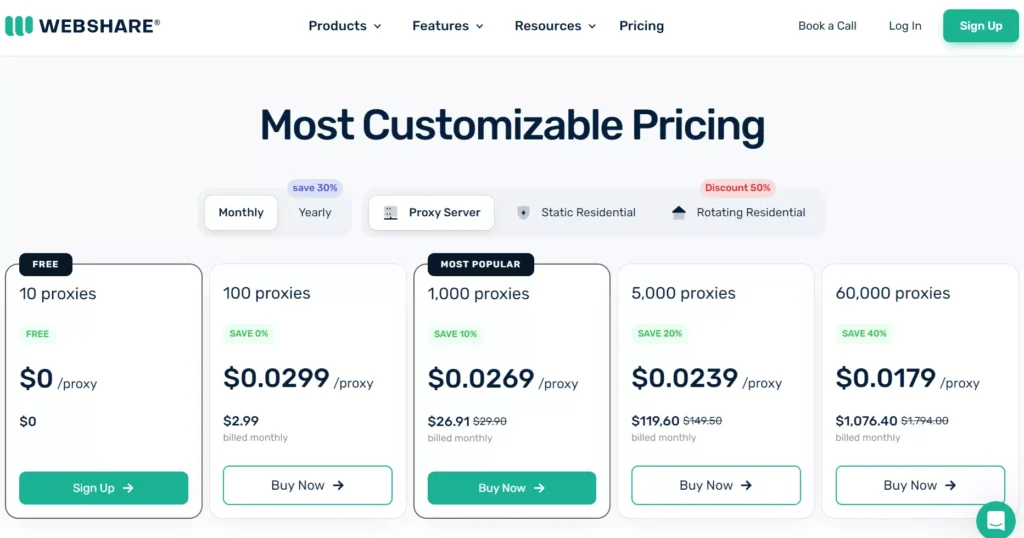
Webshare offers a self-service proxy platform with over 30 million IPs. It focuses on flexibility and provides a free plan, making it ideal for testing and entry-level users.
Advantages:
- Free plan available
- Very low pricing
- Customizable location, subnet, and protocol
- Easy-to-use dashboard
Performance: success rate ~98%+; response time ~0.7s; uptime ~99.7%; protocols: HTTP(S), SOCKS5
Disadvantages:
- Higher block rates for free/shared IPs
- Not suitable for production or high-security targets
- Limited support (email only)
Pricing:
Shared proxies: from $2.99/month (free plan includes 10 IPs + 1GB/month)
IPRoyal
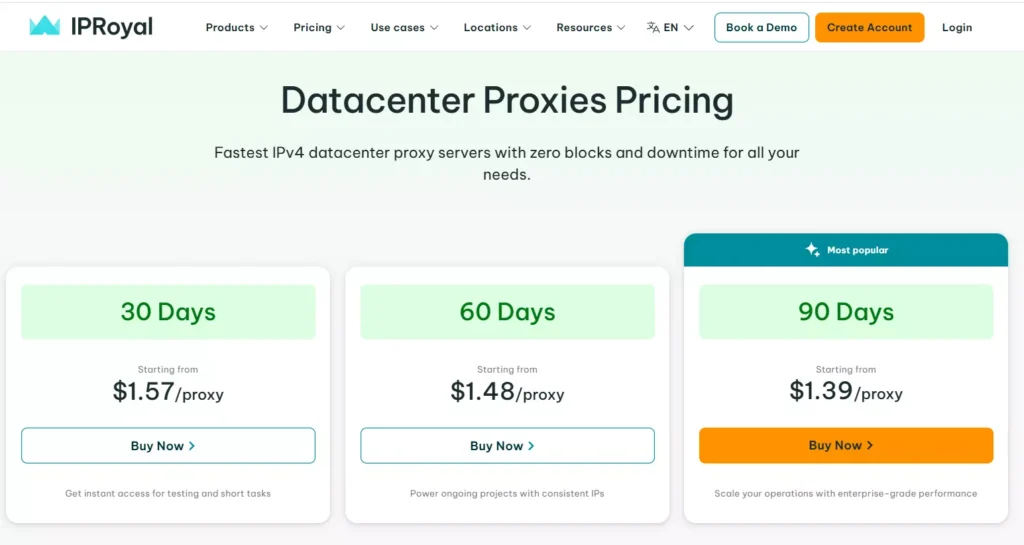
IPRoyal provides budget-friendly datacenter proxies and offers a non-expiring traffic model for residential proxy. Its datacenter proxies cover 60+ locations and focus on affordability and flexibility.
Advantages:
- Low entry cost
- Unlimited traffic and threads
- Distributed IPs reduce subnet bans
- API and basic management features
Performance: uptime ~99.9%; response time ~1.1s; protocols: HTTP(S), SOCKS5
Disadvantages:
- Smaller IP pool (~60,000)
- No built-in rotation
- No free trial
- Limited advanced features
Pricing:
Shared proxies: from $1.8/month
IV. FAQ
Datacenter proxies are ideal for high-frequency, large-scale, low-risk tasks such as price monitoring, public API access, SEO rank tracking, content aggregation, and ad verification. However, they are not recommended for strict anti-bot platforms, account logins, or high-value purchase scenarios, where residential proxy or ISP proxy are more reliable.
Datacenter proxies are generated from cloud servers, offering high speed, low cost, and strong stability, but are easier to detect. Residential proxies come from real user networks, providing higher anonymity and lower block rates, but at a higher cost.
Datacenter proxies are typically static proxy with fixed IPs, suitable for stable long-term sessions. Rotating proxy automatically change IPs based on rules (per request, time, or manual), making them better for large-scale scraping and identity rotation.
Conclusion
Overall, datacenter proxies offer strong advantages in speed, cost efficiency, and scalability, making them ideal for large-scale data tasks. Since different providers vary in performance and pricing, the best choice depends on your business scale, budget, and risk level. The key strategy is to use datacenter proxies for low-risk tasks and combine them with residential or ISP proxies for higher-risk scenarios to balance efficiency and reliability.