











Whether it’s product selection, competitor price monitoring, review scraping, or tracking Best Seller Rank, data scraping capability has become one of the core competencies for Amazon sellers and service providers.
However, as Amazon continuously strengthens its anti-scraping mechanisms, traditional data scraping methods are increasingly prone to:
- Requests rejected with 503/403 errors
- Frequent CAPTCHA prompts
- Restricted scraping speed
- Account risk control triggers
This is why more and more teams are using dynamic residential IP proxies to improve scraping stability and success rates.
This article will explain the role of dynamic residential IPs in Amazon scraping from the underlying logic and share how to select a reliable proxy service provider.
I. The Role of Dynamic Residential IPs in Amazon Data Scraping
1. Why Are Dynamic Residential IPs Indispensable for Amazon Data Scraping?
(1) Higher Authenticity, Lower Blocking Risk
Residential IPs are real home broadband exits. Unlike data center IPs, Amazon rarely blocks residential IP segments arbitrarily. Scraping behavior thus mimics real user visits, resulting in a much lower blocking rate.
(2) Wide Node Distribution, Meeting Large-Scale Scraping Needs
Dynamic residential IP pools typically cover millions of nodes worldwide, suitable for:
- Multi-category and cross-site scraping
- Batch scraping
- Location-specific scraping (e.g., local prices, rankings, shopping carts, delivery information)
(3) Automatic Rotation, Avoiding High-Frequency Access Risk Control
Amazon is extremely sensitive to the access frequency of a single IP. For example:
- Too fast access → Returns 429 (Too Many Requests)
- Scraping multiple ASINs with one IP → Triggers Bot detection
Dynamic residential IPs can switch IPs after each request or within a specific time period, greatly reducing access patterns that trigger alerts.
(4) No Complex Anti-Detection Configuration
Compared to the “fingerprint browser + data center IP” approach, dynamic residential IPs are simpler for data scraping:
- No need for complex UA/fingerprint simulation
- Works with ordinary scraping scripts
- Higher success rate and stronger maintainability
2. Typical Application Scenarios for Dynamic Residential IPs
The following scraping tasks are almost impossible to complete with high success rates without dynamic residential IPs:
(1) Large-Scale Product Data Scraping
Scraping 1000+ ASINs will continuously trigger Amazon’s bot detection, which dynamic residential IPs can naturally avoid.
(2) Cross-Site Price Monitoring and Multi-Region IP Verification
Requires real source IPs, such as:
- Comparing displays across the US, UK, and Japan
- Checking price differences for delivery to different cities within the same site
Dynamic residential IPs support precise city/state-level targeting.
(3) Review Scraping and QA Scraping
Review pages are sensitive to access frequency. Dynamic residential IPs can disperse requests to mimic real user visits.
(4) BSR/Keyword Ranking Monitoring
Ranking changes require high-frequency scraping, and dynamic residential IPs are key to ensuring stability.
In the above scenarios, dynamic residential IPs offer far better cost-effectiveness and stability than data center proxies.
II. How to Choose a Reliable Proxy Service Provider
1. IP Quality: Are They Real Residential IPs?
Must have:
- Real home broadband exits
- Not simulated residential segments maintained by bots
- Clean ASN with no bad history
Judgment method:
- Use IP detection tools to check if the ASN has a clear attribution and verify with local ISPs
- Confirm if nodes are real household nodes operated by global ISPs
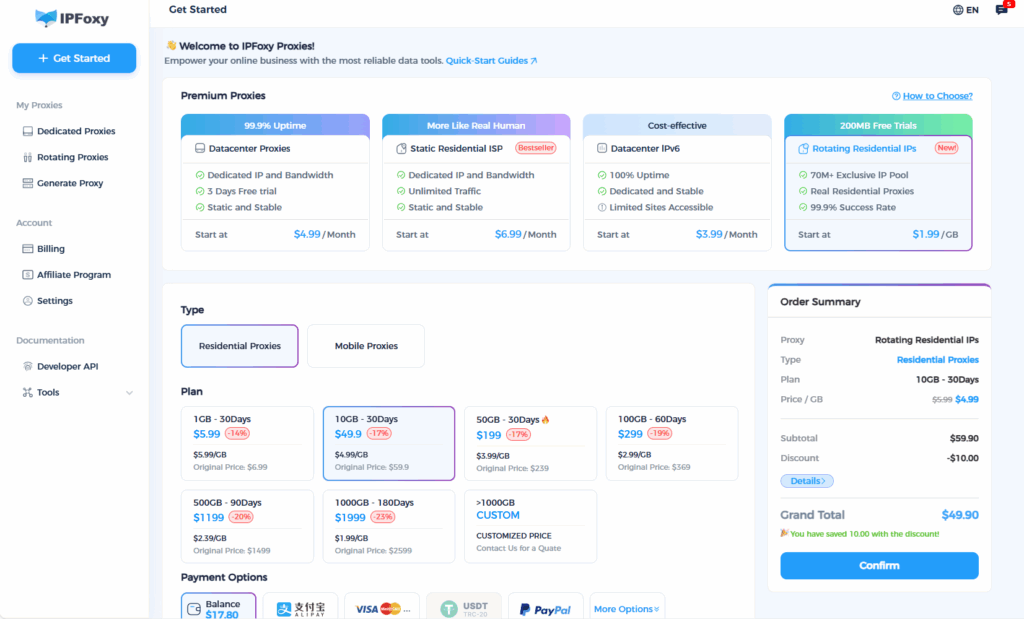
If you need a dynamic residential IP for large-scale Amazon scraping, IPFoxy is one of the highly rated professional service providers in the industry. It offers real residential IPs from home broadband, high-quality and stable ASNs, coverage of core global regions, and supports per-request rotation, sticky sessions, and API/port switching to adapt to different scraping scenarios.
For stable Amazon data scraping, IPFoxy is a mature and suitable long-term residential proxy service provider.
2. Node Scale and Coverage
Key factors:
- Global coverage across over 50 countries
- Support for city and state-level targeting
- Sufficient node quantity to support large-scale tasks
Wider coverage ensures higher scraping success rates.
3. IP Rotation Methods and Controllability
High-quality proxies should meet:
- Support per-request rotation: Consistent proxy information is generated, but the IP is randomly replaced after each request.
- Support sticky mode: Each proxy has a different sessid, and the IP remains stable for 10-30 minutes before automatic replacement.
- Support API call control.
Different scraping scenarios require different strategies:
- High-frequency scraping → Per-request rotation
- Data from the same seller’s store → Sticky mode to fix the IP for a period
4. Speed and Stability
Key indicators:
- Latency below 1 second
- Low disconnection rate
- Nodes supporting high traffic
Amazon pages have many elements, images, and redirects, making stability particularly critical.
Judgment method: Use Fast to test the network performance of the proxy IPs provided by the service provider.
5. Concurrency Capacity and Bandwidth Limits
Scraping tasks typically require:
- 50–500 concurrent connections
- Thousands of requests per minute
High-quality service providers must offer high concurrency support to avoid queue blockages.
6. Reasonable and Transparent Pricing System
Avoid:
- Hidden fees
- Speed limits
- Mandatory data packages that are difficult to control
Recommendation: Service providers offering pay-as-you-go data plans and monthly/annual subscriptions.
7. Comprehensive Technical Support
Must provide:
- 24/7 online support
- API documentation
- Access examples in multiple programming languages
Proxy services without adequate support are almost unusable for large-scale scraping.
Summary
To maintain efficient competitiveness on Amazon, the stability, success rate, and speed of data scraping are crucial.
Amid Amazon’s increasingly strict anti-scraping measures, dynamic residential IPs have become an irreplaceable underlying technical resource for maintaining high scraping success rates.