












In scenarios such as multi-account e-commerce operations, social media account nurturing, or ad campaigns, a high-quality “clean IP” is essential for account safety and stable activity.
Using an unclean IP may lead to registration failures, frequent CAPTCHA challenges, or even account bans and ad review rejections.
This article explains how to determine whether an IP is clean and how key indicators reflect risk, providing a practical reference for multi-account operations and advertising.
I. What Is a Clean IP?
A “clean IP” refers to an IP address with no history of violations, not identified as a proxy/VPN, and exhibiting normal behavior.
Common issues with unclean IPs include:
- Spam activity: If an IP has been used to send bulk spam emails, it may already be listed on blacklists.
- Malicious crawling: IPs used for scraping may trigger website security mechanisms.
- Frequent location switching: Rapid changes in geographic location can be flagged as abnormal behavior.
- Historical bans: IPs associated with past violations may be automatically marked as high risk.
To quantify IP cleanliness, the industry commonly uses the IP Quality Score (IPQS). This composite metric evaluates blacklist status, proxy/VPN detection, behavioral history, and more, scoring IPs from 0 to 100. A higher score indicates lower risk and a cleaner IP.
Clean IPs ensure smoother operations and account safety. They help avoid bans, improve CAPTCHA success rates, reduce risk controls, and maximize efficiency.
II. Why Clean IPs Matter
Clean IPs are critical for e-commerce operations, advertising, and social media account management:
- Stable multi-account operations: Unclean IPs may cause login issues or registration failures. Clean IPs allow multiple accounts to run without interference.
- Higher CAPTCHA pass rates: Platforms are more likely to challenge suspicious IPs. Clean IPs reduce verification frequency.
- Lower risk in ads and data access: Low-quality IPs may lead to ad restrictions or data access failures.
- Better long-term efficiency: High-quality IPs reduce operational costs caused by bans or repeated verification.
- Consistent geo-location: Stable IP locations help meet regional requirements and avoid abnormal access flags.
III. Key IP Quality Indicators
When evaluating IP cleanliness, consider the following metrics:
- Blacklist status
Check whether the IP appears on blacklists such as Spamhaus or SORBS. Listed IPs carry higher risk and may face access restrictions.
- Proxy/VPN detection
Determine whether the IP is identified as a public proxy or VPN. Such IPs are more likely to be restricted and considered high risk.
- Behavioral history
Analyze past activity, such as frequent registrations, spam, or scraping. More abnormal behavior indicates higher risk.
- Geo-location stability
Frequent changes in location (country or city) can signal abnormal usage and increase risk.
- IP allocation type
Common types include dedicated static residential proxy, rotating residential proxy, and data center IP. Data center IPs are generally higher risk, while dedicated static residential proxy options are more stable and suitable for long-term use.
- IP Quality Score (QS)
A composite score ranging from 0–100:
80+ → Safe
50–80 → Moderate, requires further checks
<50 → High risk, not recommended
A comprehensive evaluation across these indicators helps determine IP cleanliness and risk level.
Common IP Detection Tools
| Tools | Type | Core Use | Target Users | Notes / Features |
| IPQualityScore(IPQS) | Comprehensive scoring | Detect proxy, VPN, spam, behavior history | Marketing, advertising, multi-account operations | Detailed scoring system (Fraud Score, etc.), suitable for refined risk control |
| MaxMind | Risk database | IP geolocation + risk analysis | Finance, e-commerce risk control teams | Enterprise-grade, API-supported, suitable for large-scale integration |
| IPinfo | IP lookup | Check IP ownership, ASN, ISP, basic risk info | Individuals / developers / operations teams | Free, intuitive data, suitable for initial IP screening |
| Spamhaus / SORBS | Blacklist check | Check if IP is listed in spam blacklists | Enterprise email systems, e-commerce platforms | Authoritative but limited to spam/abuse risks only |
| Scamalytics | Risk scoring system | Score IP (0–100) for fraud risk | E-commerce platforms, payment risk control | Lower score = lower risk, should combine with device/behavior data |
| Ping0 | Blacklist check / IP evaluation | Check common blacklist presence | Security teams, e-commerce / advertising operations | Fast screening; results may vary, use as reference only |
IV. How to Quickly Check if an IP Is Clean
Below is a practical workflow using dedicated static residential proxy from IPFoxy as an example:
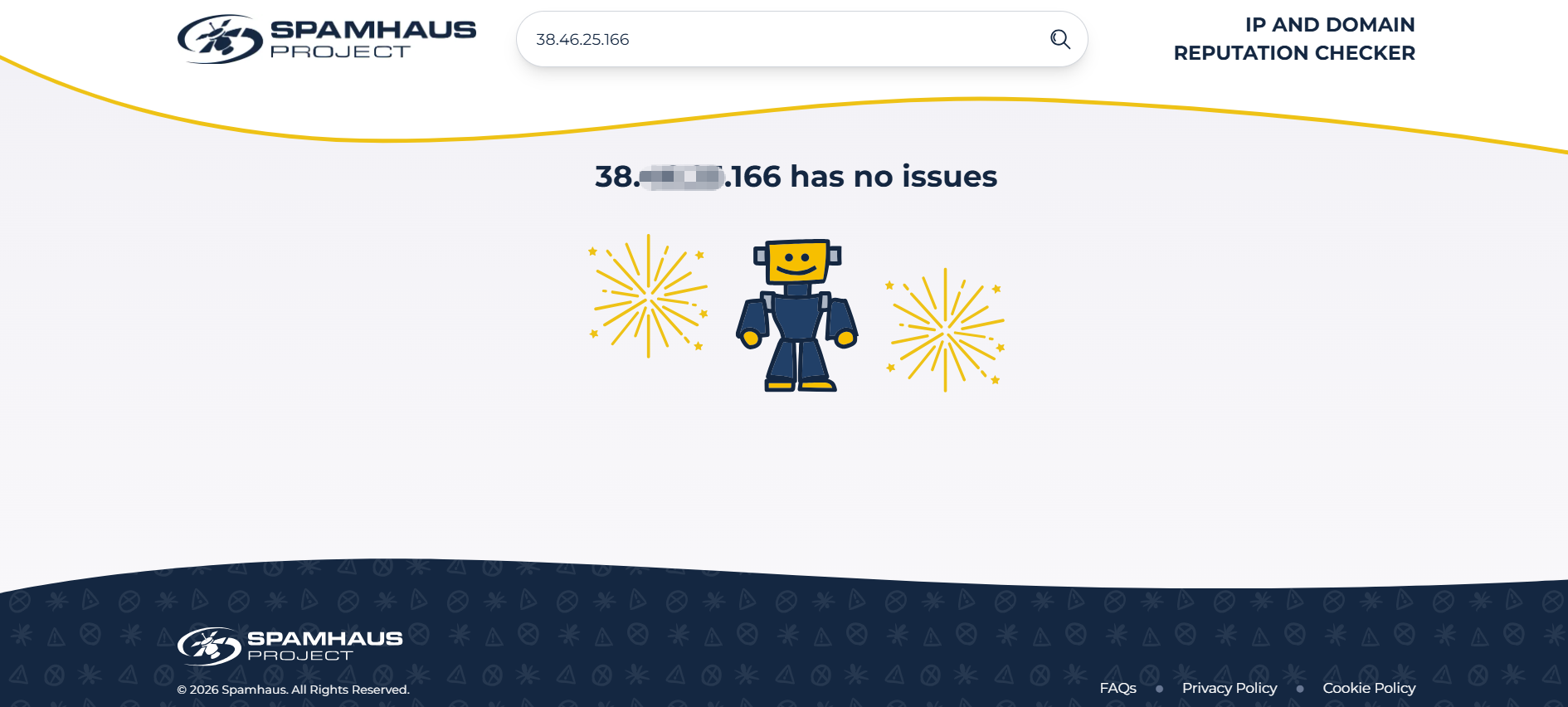
1、Blacklist check
Use tools like Spamhaus or SORBS.
For example, checking IPFoxy IP [38..,166] returns “no issues,” indicating it is not listed on blacklists.
2、IP type verification
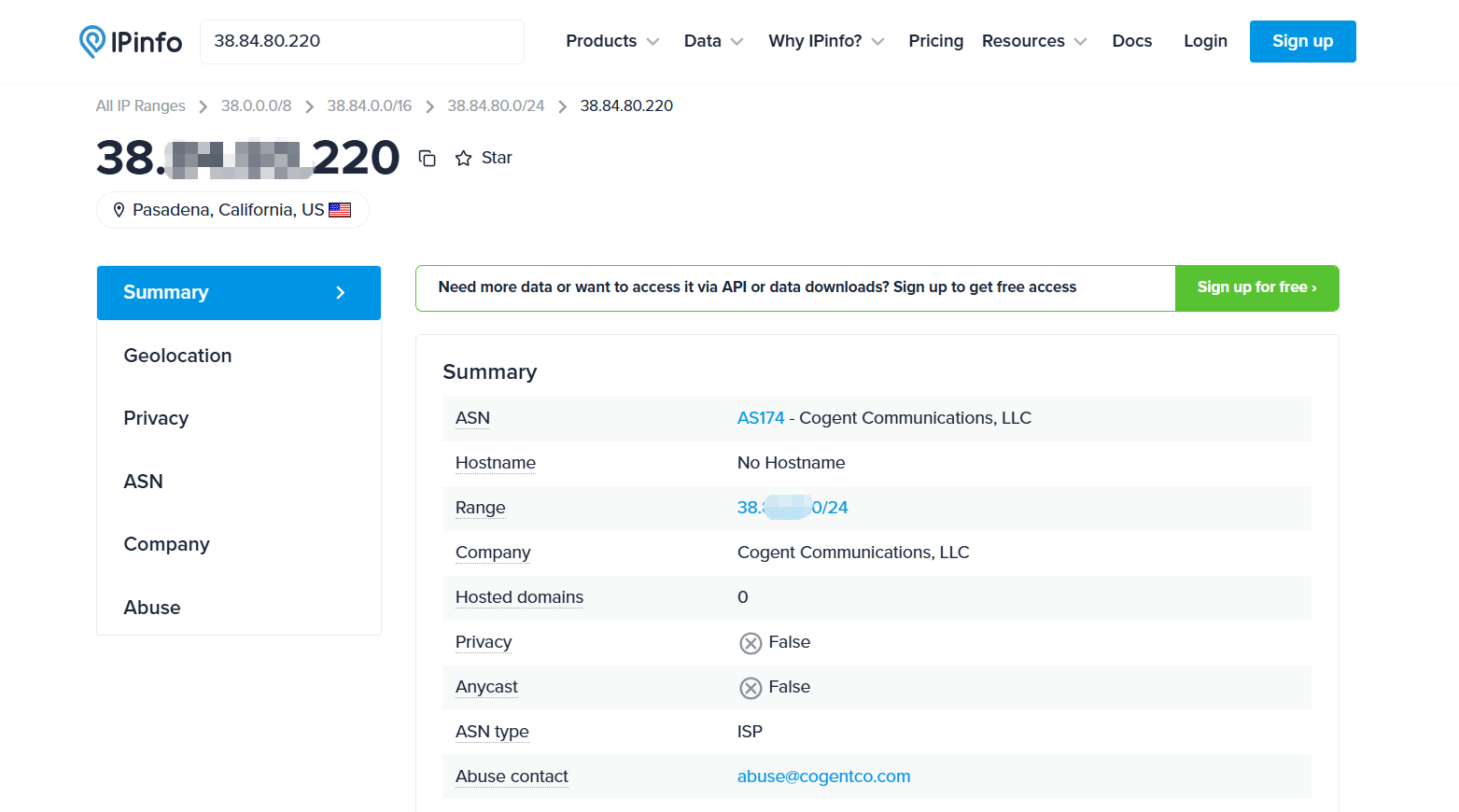
Use MaxMind or IPinfo to determine whether the IP is residential or data center. Key points include:
- ASN: Check if it belongs to cloud providers such as AWS or GCP.
- ASN Type: ISP indicates a residential network rather than hosting/data center.
- Privacy: “False” means it is not identified as VPN, Tor, or abusive proxy, indicating higher cleanliness.
3、Behavioral validation
Evaluate real usage performance:
- Request success rate (blocked or not)
- Account registration and login success
- Frequency of CAPTCHA triggers
4、Risk score evaluation
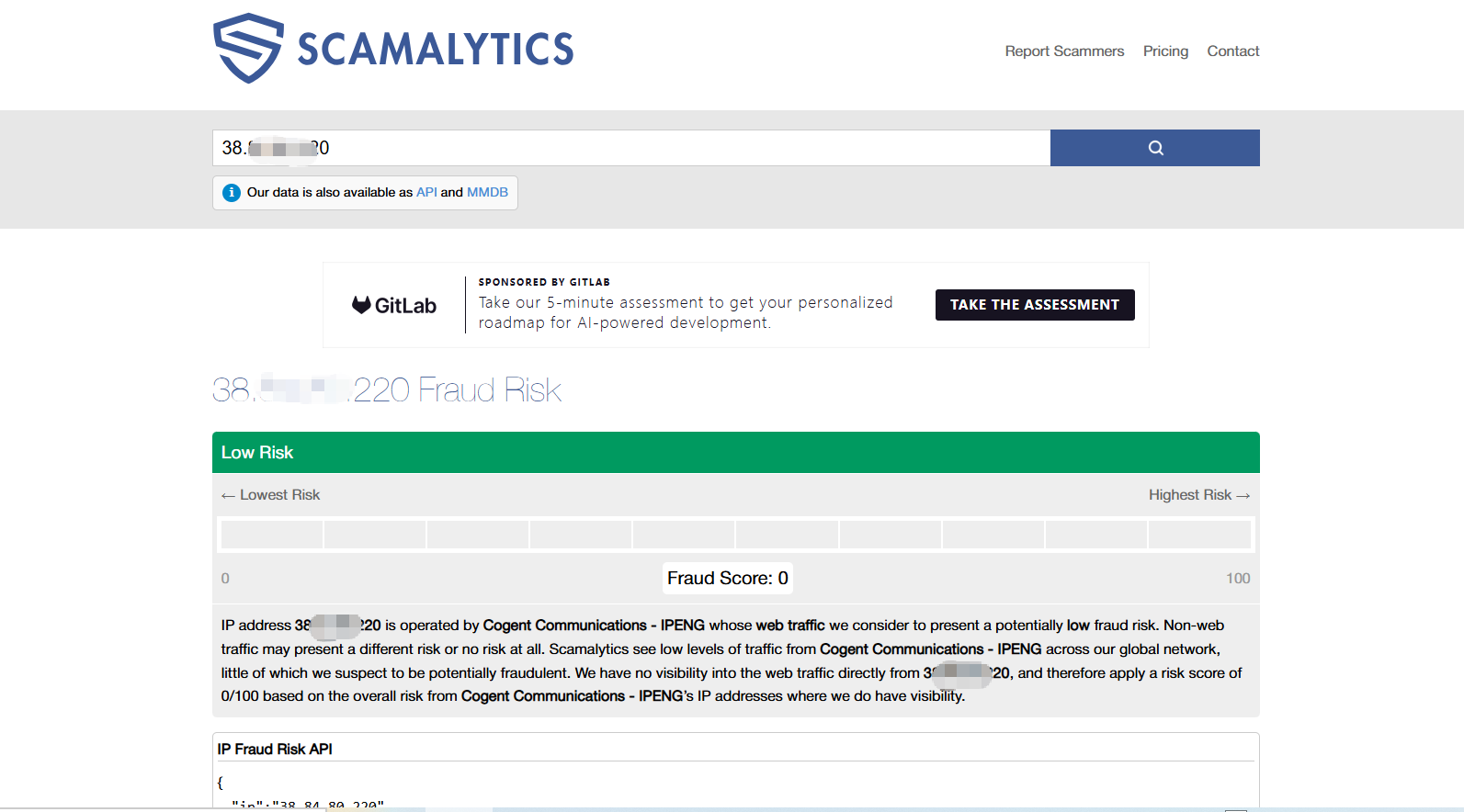
Use IPQualityScore or Scamalytics to obtain:
- Fraud Score
- Abuse Score
- Proxy/VPN probability
High-quality residential proxies typically show:
- ISP-based allocation (non-cloud)
- Low or no proxy/VPN flags
- Low fraud risk scores
These factors directly affect whether platforms flag activity as abnormal, trigger CAPTCHA, or apply restrictions.
High-quality IPs require evaluation across multiple indicators. Based on the results above, this IPFoxy dedicated static residential proxy performs well across all metrics and is suitable for web scraping, multi-account operations, and advertising.
Summary
High-quality, clean IPs are essential for stable operations in e-commerce, advertising, and social media management. By combining blacklist checks, proxy detection, behavior analysis, and risk scoring, you can quickly assess IP cleanliness and minimize operational risk.