












Recently, many users have reported problems such as failing to log into Threads (Meta’s social app), frequent risk control triggers, and even restricted account access. Being unable to log in not only affects daily social interactions but also may disrupt content creation and account operation— a major issue for both individual users and marketing teams.
In fact, many of these problems are closely related to your IP environment. This article will start from the root causes, help you understand how IP affects login stability, and teach you how to correctly choose a dedicated IP solution to make Threads login more stable and secure.
I. Why Can’t I Log Into Threads? Does IP Matter?
1. Abnormal IP Environment
In Threads’ risk control logic, IP is one of the core indicators to determine whether a login behavior is “trustworthy”. The following situations are essentially IP environment issues:
- Using shared IP / public proxy IP: Multiple users share the same IP. If any user engages in abnormal operations, the entire IP may be flagged by Meta’s risk control system, and legitimate users will also be implicated.
- Data center IPs or cheap proxy IPs: These IPs lack real user network characteristics and have long been the focus of monitoring by social platforms, making them highly likely to trigger login verification, captchas, or even direct access restrictions.
- Frequent IP changes or abnormal geographical locations: Switching countries or cities multiple times in a short period (e.g., the U.S. today and Europe tomorrow) will be deemed an abnormal login behavior.
- Unclean IP history: If the IP has been used for bulk registration, marketing accounts, or automated tools, even your “legitimate use” may be directly blocked by the system.
2. Non-IP Reasons
In addition to IP, Threads login abnormalities may also stem from the following factors:
- Abnormalities or violations in the linked Instagram account: Threads is deeply integrated with Instagram (IG). If your IG account is restricted, warned, or banned, Threads login will naturally be affected.
- Excessively frequent operations in a short period: Multiple login attempts, repeated refreshes, or consecutive verification failures will lead to temporary restrictions by the system.
These issues usually come with prompts, can be appealed, and are recoverable, with clear handling paths.
Among all causes, IP is the most fundamental factor— it is most likely to repeatedly trigger risk control and is also the easiest to overlook. Whether it’s account nurturing, content posting, or multi-account operation later, IP is the basic environment.
II. The Importance of Dedicated IP
1. What is a Dedicated IP?
A dedicated IP is a public IP assigned exclusively to you and not shared with other users. Compared to shared IPs, it offers independence, stability, and higher account credibility.
2. Core Values of Dedicated IP for Threads Login
- Reduce the risk of risk control triggers: A dedicated IP does not mix with other users’ behaviors, making it harder for the platform to mark it as a “suspicious source”. This is especially important for users who need to log in frequently or operate multiple accounts.
- Minimize login verification and restrictions: A stable and real IP will make the platform recognize your login behavior as legitimate and consistent, effectively reducing tedious processes such as captchas and two-step verification.
- Enhance account operation stability: For long-term content creators or social media operation teams, a dedicated IP is an important part of building a “credit environment”, helping to avoid content restrictions or account bans caused by IP issues.
III. How to Choose a Dedicated IP? Selection Criteria & Guide
1. Ensure it’s a truly dedicated IP, not a “nominal dedicated IP”
Selection criteria:
- Is the IP assigned to only one user?
- Does it support long-term fixed use instead of rotation?
How to verify:
- Confirm with the service provider whether they explicitly promise one IP per account.
- Use the same IP for consecutive days and observe if the outgoing IP changes frequently.
- Use IP query tools like Whoer or IPinfo to check if the IP’s ASN/routing switches frequently in a short period.
If the same IP shows obvious changes at different times, it is basically not a strictly dedicated IP.
2. Check if the IP type is real residential / ISP-level
Selection criteria:
- Is the IP from an internet service provider (ISP)?
- Does it have real home or broadband user network characteristics?
- Avoid data center IPs.
How to verify:
- Use IP detection tools like Scamalytics to check if the IP type is marked as “Residential / ISP”.
- Verify if the ASN belongs to a telecom operator rather than a cloud service provider.
If it is labeled as “Data Center”, “Hosting”, or “Cloud Provider”, even if it’s “dedicated”, the risk is high.
3. Assess IP purity
Selection criteria:
- Is the IP blacklisted?
- Is it identified as a proxy or high-risk IP?
How to verify:
- Use platforms like Scamalytics to check the IP’s risk score in risk control databases.
- See if it is marked as “Proxy / Fraud Risk”.
A high risk score indicates complex historical usage of the IP, making it unsuitable for social platforms like Threads.
4. Ensure IP geographical location matches the account’s target market
Selection criteria:
- Does the IP’s country/city match your account’s positioning?
- Does it support refined regional selection?
How to verify:
- Use an IP detection platform to check the IP’s displayed country, city, and time zone.
- Compare it with the login location shown on Threads / Instagram.
5. Check compatibility with account operation tools and multi-scenario use
Selection criteria:
- Does it support HTTP / SOCKS5 protocols?
- Can it be used with fingerprint browsers or cloud phones?
- Does it provide an API interface for easy multi-account management?
A truly “account operation-oriented” proxy service provider will definitely offer good tool compatibility.
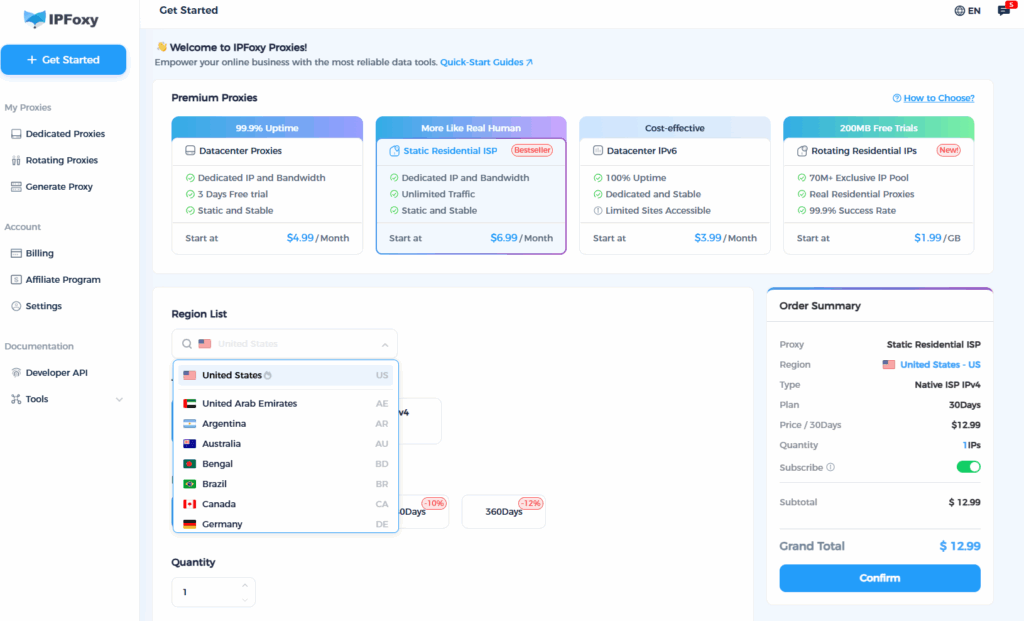
Based on the above criteria, IPFoxy’s dedicated IP is more suitable for high-risk control platforms like Threads in practical use:
- Offers multiple IP types including static dedicated ISP residential proxies, dynamic residential proxies, and IPv4/IPv6, supporting HTTP/SOCKS5 protocols.
- Covers over 200 countries/regions, enabling precise matching with your target login market environment.
- Features a pure IP pool, not shared with other users, reducing the risk of platform detection.
- Supports custom configurations and automatic API switching, and can be integrated with fingerprint browsers, cloud phones, and other device environments to improve operational efficiency.
- Allows users to claim free trial data to test the effect before deciding on long-term use, reducing purchase risks.
For those looking to resolve Threads login failures, frequent verifications, or account instability, such a “detectable, verifiable, and long-term usable” dedicated IP is more effective than blindly changing accounts.
Summary
Failing to log into Threads is not always an account issue— the IP environment is one of the key factors leading to login failures, frequent verifications, or even bans. By using a high-quality and stable dedicated IP, you can effectively reduce the probability of triggering platform risk control and make your login behavior appear more natural and trustworthy.