












In e-commerce, social media multi-account management, or data collection operations, issues such as account restrictions, request blocks, or frequent CAPTCHA prompts are common. After ruling out operational behavior and anti-detect browser environment factors, the choice of proxy is often at the core of the problem. When evaluating providers, users typically face a fundamental choice: Dedicated vs Shared Proxies, and which one to pick.
This article will introduce how to choose between Dedicated vs Shared Proxies across five key dimensions.
A dedicated proxy means an IP address is assigned exclusively to a single user at any given time. The user enjoys exclusive usage rights, and no other users can send network requests through this proxy.
A shared proxy involves multiple users accessing a shared proxy pool simultaneously or alternately. Providers allocate limited proxy resources among a large number of users, routing requests through a public proxy channel.
The most direct difference lies in proxy usage rights:
| Comparison Dimension | Dedicated Proxy | Shared Proxy |
| Proxy Usage | Used by a single user | Shared by multiple users |
| Usage Environment | Easier to maintain consistency | Affected by other users |
| Proxy Reputation | Easier to control | Affected by shared users’ behavior |
| Stability | Ideal for long-term, fixed usage | Ideal for short-term or non-continuous needs |
| Cost | Typically higher | Typically lower |
| Best Suited For | Account management, long-term operations, fixed environments | Temporary access, testing, low-continuity needs |
Understanding the difference requires looking beyond basic definitions and examining real-world business performance:
- Proxy Usage Rights:
Dedicated proxies are bound one-to-one and completely controlled by a single user; shared proxies are one-to-many or many-to-many, meaning users cannot control other activities taking place on the same proxy.
- Stability:
Dedicated proxies feature independent bandwidth and resources, offering constant access speeds and response times; shared proxies are prone to increased latency or connection drops during peak traffic due to resource contention.
- Proxy Reputation:
Dedicated proxies maintain a clean history and high reputation as long as the user stays compliant; shared proxies carry risk because bad behavior by others (such as aggressive web scraping or spam registrations) can cause target websites to block the proxy, impacting all shared users.
Concurrent Usage: Dedicated proxies usually place no limit on concurrent requests, making them ideal for multi-threaded tasks; shared proxies limit concurrency based on provider resource limits, which can easily trigger rate limits under high concurrency.
III. Use Cases for Dedicated Proxies
Dedicated proxies are better suited for operations with clear requirements for proxy continuity, access environment consistency, and account isolation.
1.Long-Term Account Operations
Accounts on social media, e-commerce platforms, or other services requiring long-term logins prioritize network environment consistency.
If accounts require a long-term fixed regional network environment, switching proxies frequently introduces environmental variables. Dedicated proxies reduce uncontrollable factors caused by shared users.
2.Operations Requiring High Proxy Reputation
If a task requires using a proxy over an extended period, focus should be placed on whether the proxy is shared among multiple users and its network attributes.
In this context, the value of a dedicated proxy goes beyond single-user usage; it minimizes external user activity variables that could affect the current operation.
3.Operations Requiring Location-Specific Access
Geographic location involves more than just country-level placement; it can extend to specific cities, ISPs, and network types.
For example, even within the target country, if an operation needs to replicate an access environment in a specific city, country-level coverage may be insufficient, requiring proxy nodes that support city-level targeting.

Not all tasks require dedicated proxies.
1.Temporary Access and Basic Testing
If a task only requires short-term access to a website in a specific region or basic testing to verify page loading without needing long-term proxy retention, a shared proxy is generally sufficient.
The priority for such tasks is whether the current proxy functions properly, rather than whether it remains exclusively assigned to the same user later on.
2.Data Collection with Low Proxy Reputation Requirements
Some public data collection tasks require multiple proxies for requests but do not demand a fixed proxy over time.
These tasks should choose proxies based on target site access rules, request frequencies, and proxy rotation needs. If the workflow allows proxy changes, shared resources can lower proxy costs.
However, if the target website strictly enforces access frequency, proxy origin, or network type restrictions, relying solely on shared proxies will not solve the issue. Proxy types and request methods must be adjusted based on actual constraints.
3.Development and Functional Testing
During development, if you only need to verify whether an application connects correctly to a proxy, sends requests, or rotates proxies, shared proxies serve well as test resources. Once operations move to long-term execution, re-evaluating proxy types based on actual account, location, and stability requirements is generally more practical than configuring dedicated proxies for all test environments from the start.
V. Four Common Pitfalls When Using Dedicated Proxies
In practice, the following issues can significantly diminish the effectiveness of dedicated proxies.
1.Sharing a Single Dedicated Proxy Across Multiple Accounts
The core value of a dedicated proxy is isolation.
Binding multiple store or social media accounts to a single dedicated proxy to save costs essentially turns a dedicated proxy into a shared one. Once platform risk controls detect multiple accounts operating from the same proxy, account linkage risks increase significantly.
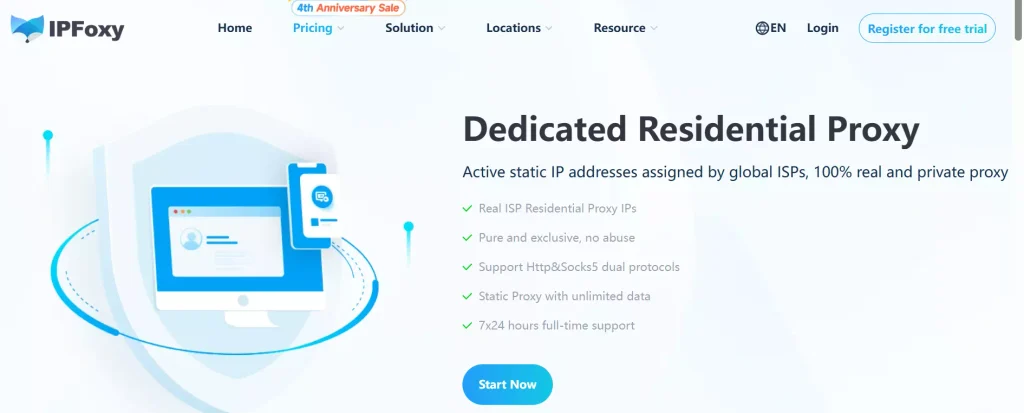
In practice, strictly follow the one-account-one-proxy rule. When operating across multiple regional markets, allocate local proxies for each target market to ensure independent and matching network environments for every account. It is recommended to choose professional proxy providers like IPFoxy Proxies, which offer dedicated static proxies with no IP reuse. Combined with isolated anti-detect browser environments, this preserves proxy isolation between accounts while matching local proxies to target markets, making it ideal for multi-account and multi-market operations.
2.Failing to Match Proxy Types to Business Needs
Dedicated proxies are not synonymous with static proxies or residential proxies.
Dedicated refers to usage rights, static/rotating refers to session handling, and residential/datacenter/mobile refers to proxy origins.
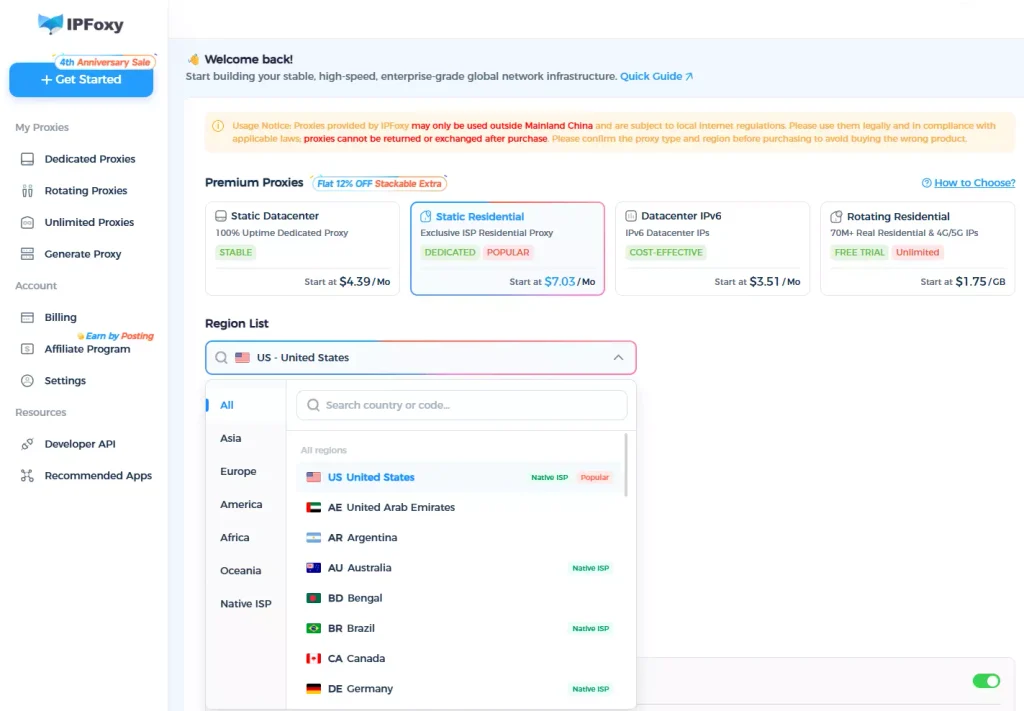
For long-term account management or ad account management that requires a residential network environment, choose a dedicated static residential proxy to ensure long-term stability; if residential attributes are unnecessary—such as for API integrations or server communication—choose a dedicated static datacenter proxy for lower costs while meeting stability demands.
However, for high-frequency data collection or tasks requiring distributed access patterns, using a dedicated static proxy can easily trigger target website rate limits. In these cases, rotating proxies are more suitable, distributing requests via proxy rotation. Depending on target site requirements regarding proxy origin, you can further choose between rotating residential proxy or rotating datacenter proxy options.
Therefore, when managing diverse tasks like account operations, API access, and data scraping simultaneously, providers like IPFoxy Proxies—which support multiple proxy types—allow flexible switching and selection to prevent mismatch issues.
3.Deploying at Scale Without Testing Configurations First
Running core accounts immediately after obtaining proxy credentials is one of the highest-risk practices in implementation.
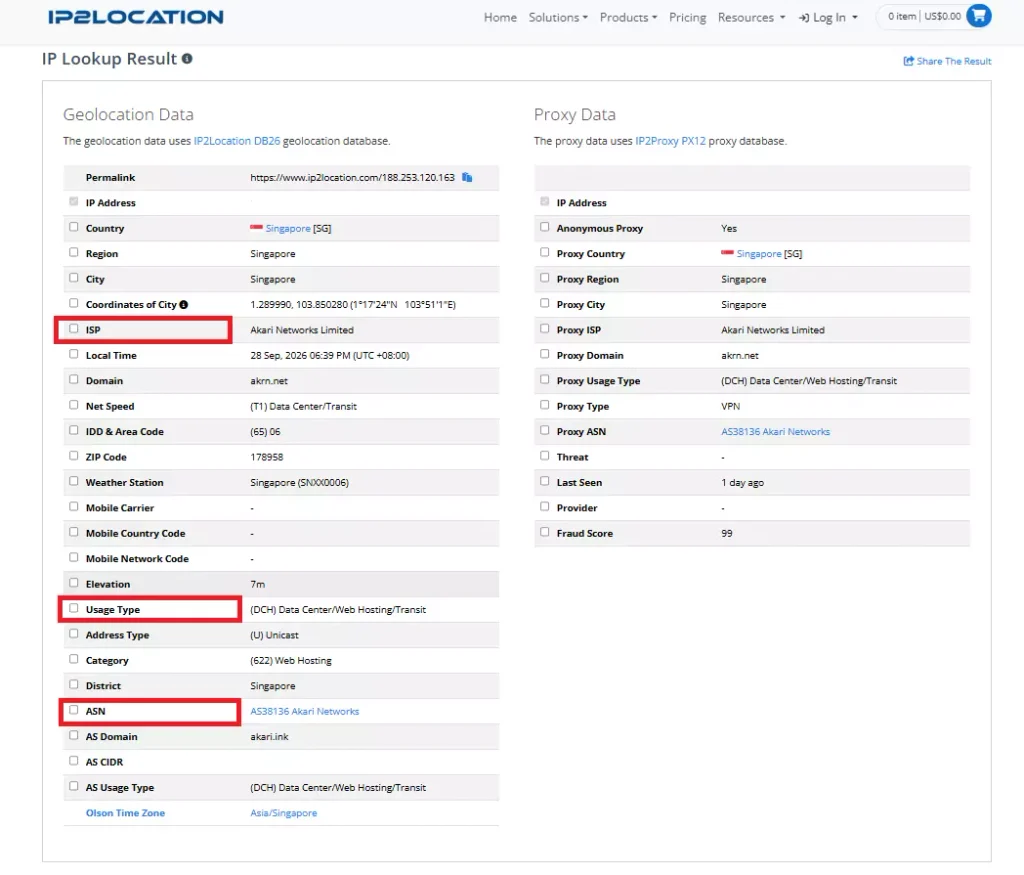
After configuration, first verify the network type of the proxy, such as datacenter or residential.
Use proxy lookup tools to check information like ASN, ISP, and Usage Type. For example, a Usage Type showing Data Center typically indicates a datacenter network, while Residential aligns with residential network attributes. ISP identifies the network provider, while ASN assists in determining the network organization behind the proxy.
Simultaneously, confirm whether the actual location of the proxy matches the target region of the business, avoiding logical contradictions such as using a proxy in Southeast Asia for profile details set in Western markets. Once test results meet standards, gradually scale up usage.
Combining this information helps confirm whether the proxy meets the network environment criteria required by the business.
4.Ignoring Proxy Protocol Compatibility with Target Devices
Different devices and tools support different proxy protocols.Certain cloud phone environments require SOCKS5, while most browsers and automation scripts support HTTP/HTTPS. Purchasing without verifying protocol compatibility leads to configuration issues or connection failures. Always verify protocol compatibility with target devices or software tools prior to purchase.
VI. FAQ
Dedicated proxies are used exclusively by a single user, so proxy reputation is affected only by your own activity and is immune to violations by others. Shared proxies are shared among multiple users with unpredictable history; if others use the proxy for malicious requests, account security may be compromised. Operations requiring high account security should prioritize dedicated proxies.
Not necessarily. If your operation has low requirements for proxy reputation and the target platform does not strictly audit proxy history, shared proxies can fulfill the requirement. However, when platform risk controls are strict, unpredictable shared proxy factors increase account restriction risks. Usability depends on your actual requirements for proxy purity and stability.
Focus on four key items:
Whether the proxy is never reused.
Whether bandwidth and concurrency are restricted.
Which proxy protocols and types are supported.
Whether regional coverage includes your target markets.
If long-term environment consistency is required, confirm support for static proxies; if proxy switching is required, verify proxy rotation capabilities.
VII. Conclusion
There is no single answer for Dedicated vs Shared Proxies that fits every business requirement. The essence of proxy selection lies in matching proxy capabilities to your network environment requirements.
Operations heavily dependent on proxy reputation and stability should prioritize dedicated proxies; while scenarios with low cost and lower exclusivity requirements can be served by shared proxies.
When selecting dedicated proxies, evaluate metrics such as proxy purity, protocol support, resource limits, and coverage area. Validating real-world performance through trials is the best way to find the optimal solution for your business.